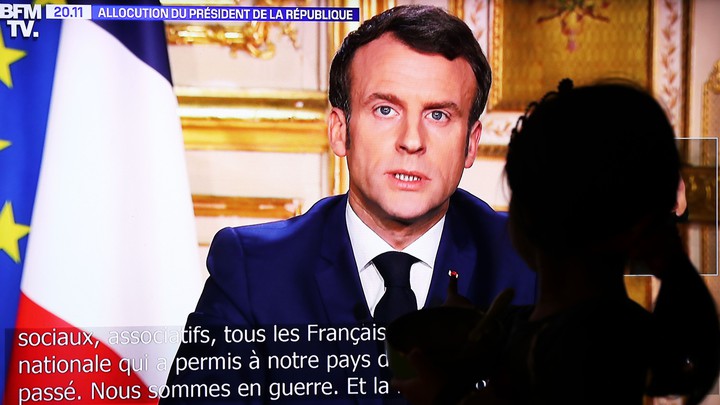
Macron: Wearing masks ‘in enclosed public spaces’ to become mandatory in France

France will in the next few weeks make it compulsory for people to wear masks in shops and other enclosed public spaces to stop a resurgence of the COVID-19 outbreak, President Emmanuel Macron said on Tuesday.

The virus, which killed more than 30,000 people in France, has been on the decline, but Macron said it was spreading again in some places as France opens up beaches, bars and restaurants after a two-month lockdown.

“We have some signs that it’s coming back a bit,” Macron said in an interview with French broadcasters. “Faced with that, we must anticipate and prepare.

“I want us, in the next few weeks, to make masks compulsory in enclosed public places.

“I ask fellow citizens to wear masks as much as possible when they are outside, and especially so when they are in an enclosed space,” Macron said.

Source: Macron: Wearing masks ‘in enclosed public spaces’ to become mandatory in France
Johnson, Macron to honour the 80th anniversary of the French Resistance

French President Emmanuel Macron has met Prince Charles in London ahead of crunch quarantine talks with Boris Johnson later. They appeared to only be around 1m apart – as is the rule in France.

The French President and Duchess of Cornwall pressed their hands together to greet each other instead of shaking them. The trio then traveled to Carlton Gardens in central London for a short ceremony to commemorate the wartime President Charles De Gaulle, near where he made his famous speech on BBC radio which inspired the French resistance while under Nazi occupation.

Macron laid wreaths at the statues of King George VI and Queen Elizabeth before giving a short address praising Britain and wartime hero PM Winston Churchill.

The French President said this afternoon: “On the 18 June 1940, Churchill and de Gaulle sounded the words of resistance and hope. “The French army had been defeated in only six weeks, there was despair. But already a patriotic pride and a sense of honour and a strong will to resist lit up french hearts, and especially that of General De Gaulle.

“He refused defeat and he decided to carry on the fight. “He had to find somewhere to shelter, a place for his exile. That was London. The hope was embodied by the last European country able to carry on fighting.

“Winston Churchill refused to give in and did not give in. “He said he had nothing to offer but blood, sweat and tear but he offered so much more. “Determination, faith in victory, honour and pride.”

Lockdown Diary: Why I’m grateful for being on lockdown in Paris

“I’m grateful to be living in France, where there is universal healthcare and where the president has chosen to save human lives over the economy.”

Today, March 25, is the eighth full day of living in true confinement. As of Tuesday, March 17, at noon, the whole country of France has been on lockdown.

It was nearly two weeks ago that President Emmanuel Macron earnestly asked us to stay home, and the Prime Minister Édouard Philippe ordered all non-essential businesses to close at midnight. By March 15, there were whispers on the street that the government would be locking down, with the military and all, because the people here weren’t taking it seriously, and the infection and death rates were rising.

I’d been preparing for weeks.

Food Stored in Apt: Eileen Cho during Paris lockdown
The author’s stored food and books. 
Eileen W. Cho

Because most of my family is located in South Korea and Seattle, Washington, two places that were hit hard by the pandemic, and

Continue reading “Lockdown Diary: Why I’m grateful for being on lockdown in Paris”

France ‘at war’: how Parisians are coping with life under lockdown

Residents of the French capital are adjusting to the country’s toughest restrictions on public life outside wartime

And suddenly, it was August. Grudgingly but obediently, the rue des Martyrs in Paris’s ninth arrondissement entered lockdown at midday on Tuesday, the few people on its pavements making their way home, baguettes and shopping bags in hand.

By 12.30pm, half an hour after France’s new reality – in essence, no going out unless to buy food or essentials, visit the doctor or get to a job certified as not doable from home – came into force, the normally bustling shopping street had emptied. Continue reading “France ‘at war’: how Parisians are coping with life under lockdown”

A Letter From Wartime France

Streets that are normally busy, all of a sudden aren’t.

At noon today, as France slipped into confinement, I looked down from my balcony at the street below. A few people were riding bikes or walking. At the tobacconist next to the closed café, a woman was wiping down the door frame. The street is normally busy, and all of a sudden it wasn’t. For the next two weeks, and likely longer, we cannot go out except for urgent reasons: food, medicine, or essential work. A nationwide lockdown, enforced by police. “We are at war,” French President Emmanuel Macron said six times in a speech yesterday evening. “The enemy is there—invisible, elusive—and it is advancing.”

Macron is right. COVID-19, the disease caused by the novel coronavirus, has killed thousands and will likely kill thousands more, a tsunami that doctors have been warning will overwhelm the health-care system, as it’s already doing in neighboring Italy, the country hardest hit by this virus after China. This weekend, the government ordered all restaurants, cafés, and retail stores closed in France.

And finally, last night, Macron followed Italy and Spain—but not Britain or the United States—and mandated confinement to slow the exponential spread of the virus. Overnight, Macron, who was elected on a fluke and has faced popular revolts and flagging popularity, has become a war president.

We are at war. How strange to hear those words in Europe in 2020. It’s impossible, here in Paris, not to think of the Second World War. Not since Continue reading “A Letter From Wartime France”