France’s lockdown vice? Cheese

French households feasted on cheese last year as they turned to home cooking and sought gastronomic comfort during coronavirus lockdowns that shuttered the restaurant trade.

The amount of cheese purchased by French shoppers for at-home consumption increased by more than 8% in 2020, compared with just 2% the previous year, according to figures from farming agency FranceAgriMer and market data firm Kantar.

That was part of a shift in food consumption in many countries last year as the COVID-19 pandemic unfolded, with households initially bulk buying staples like pasta and flour, and later settling into home-eating habits with extra purchases of products like butter.

In France, mozzarella saw the steepest rise in demand among major cheese categories, with a 21% volume jump, followed by a 12% increase for raclette – a winter favourite eaten melted with potatoes and cured meats. Continue reading “France’s lockdown vice? Cheese”
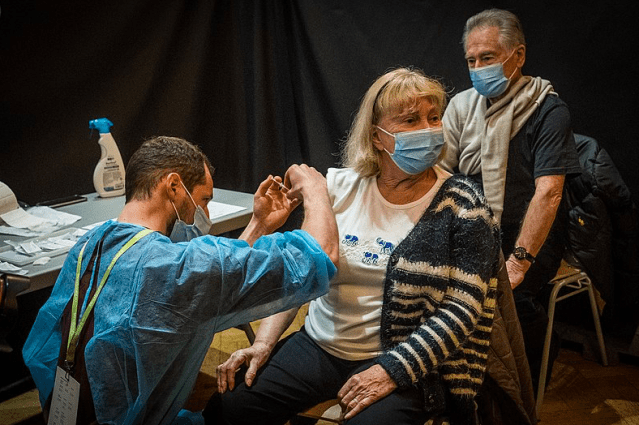
Covid variants are sign of hope says leading French doctor

Covid variants are sign of hope says leading French doctor

By Joanna York

A leading French doctor has said that the emergence of new Covid variants could be a sign of “hope”, as immunity against the virus grows.

Professor Bruno Lina, virologist and member of national health advisory board le Conseil scientifique, spoke to news source FranceInfo yesterday.

He said that increasing immunity due to vaccinations and prior infections was “starting” to impact the spread of the virus, and new variants could be seen as a sign of the Covid-19 virus trying to survive.

He said: “If [the virus] wants to continue to spread within the human population, it has to adapt and evolve.

“That is what it is doing now.”

Virus will not completely disappear

The professor said that while the Covid-19 virus would not completely disappear, it would become less significant over time.

He said: “At a given moment, the potential for the virus to evolve will come to an end.

“At that point, it will join the ranks of other banal seasonal viruses that cause colds and other infections which are not serious.”

UK variant now dominant in France

Covid variants have been partially blamed for the health situation worsening in 20 departments in France in recent weeks.

The UK variant now accounts for 60% of Covid cases nationally.

Specialists have said that the highly contagious strain could become the only variant in circulation by the end of March.

And new strains are still emerging, such as the New York variant, which has been identified in 15 US states since it was first detected in November 2020.

But Professor Lina said the emergence of new variants is a positive sign.

He said: “It’s an element of hope.”

“We are maybe in a phase in which the virus has finished evolving, which means we are coming to the end of the pandemic phase, and will enter into a phase in which circulation of the virus is much lower.”

Source: Covid variants are sign of hope says leading French doctor

Illegal French New Year’s Eve party that drew 2,500 ends after 36 hours and a failed attempt to shut it down

Regional authorities set up a coronavirus testing site near the party location and urged all participants to quarantine for seven days.

Continue at WASHINGTON POST: Illegal French New Year’s Eve party that drew 2,500 ends after 36 hours and a failed attempt to shut it down – The Washington Post

Man of our times: Why Albert Camus matters today – The Debate

He’s been gone six decades but after 2020, it feels like French literary great Albert Camus matters more than ever. The year began with tributes for the 60th anniversary of the French existentialist icon’s premature death in a car crash. Then came Covid-19. And readers locked down the world over dusted off that go-to guide, “The Plague”, to make sense of the randomly unexpected. We ask our panel about the re-reading of a novel set in Camus’s native Algeria in the wake of World War II. But it’s not just “The Plague” that is timeless.

In all of the Nobel literature laureate’s plays, essays and novels, protagonists struggle to understand where they belong in times of upheaval. Just look at today. We live in an age of alienation, identity politics, the loss of a sense of self. A bit like in “The Stranger” – also set in colonial Algeria.

What would Camus have made of 2020 and the age of digital discourse, where powered by tribal echo chambers, we judge and sometimes sentence our peers? When Covid-19 is long behind us, “The Fall” will still be worth re-reading. We tell you why.

Produced by Alessandro Xenos, Juliette Laurain and Imen Melllaz

Source FRANCE 24: Man of our times: Why Albert Camus matters today – The Debate

One of the Most Iconic Bookstores in the World Is in Trouble—but You Can Help

Shakespeare and Company has weathered many storms, but the pandemic has been the most devastating of them all.

For over a century the legendary bookstore Shakespeare and Company has beamed out from the Left Bank of Paris like a lighthouse of literature.

The former 16th-century monastery on Rue de la Bûcherie, and its previous site not far away at 12 Rue de l’Odéon, has been a home away from home for the Lost Generation in the 1920s and the Beatnik generation in the 1950s, a publisher and reading resource for the likes of James Joyce and Ernest Hemingway, and shelter for the estimated 30,000 “tumbleweeds”—young writers and enthusiasts allowed to stay for free—over the years.

But the economic disaster wrought by the coronavirus pandemic has hit independent bookstores in France, including this timeless Anglophone institution, hard. Deemed “non-essential” by the government even during the country’s second lockdown, they were forced to close to in-person customers, while commerce for online behemoths like Amazon has soared. Paris mayor Anne Hidalgo herself warned city-goers: “Don’t buy on Amazon. Amazon is the death of our bookshops and our neighborhood life.”

Continue reading “One of the Most Iconic Bookstores in the World Is in Trouble—but You Can Help”

Pope Francis’ Covid message: We must let ourselves be touched by others’ pain.

Pope Francis is the head of the Catholic Church and the bishop of Rome

By Pope Francis

In this past year of change, my mind and heart have overflowed with people. People I think of and pray for, and sometimes cry with, people with names and faces, people who died without saying goodbye to those they loved, families in difficulty, even going hungry, because there’s no work.

Sometimes, when you think globally, you can be paralyzed: There are so many places of apparently ceaseless conflict; there’s so much suffering and need. I find it helps to focus on concrete situations: You see faces looking for life and love in the reality of each person, of each people. You see hope written in the story of every nation, glorious because it’s a story of daily struggle, of lives broken in self-sacrifice. So rather than overwhelm you, it invites you to ponder and to respond with hope.

These are moments in life that can be ripe for change and conversion. Each of us has had our own “stoppage,” or if we haven’t yet, we will someday: illness, the failure of a marriage or a business, some great disappointment or betrayal. As in the Covid-19 lockdown, those moments generate a tension, a crisis that reveals what is in our hearts.

Continue reading “Pope Francis’ Covid message: We must let ourselves be touched by others’ pain.”