
Seventies French actress Marlène Jobert

Three Colours: Blue review – Binoche as charismatic as ever in Kieślowski masterwork
Krzysztof Kieślowski’s meditation on love and fate is the first in the trilogy to be rereleased 30 years on
Krzysztof Kieślowski’s vast meditation on love, fate and the unheard harmonies of the universe begins its 30th-anniversary rerelease tomorrow. This is the first in his film trilogy with its tricolour motif (to be followed by White and Red); the whole is a triptych with overlapping images and character-glimpses, all destined to be tied up in a chaotic conclusion.
Here, Juliette Binoche plays Julie, the wife of a famous composer working on a huge commission from the European Council: a symphony to be played by no fewer than 12 orchestras, symbolising the 12 nations of the European Community (as it then was). Kieślowski teasingly hints that the hubris of this project is maybe not too different from his own triple-decker movie fantasy, and the music itself periodically crashes on to the soundtrack in Julie’s mind, disruptively jolting her from a trance of anxiety. The chords are vehement but halting, self-questioning, a very different officially sanctioned Euro-celebration to, say, the Ode to Joy from Beethoven’s Ninth.
While her husband is driving her with their young daughter, their expensive car’s brake fluid leaks and it crashes, as the child is opening a lollipop with a vivid blue wrapper, speckling the entire film with a traumatised aftershock colour scheme: blue crystals, blue swimming pool water. Kieślowski contrives an interestingly low-key but very real-looking smash: Alfa Romeo has a note over the closing credits saying that such a thing could never actually happen with one of its vehicles.
The composer and child are killed and Julie survives; in the midst of her reclusive grief, she is waylaid by an intrusive journalist who asks if it is true that she actually wrote all her husband’s music. The question is never explicitly raised again, but in an agony of self-annihilation, Julie puts the family’s handsome country estate up for sale, destroys all the manuscripts she can, moves to a small apartment in Paris and tries living a life of utter anonymity.
But the film shows how the past nags, a web of obligations and unresolved emotional ties: her husband’s assistant Olivier (Benoît Regent) is clearly in love with her; her husband was clearly in love with someone else, a lawyer called Sandrine (Florence Pernel). And in Paris, she is drawn into the life of a sex club dancer called Lucille (Charlotte Véry) who confesses to Julie her trauma at seeing her elderly father in the audience one night. And Julie must continue to visit her elderly mother who has dementia; this is a poignant performance from Emmanuelle Riva, who was to portray something similar 20 years later in Michael Haneke’s Amour.
Three Colours trilogy: Decoding the blue, white and red
Read more
Shots of Binoche in Paris – especially in this movie – have become icons of cinema, like De Niro in New York; when she drifts or runs through the Paris streets, or takes an elegant coffee in a cafe or walks up the stairwell of her apartment building, she is so sinuously at home that there is a thrill in just watching her, even when she is palpably uncomfortable, as when she carries a neighbour’s cat into her flat to kill the mice.
Thirty years on, though, it is possible to be conflicted about Binoche’s award-winning performance; her dreamy, just-on-the-verge-of-tears smiles and silent trains of thought can look a bit precious, and her occasional air of detachment and integrity are surely complicated by the possible imposture and dishonesty involved in the music’s authorship, a complication which the movie does not entirely absorb. But she has marvellous charisma and address to the camera; there is something so rich and spacious and unhurried here. There is a wonderful reach and flair in Kieślowski’s film-making.
Listen to: SPÉCIAL POP FRANÇAISE Vol. 3
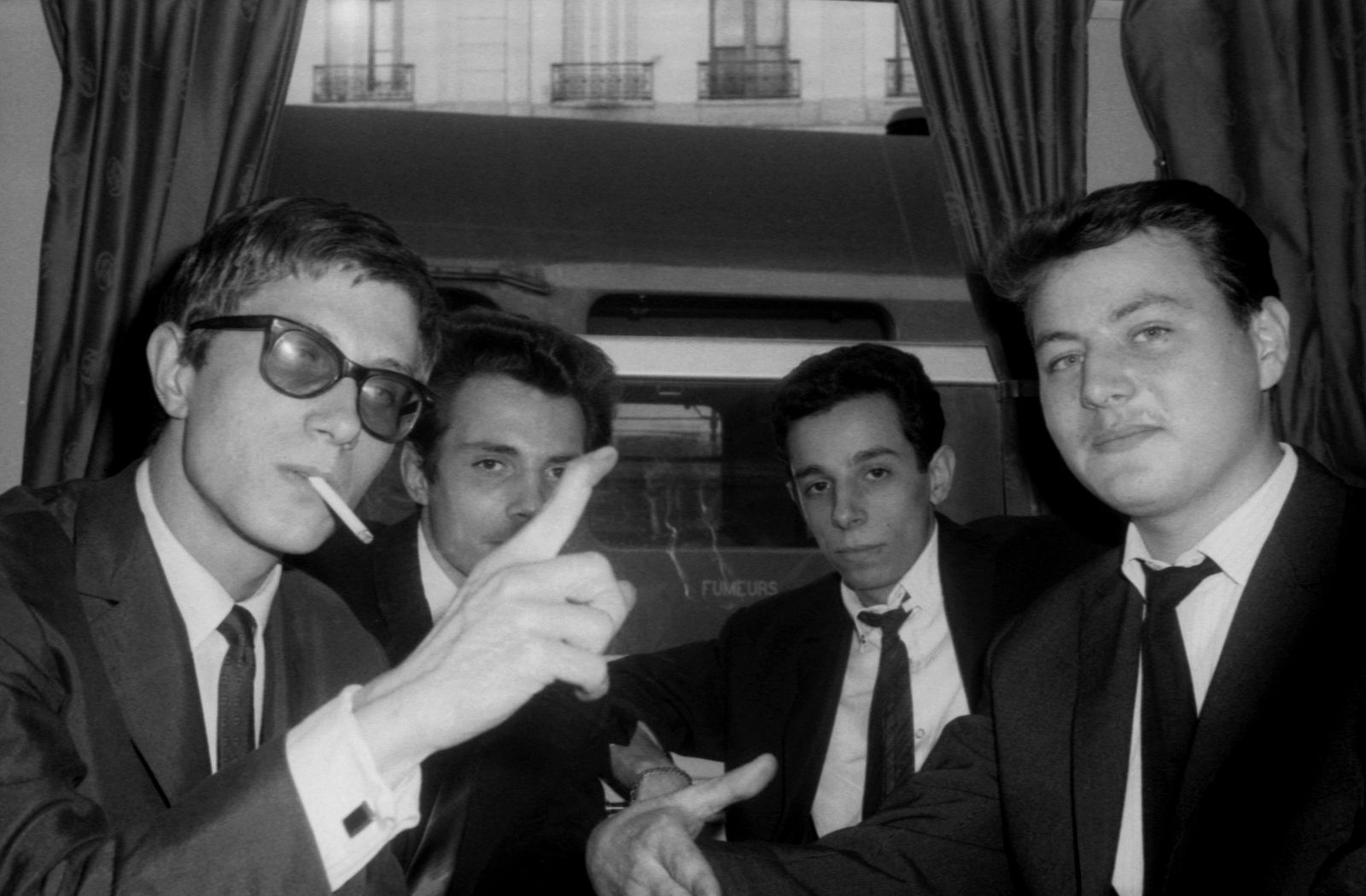
Playing Pop, Chanson. An hour of Francophone pop music that emerged out of the post-war styles of Yé-Yé and early rock’n’roll.
Source: NTS Guide To: SPÉCIAL POP FRANÇAISE Vol. 3 20th December 2022 | Listen on NTS
Macron Faces an Angry France Alone
How can I reconcile the good and evil of Jean Vanier?

I can no longer in good conscience call Jean Vanier a saint, but I cannot accept the disturbing truth about him as proof, as some have understood it, that sanctity does not exist.
By Colleen Dulle
I keep a photo of Jean Vanier on my desk. It is painful to look at today.
I’ve written almost completely uncritically about the founder of L’Arche several times at America: I called him a “revered spiritual master and prophetic voice” whose messages “always bear repeating” in a review of his last book; I wrote America’s obituary of Vanier; I teared up on camera while talking with Tina Bovermann of L’Arche USA about Vanier’s life.
Now, L’Arche has released an internal report detailing credible allegations of sexual abuse against Vanier by six non-disabled women. The report says that Vanier initiated sex in the context of spiritual direction and offered “highly unusual spiritual or mystical explanations used to justify these behaviors.” This kind of behavior echoes the sexual abuse perpetrated by Vanier’s spiritual mentor, Father Thomas Philippe. The new L’Arche report also shows that Vanier lied about how much he had known about accusations against Father Philippe.
Ms. Bovermann, the L’Arche spokeswoman I interviewed just after Vanier’s death, spoke to my colleague Michael J. O’Loughlin about the abuse allegations against Vanier: “I can’t wrap my head around it,” she said.
Nor can I.
I don’t mean that I disbelieve the women who brought these accusations forward. The public excerpts of their testimonies were harrowing, and I trust the thoroughness of the third-party investigation. What I mean is that it is difficult for me to reconcile Vanier’s abuse with my long-held image of him as a saint.
I was introduced to Jean Vanier’s thought as a senior in college, when I was stressed about my impending graduation to “the real world.” Would I make enough money? Would I move up quickly in my career? Would people think well of me?
One night, I sat with my friend Katie, who had recently returned from a year at a L’Arche community in Ireland. In response to my anxieties, she asked if I’d ever heard of Jean Vanier. She explained to me his idea that, while society tells us we will only find happiness by climbing the ladder of wealth and prestige, true Christian happiness comes from climbing down the ladder, choosing to give up power and money in order to live in community and solidarity with the poor and outcast.
The idea was a revelation. I chewed over it for hours in my prayer and writing and tried to apply it, however poorly, in my decision-making. I deeply wanted the true happiness Vanier pointed to. I read his books and listened to his interviews slowly and meditatively and urged others to do the same. After he died, I hung a photo of him on my desk. Like many, I believed he was a saint.
Part of me wonders now if I was foolish, if I should have known better than to valorize any Catholic this way after watching Theodore McCarrick’s precipitous fall from grace in 2018 or even watching St. John Paul II’s record on sexual abuse be called into serious question after hearing the crowds chant “Santo Subito” in 2005. If such widely respected men could commit decades of abuse or turn a blind eye to allegations, why should I have believed Jean Vanier could not do the same?
I think of the women who had to endure the trauma of hearing a man who had sexually manipulated them be called a “living saint” when he was alive and as the world eulogized him. Although none of the women’s allegations were public until this morning, perhaps if those of us praising him had thought more critically about Vanier’s relationship with Father Philippe, we would at least have been more hesitant to canonize Vanier in our popular imagination.
This kind of critical thinking will be vital as those of us who admired Vanier struggle to reconcile the good he did with the abuse he perpetrated. It is difficult, but possible and necessary, to hold the truth of both Vanier’s good and evil at the same time. Holding these facts in tension both invites, as the leaders of L’Arche International wrote, “mourn[ing] a certain image we may have had of Jean” and raises important concerns about who holds power in the church, the ways that power can corrupt those who hold it and the disturbing links between spiritual and sexual abuse in so many similar cases in the church. L’Arche, especially, faces a long road ahead of reimagining its past and protecting against future abuses.
Mourning and grappling with the upsetting paradox of Jean Vanier has made me angry, but I am trying to resist letting it drive me to despair. I can no longer in good conscience call Jean Vanier a saint, nor will I hypothesize about any conversion he may have had before or after his death, but I cannot accept the disturbing truth about him as proof, as some have understood it, that sanctity does not exist. Rather, I think it challenges us to consider our own and others’ simultaneous capacity for profound goodness and evil, to seek models of holiness away from the world’s spotlight and to pursue holiness ourselves far from the spotlight, at the bottom of the ladder.
Source: How can I reconcile the good and evil of Jean Vanier? | America Magazine
 Pas De Merde