Cannes Film Festival – Official Selection of the 2018 Cannes Film Festival, Interview-Duel # 1 – Rodolphe Burger
For this episode of Radio Vinyl, Rodolphe Burger will looks over the shelves of vinyl records electro, jazz, blues, rock or pop. Ornette Coleman, Kraftwerk, James Ulmer Blood and Iggy Pop are among his platinum choices. As a bonus, Rodolphe Burger offers us a cover of the song “Hard Times”, bluesman Skip James. | More Radio Vinyl,
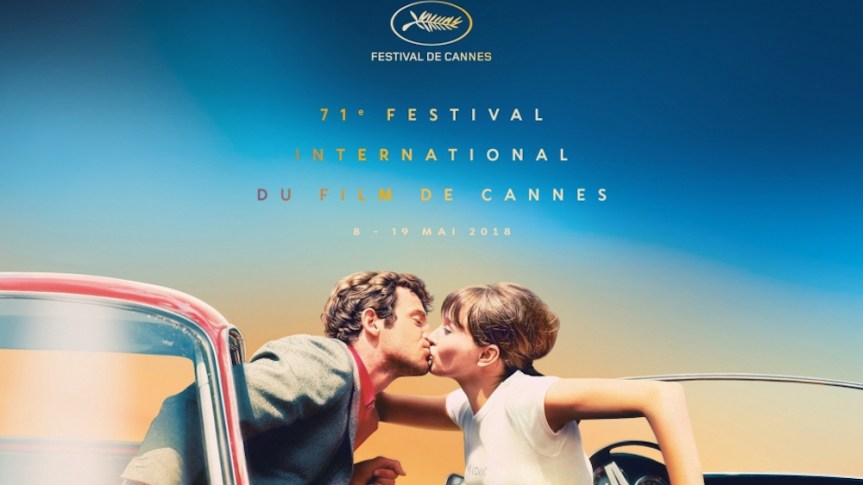
The Cannes Film Festival has unveiled its official poster for this year’s 71st edition, featuring an image from Jean-Luc Godard’s 1965 film “Pierrot le Fou.”
The poster, designed by 27-year-old graphic designer Flore Maquin, is inspired by the work of French stills photographer Georges Pierre and features “Pierrot le Fou” stars Jean-Paul Belmondo and Anna Karina.
The new poster shows Belmondo and Karina leaning out of their cars to share a kiss. The two play lovers on the run who settle for a time on the French Riviera, which is also where the Cannes Film Festival takes place.
“I loved him,” says the star of ‘Elle’ and ‘Things to Come.’
French superstar Isabelle Huppert — one of the leads of 1980’s legendary disaster Heaven’s Gate — says she stayed in touch with its director, Michael Cimino, and saw him “a few months before he died [in July]. In Paris.”
The actress — who has drawn acclaim for her role in Elle as a successful businesswoman who is raped by a mystery man, and whose new film, Things to Come, […] — added: “I loved him, of course. He was extraordinary, probably one of the greatest living American filmmakers.”
But, Huppert said, she believed the turmoil surrounding his picture, which went massively over budget and almost destroyed United Artists, had a terrible effect on him: “Basically he never really, deep inside, he never really got over it. But it was completely inspired. I went there for two months, and then we ended up being there, in Montana, for seven months.”
Huppert last saw the picture in Lyon, France, where it was screened at a film festival. “Michael remastered the print, with new colors,” she said. “It was a bit weird for me, I have to say, because the colors were very different. You know, the colors of the original film were very [muted].”
The actress added: “It was Vilmos Zsigmond, the great cameraman who passed away, too, recently. And Michael and Vilmos didn’t get along so well. After the movie, Michael always thought that it was not the color he wanted. It was a bit sepia-like. And then Michael was very happy with the new [version]. When I first saw it, the green was so green, and the red was so red. It was very, very different from what I saw in the first place. But he was happy that he did it. I think he was happy, because also he was completely immersed in the film again by doing this, because it took him many weeks to do that version.”
Since making Heaven’s Gate early in her career, Huppert, 63, has appeared in some 90 movies (even she is not quite sure of the exact number), including the Cannes release Elle, directed by Paul Verhoeven, and Things to Come, in which she plays a philosophy professor whose husband leaves her for another woman.
Speaking at Loyola Marymount University’s School of Film and TV earlier this month, while taking part in the ongoing interview series The Hollywood Masters, Huppert said she was not concerned about fallout from Elle‘s mix of comedy and drama — though she argued that it was a complete misnomer to refer to it as a “rape comedy,” as some have done.
“I think personally, the ‘rape comedy’ is absolutely irrelevant, because it can’t be a ‘rape comedy,’ you know?” she said. “To me there is an integrity to the film. It’s not [a comedy simply] because there’s this huge sense of irony; irony doesn’t mean that a film is comic. It’s two different topics. People get the film in its integrity, in its complexity, in its disturbance. I’m not denying how much Verhoeven is on the razor’s edge. And certain people won’t get the movie. But that’s the risk.”
Actor and director performs Barbara, a biopic on the fascinating French singer starring his wife, Jeanne Balibar
The window of Parisian hotel resists. In person Mathieu Amalric ( Neuilly-on-Seine, Hauts-de-Seine, 1965) possesses same playful spirit that many of its characters on screen, goblins who take refuge behind its big eyes and its enormous smile of joker. And with those weapons he has involved journalist in attempt to open a window so that actor and director can smoke. There is a padlock in between and an alarm that jumps somewhere in reception. Amalric doesn’t stop laughing with little girl. “We can’t even kill ourselves here!” Until a conical waiter appears. Impossible. Amalric looks at him and in 30 seconds he coaxes with his chatter. Result: The filmmaker smokes in room thanks to a cup reconverted into an ashtray. Continue reading “Mathieu Amalric, the vibrant goblin of the French cinema”→
When you think of France, sure you think of cheese and berets, baguettes and love–or at least adultery–and what else? Wine. You think of the Bordeaux you can’t afford, snapped up by those pesky Russian oligarchs and Chinese financiers. Or the Rhones that are earthy, or the Rosés that, while not fine wines are runaway must-have now on the American Left and Right Coasts to augment their Mediterranean diets. A special spot in the heart of France is reserved for Burgundy, Southeast of Paris, where the French relate with a fanaticism to the Grand Cru Montrachets, Mersaults, and Chambertins the way we do to fantasy baseball. Where we might head to Spring Training in Tucson, French director Cedric Klapisch’s father made a bi-annual visit to his Burgundy connection to smell the earth, pinch the grapes, shmoos—they do that in French Yiddish, too—with the domain owner and, of course line up the cases they’d lay in to make sure the good times rouler, that’s French for roll.
I almost said roulot. That’s because French actor Jean-Marc Roulot is also a vintner of Burgundy, and while Klapisch didn’t cast Roulot in his first film in the early 90s, he became a client for his burgundy. That’s until Klapisch decided that instead of making another film about the slightly cracked but earnest young urban sophisticates of When the Cat’s Away, Family Resemblances, Paris, My Piece of the Pie and The Spanish Apartment. He was ready to make a film in Burgundy about winemakers. And so, he arranged to film a story with an early writing partner Santiago Amigorena at actor-vintner Jean-Marc Rolout’s vineyard and cast him in the film. Big win for Roulot, who plays Marcel, the hired master winemaker on a family vineyard, and who infused the script with a level of detail about the life and production cycles of wine that’s perhaps seen nowhere else except in a documentary about winemaking, Natural Resistance, by Jonathan Nossiter and produced by the writer here, Amigorena.
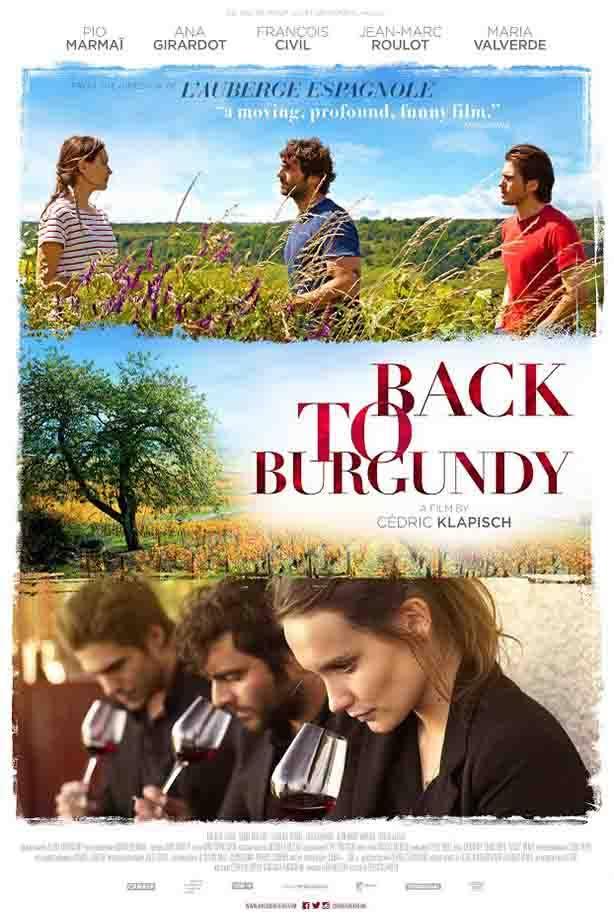
Back to Burgundy is fiction and concerns three sibling Millennials, two brothers and a sister, and how they grapple with saving the family vineyard after the death of their father. It’s somewhere between a basic text for future sommeliers and wine connoisseurs and a porn flic about the process by which an actress’ pretty feet trod the terroir and then stamps the succulent grapes in the vats, as you hear each grape pop and sigh, Oh, mon Dieu, I die for you!
Okay, back to reality here, or at least the film. It helps that the three siblings are the prettiest 30-somethings in France right now—Pio Marmai as the older Jean, who returns to the farm after a 10 year self-exile that ended in Australia on a vineyard with a wife and son, Francois Civil as the baby brother, Jeremie, the dutiful but less talented son and young family man who has married into a more prominent wine family, and Ana Girardot as Juliette, the middle sister, whose taste buds and instincts–shown in the story all the way back to childhood–make her the natural master winemaker, heralding a timely nod to feminism come to France.
Now listen up: In this clip, first we’ll hear Pio Marmai as Jean explain–in French, of course– to a beautiful African grape harvester that he’s travelled the world but now he’s come home. That’s followed by Ana Girardot as Juliette addressing the entire crew that this is a special year, the first harvest without their father. And then it ends in La Paulée, the party that celebrates the end of the harvest, and is the only party outside of the one Stanley Kubrick filmed in Eyes Wide Shut that I’m truly sorry I missed.
In all this filmed beauty by the 56-year-old Klapisch—who worked as a waiter in a French restaurant while he studied film at NYU in the mid 80s—there’s a small gap. The story’s central problem—how to pay the inheritance tax—is sort of spat out like a rogue grape skin. I guess that’s forgivable, because Back to Burgundy is a fantasy set in the four seasons of beautiful wine country, with pretty people fighting to save the vision of Old France and the French standards that make France France. The original French title is “Ce qui nous lie.” What Binds Us. That’s not only a topic that has been on the minds of French filmmakers for the last two decades, in such masterpiece films as Olivier Assayas’ Summer Hours of 2009—but the French electorate itself. How you come out on such issues that are the sharp notes just below the surface of the enjoyable Back to Burgundy can drive you to drink.
Early Friday morning, actor Asia Argento, who has become vocal within the #MeToo movement after detailing her own experience being assaulted by Harvey Weinstein in 1997, tweeted extensively about her her time working with the film director Catherine Breillat.[ . . . ]