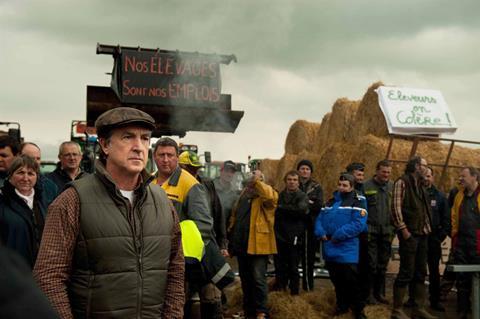
Banned in 2012, authorized in 2015, then suspended in 2017, all before being re-banned in 2019. After many developments, the United States Supreme Court settled the fate of foie gras in California on January 7 by rejecting the case. The 2004 law prohibiting the sale of products that involve the “force feed[ing of] a bird for the purpose of enlarging the bird’s liver beyond normal size” remains in force in the Golden State [ . . . ]
The year begins in earnest at UniFrance’s Rendez-vous with French Cinema in Paris, which is celebrating its 20th anniversary.
Julliet Binoche
Veteran director Jean Becker’s First World War drama The Red Collar opens UniFrance’s Rendez-vous with French Cinema in Paris this month (January 18-22). It is a choice that breaks with the event’s spotlight on mainstream comedies and romances in recent years.
The film sees Nicolas Duvauchelle star as a decorated army officer who falls from grace after he desecrates his medals in a protest against the absurdity of war; Francois Cluzet plays the judge who is charged with interrogating the young man.
It is the 15th feature from 84-year-old Becker, following a pair of mainstream dramas, Welcome Aboard(2012) and Get Well Soon (2014), and The Red Collar’s release in 2018 coincides with the centenary of the end of the First World War. “The film belongs to a type of classic French cinema that distributors love,” comments UniFrance managing director Isabelle Giordano.
UniFrance celebrates the 20th edition of Paris Rendez-vous this year. Deputy managing director Gilles Renouard recalls how the event was created by late producer and UniFrance chief Daniel Toscan du Plantier from the ashes of Avoriaz Fantastic Film Festival in the French Alps.
“When the festival stopped in 1994, he started inviting European distributors to watch French films there instead,” he recounts. “This took place for a few years. Then it was decided the screenings should move to Paris and the Rendez-vous was born in 1999.”
In that inaugural year, 60 European distributors were invited for a programme of 20 screenings in Elysées Biarritz, a restored Art Deco cinema off the Avenue des Champs-Elysées. Around 15 sales companies took part, and a press junket aimed at international film journalists also kicked off the same year.
Two decades later, the meeting — now located in the swanky InterContinental Paris-Le Grand hotel and nearby Gaumont Opéra cinema on the edge of the Grands Boulevards shopping and entertainment district — is billed as the biggest market for French cinema out- side of Cannes’ Marché du Film. More than 40 international sales companies, representing 169 features and 500 buyers — hailing mainly from Europe but also the US, Asia and Latin America — will participate in the market this year, while 120 journalists have been invited to the press junket.
Rendez-vous now kicks off the market and festival calendar for many distributors, ahead of Rotterdam, Sundance and Berlin, who come not just to screen finished features but also to sniff out titles that will be ready for Cannes.
Cinema award
Beyond the market and press junket, UniFrance will honour Juliette Binoche with its annual French Cinema Award, in recognition of a cinema professional who has raised the profile of French film around the world. Past recipients include Isabelle Huppert and Luc Besson.
“It’s a particularly high-profile time for Juliette Binoche internationally, thanks in part to Claire Denis’ Let The Sunshine In, which played festivals all over the world, and this looks set to continue into 2018,” says Giordano, noting the actress’s upcoming performances in Japanese director Naomi Kawase’s Vision and Denis’ sci-fi tale High Life.
In other events, UniFrance will hold its annual presentation of preliminary international box-office figures for French cinema in 2017 as well as launch the eighth edition of its online French-language film festival MyFrenchFilmFestival, which drew 7 million spectators worldwide last year. Ten features, including Guillaume Canet’s midlife-crisis comedy Rock ’n Roll, late-developer comedy-drama Willy The 1st by twin brothers Ludovic and Zoran Boukherma, and Cannes Critics’ Week title Ava, will compete in the main competition. Italian filmmaker Paolo Sorrentino presides over a prestigious jury comprising Julia Ducournau, Nabil Ayouch, Brillante Mendoza and Kim Chapiron.
UniFrance will also mark Rendez-vous’ 20th edition with a party on January 20, putting the spotlight on the work of innovative French institutions and companies such as Gobelins animation school in Paris and videogame company Ubisoft, as well as the country’s burgeoning virtual-reality scene. “Rather than looking at the past, we want to look to the future and spotlight the best of French innovation,” comments Giordano.
Screening highlights
Jean Becker’s The Red Collar is one of 80 new French features due to screen over the course of Rendez-vous’ five-day meeting, with two-thirds of the titles making their market premieres. As per recent tradition, the line-up features a number of comedie including Dany Boon’s La Ch’tite Famillein which the actor-director star plays a top architect moving in elite Paris circles whose working class northern French roots are exposed when his scrap-dealer family turns up unannounced at a retrospective of his work. The feature plays on the distinctive Ch’tis dialect and culture of Boon’s home region of Nord-Pas-de-Calais in northern France that he first explored in his 2008 breakthrough hit Welcome To The Sticks, which drew more than 20 million spectators and remains the second most successful theatrical release in France after Titanic. La Ch’tite Famille is sold by Pathé International.
Other comedies include Philippe Le Guay’s Normandie Nue, co-starring Francois Cluzet as a village mayor opposite UK actor Toby Jones as a famous photographer who wants to capture the small rural community in a nude shoot; SND is handling sales.
NORMANDIE NUE’
Studiocanal will unveil Laurent Tirard’s period comedy-drama Le Retour Du Héros, while TF1 Studio will screen Momo, in which Catherine Frot and Christian Clavier play a childless couple whose life is thrown into turmoil by the arrival of a deaf and dumb man claiming to be their son. Gaumont will present Anne Le Ny’s family-inheritance caper Family Business (La Monnaie De Leur Piece).
Beyond comedy, Elle Driver will present Cain and Abel-inspired thriller Carnivores, the feature co-directorial debuts of Belgian actor brothers Jérémie and Yannick Renier. The film stars Leïla Bekhti as a struggling actress who covets the life of her more successful younger sister. Playtime (formerly Films Distribution) will screen Erick Zonca’s Black Tide starring Vincent Cassel as a jaded detective assigned to the case of a missing teenager mixed up in drug trafficking, opposite Romain Duris as a former tutor of the boy who joins the search.
In other drama highlights, Memento Films International will market premiere Xavier Giannoli’s The Apparition, starring Vincent Lindon as an investigative journalist reporting on mysterious religious events in a small French village, while Alma Cinema will screen a new promo reel for Guillaume Nicloux’s Indochina War drama To The Ends Of The Earth, starring Gaspard Ulliel and Gerard Depardieu.
Marie-Andrée Lagroua Weill-Hallé, founder in March 1956 of the association “Maternité heureux”, which will become the French Movement for Family Planning in 1960, in April 1968 in Paris (Photo by AFP)
In “Sad pregnancies”, the historians Danièle Voldman and Annette Wieviorka exhume the case of the couple Bac, a news item became a fact of society, which gave birth in the 1950s to the movement for contraception.
It is a defect of the manufacture of the law in France. Very often, those who change the course of history are given a unique name, that of the minister or the elected representative who presents the text to the Assembly. Thus, years of collective struggles and activist work to raise awareness of public opinion and the political sphere are invisible to the benefit of the courage of one person, who receives all the merits. This is the case of the Veil Act, authorizing abortion (abortion) in 1975, and a fortiori the Neuwirth Act, named after Senator Lucien Neuwirth, who authorizes contraception in 1967. His fiftieth birthday (in 2017 ) has shown that the thirties have little memory, unlike the law Veil. This is to say if his genealogy has gone to the trap in the collective memory.
“Five pregnancies in five years”
In Sad pregnancies – The case of the married Bac (1953-1956) , published this January 10th at Seuil, they go back to the origin of the movement in favor of contraception in France. This one would not have emerged without the chance meeting between the gynecologist Marie-Andrée Lagroua Weill-Hallé, founder of the association Happy Maternity (which became Family Planning) and a news item in the mid-1950s, of which she knew how to seize herself. In 1954, Ginette and Claude Bac, aged 25, were sentenced to seven years’ imprisonment for letting their fourth child, who was eight months old, die for want of care.
The case of the husband and wife Bac is not at first one. The press is largely indifferent to the fate of this working-class couple, whose drama is struggling to find a place in the news column. Le Monde is still an article, the day after the judgment: “Unworthy parents are sentenced to imprisonment” , without seeking further. L’Humanité specifies in an intertitle that Ginette Bac knew “five pregnancies in five years” . Nobody thinks then that the case Bac will question the law of 1920 prohibiting propaganda contraceptives and plead for the fight of women to control their fertility.
“To move, to understand, you need a tragic story”
In exhuming their legal record, Danièle Voldman and Annette Wieviorka describe in detail the miserable living conditions of the couple in Saint-Ouen, and the fatal sequence of unwanted births, to the drama of the death of their granddaughter. The day after that, her father – who was working overtime to feed his four children – said to the commissioner: “It was you who during your observations showed me the horror of the condition of my child because I examined him then closely and naked . I thought about deportee body visions “. He had never seen his baby undressed. Ginette Bac’s lawyer, Odile Flory (last survivor of the case, with whom the authors spoke in 2017), may point to a tragedy of misery and lack of information, nothing helps .
In parallel with this case, the gynecologist Marie-Andrée Lagroua Weill-Hallé (this “heroic fighter of the heroic times, the first of them, even” ) observed in the United States the advances of the birth control(birth control) under the influence of feminist and anarchist activist Margaret Sanger, who founded the Planned Parenthood. It is with reference to this experience that Lagroua Weill-Hallé founded the family planning a few years later. Returning to France, she pleads in a scientific journal for a challenge to the 1920 law. She denounces the inequalities between rich and poor families in the practice of birth control, and the bullying suffered by women hospitalized after an abortion. The schizophrenia of the representatives of the law vis-a-vis the means contraceptives is patent according to her. But his article has no echo.“To move, to gain acceptance, to understand, requires a tragic story capable of upsetting public opinion and making it accessible to the issue of birth control. This will be the Case Bac “, write the historians.
Church and PCF in ambush
During the second trial of the couple Bac, following a defect form, in 1955, she is a spontaneous witness. His speech impresses. The media relay it. It makes the jury understand the consequences of non-voluntary maternity, so that the sentence of the spouses is reduced to two years in prison, already accomplished. Faced with resistance from the medical community, she organized a press campaign , “for the free access of French women to the means to avoid unwanted pregnancies”, with the journalist at LibérationJacques Derogy. The taboo is broken. Yet it will take another dozen years for contraceptive activists to win. Besides the Catholic Church, they face an unexpected opponent: the PCF.“The road to the liberation of women passes by social reforms, by the social revolution, and not by abortion clinics” , dares to declare the secretary general of the “great party of the working class”, Maurice Thorez, who fears that the proletarian transforms himself into a pleasure-giver, and turns away from the revolution … “Their de facto alliance delayed for a dozen years the end of the penalization of the contraceptive propaganda with the vote of the law Neuwirth on December 19, 1967 “ , Conclude Annette Wieviorka and Danièle Voldman.
Danièle Voldman, Annette Wieviorka, Sad Pregnancy, The Case of the Spouses Bac (1953-1956) , 192 p., 18 € (released on January 10)
The enduring rumors are true: France is good at cheese. Studying abroad there in college was a semester-long all-you-can-eat buffet, and not just in Paris, either. The Franche-Comté region (where I stayed, on the Swiss border) is home to the medieval city of Besançon, whose university has been thriving since the 15th century. More importantly, it’s home to a hard regional cheese simply called Comté. Continue reading “In celebration of Trader Joe’s totally legit Comté cheese”→
Fifty years of May 68 requires, The Revolt arrives on the screens after many commemorations that have already taken place in 2018 at the cinema (and in the street).
[Translation] Seeking to show the current interest of the event, the documentary of Michel Andrieu and Jacques Kebadian has the particularity of being devoid of any contemporary commentary. As if the images and sounds of the time were self-sufficient, the duo of filmmakers opted for an assembly of archives and sound clips captured during the cacophonic months of May and June 1968. [ . . . ]
Juliette Binoche, Guillaume Canet et Vincent Macaigne, les acteurs de Doubles vies d’Olivier Assayas, nous racontent ce qu’ils attendent de demain.
What are the double lives of Olivier Assayas’ new film? Most of his characters lead double lives. Because the life of the bourgeois often resembles caricature to bourgeois theater, their double lives are at first conjugal: Alain (Guillaume Canet) cheats his wife Selena (Juliette Binoche) with a young collaborator of his publishing house ; and Selena misleads Alain with one of his best friends, Leonard (Vincent Macaigne). The friendly lives are also double: Alain is the friend of Leonard, but also his publisher, and their friendship does not prevent the first to release the second when the potential of his new novel leaves him skeptical. Double games, double stakes …
Double lives travels with a lot of verve on the tracks of satirical marivaudage and the chronicle as amused and inspired by the mores of a social environment and an era. But the title of the film is itself double. The true object of investigation of Doubles lives , it is first of all what which doubles the life, the duplicate, deploys it in a more virtual space than current. This power of duplication is the great digital switch of the world that affects our lives in their smallest ramifications, revolutionizes the world of work, transforms relations between people. Double livesinspected with great precision and irony – but also with tenderness and delicacy of human understanding – the way everyone negotiates with the principle of transformation of the world, alternates between resistance and adaptation. To begin an issue mainly dedicated to the coming year, we wanted to bring together the three main performers of the beautiful film by Olivier Assayas to project further and ask them the question posed by the film: what are the reasons to fear or hope in the world that is coming?
Is technological progress a source of worry or excitement for you?
Guillaume Canet – On these questions, I feel pretty close to my character in Doubles Lives. I want to welcome progress with a lot of curiosity and yet it mixes a little skepticism. I want to live in my time, but I sometimes freak out at the implications in creating this digital revolution. The way art is consumed, that is to say as a content, delivered at home, among many others, interferes with the way it is conceived. It affects thought at work in every creation. To satisfy these new modes of consumption, there is an injunction to make simpler, shorter. Here, for example, I finish the postproduction of my new film, and the mixer explains to me, about a replica which I wanted it to be really whispered, that it will go to the trap with the compressed sound smartphones. What are we doing ? Do we consider it or not?
Vincent Macaigne – I think that in terms of VOD, you would have to invent media where the films disintegrate as you see them … (laughs). No, but I’m not kidding! On streaming sites, I myself watch bits of movies, which do not really exist as works, and from which I take fragments. When the ritual of the hall jumps, bending to the rhythm of the one who thought the work becomes something more restrictive. And yet, for me it really is what defines the aesthetic experience: to bend to the rhythm of another. Basically, I find it odd that the viewer has control of the progress of the work. It creates a somewhat strange spectator grammar. But yet, I do it. For example, I watch some series focusing only on one character. All the related intrigues, I pass them in fast forward, and I stop only when my character comes back (laughs) .
Continue at LesInRocks https://www.lesinrocks.com/2019/01/09/actualite/binoche-canet-et-macaigne-entretien-avec-les-acteurs-de-doubles-vies-111157342/