Polanski’s ‘Oscar’ divides elite world of French cinema


The elite world of French cinema, one of the pillars of the country’s exception culturelle, was bitterly divided after Roman Polanski was named best director at France’s equivalent of the Oscars.Several actresses walked out on Friday night as the César was awarded to the Franco-Polish director who is still wanted in the United States after he admitted the statutory rape of a 13-year-old girl.The award was viewed as provocative and a slap in the face for sexual abuse victims and #MeToo campaigners who have struggled to gain recognition in France. Outside the ceremony, feminists clashed with police. Polanski, 86, had stayed away, saying he feared a “feminist lynching”.On Saturday, Ursula Le Menn, an activist with Osez le Féminisme (“Dare to be feminist”), the group that organised the protest outside the ceremony, said the award showed that nothing had changed in the world of French cinema. “The empathy shown is a facade …. There is no real change of mentality,” she said.

Polanski’s film, J’Accuse (An Officer and a Spy), about the Dreyfus affair, was nominated for 12 Césars, and won two others – for best adaptation and best costume design. But it was the decision to name him best director that caused the most outrage.

“Polanski has presented himself like Dreyfus, a victim, and used his film for his own defence. For women who have had the courage to speak out about the abuse they suffered, there is an enormous pain seeing this man distinguished,” said Le Menn.

“We ask women to come forward and speak out and they see not only are there no consequences for their aggressors, but those same aggressors are honoured in this way.”

Actress Adèle Haenel, who last year revealed she had been sexually abused as a child by another director, shouted “Shame!” as she left the awards. Others followed, including the director Céline Sciamma. The ceremony’s host, Florence Foresti, also failed to return to close the event. On her Twitter account Foresti said she was “disgusted”.

Alexis Poulin, a French journalist and co-founder of an online media site, said many in France felt the same way. “A lot of people in France are disgusted this morning. What happened yesterday was wrong and I have been saying this for ever. I think it’s unfair Polanski is given all these honours,” he said.

“Giving Polanski a prize was quite a statement. The film is something a lot of people work on, not just him. Giving him the prize protects him – it says you cannot reach him and the French cinema elite will stick together: it’s like a cinema mob and he’s the godfather.

“It says to the victims, ‘we don’t want to hear you, you are nothing, we don’t trust you’,” Poulin added.

J’Accuse recounts the persecution of the French Jewish army officer Alfred Dreyfus in the 1890s, convicted of trumped-up charges of treason. In an interview to promote the film, Polanski admitted he saw himself like Dreyfus: “I am familiar with many of the workings of the apparatus of persecution shown in the film… I can see the same determination to deny the facts and condemn me for things I have not done. Most of the people who harass me do not know me and know nothing about the case.”

Poulin said the award had revealed a deep problem in French society. “Polanski fled and found refuge in France. In France, we accept rapists on the run because they’re artists. It’s a problem of French society.”

Polanski admitted the statutory rape of 13-year-old Samantha Gailey in 1977 after more serious charges were dropped in a plea bargain. While awaiting sentencing, he fled the US. France has refused to extradite him.

Since then, a number of other sexual abuse allegations have been made against the director, who became famous with his film Rosemary’s Baby. The most recent was last November when a French photographer, Valentine Monnier, accused Polanski of raping her in 1975, when she was 18, at his chalet in Gstaad, Switzerland. Polanski has denied all the allegations.

He received backing on Saturday from the philosopher Bernard-Henri Lévy, who tweeted: “That the #Cesars waited until #Polanski was absent and could not respond, to mock him, humiliate him, overplay disgust and go so far as to refuse to pronounce his name, that says a lot about where the real “Miserables” were last night.”

Source: Polanski’s ‘Oscar’ divides elite world of French cinema | Film | The Guardian

Adèle Haenel Left Césars When Roman Polanski Won Best Director

Snubbed by the French film awards, the “Portrait of a Lady on Fire” star has been an active voice in the #MeToo movement.

In what felt like a statement against criticisms of the embittered French film academy, controversy magnet Roman Polanski won the Best Director prize at the 2020 César Awards in Paris on Friday for his Dreyfus Affair drama “An Officer and a Spy.” He beat out fellow nominees including Ladj Ly, whose “Les Misérables” ultimately won Best Film, and Céline Sciamma, whose wildly acclaimed “Portrait of a Lady on Fire” went home with just one award, for Best Cinematography. Polanski’s win did not sit well with “Portrait of a Lady on Fire” star Adèle Haenel, who could be seen in the telecast walking out of the ceremony at the Salle Pleyel when the award was announced. Watch below.

Haenel has been an active voice in the #MeToo movement which, as she outlined in a recent New York Times interview, she believes has failed in France. That claim appeared to resonate at the Césars — France’s equivalent to the Academy Awards — when Polanski, a convicted sex offender, won the top directing prize. In fall 2018, Haenel spoke about her own experience with sexual harassment while working with “The Devils” director Christophe Ruggia. Haenel was up for Best Actress at the French awards this year, but lost to Anaïs Demoustier for “Alice and the Mayor.”

Polanski was a no-show at the ceremony, as were his “Officer and a Spy” team members, all of whom boycotted the ceremony earlier this week.

“Activists are threatening me with a public lynching. Some have called for demonstrations, others are planning to make it a platform,” he told Agence France Presse earlier this week. “This promises to look more like a symposium than a celebration of cinema designed to reward its greatest talents.”

Polanski, a convicted sex offender, has lived in exile in France since fleeing the United States in 1978. In France, his continuing body of work is well-received. Along with three César trophies for “An Officer and a Spy” on Friday night — directing, adapted screenplay, and costumes — the annual awards have past feted Polanski with Best Director in 2014 for “Venus in Fur,” Best Adapted Screenplay for “Carnage” in 2012, along with multiple prizes each for “The Ghost Writer,” “The Pianist,” and “Tess.”

As the César Awards were underway on Friday, women’s activist groups outside the venue protested Polanski’s inclusion among the nominees.

Source: Adèle Haenel Left Césars When Roman Polanski Won Best Director | IndieWire

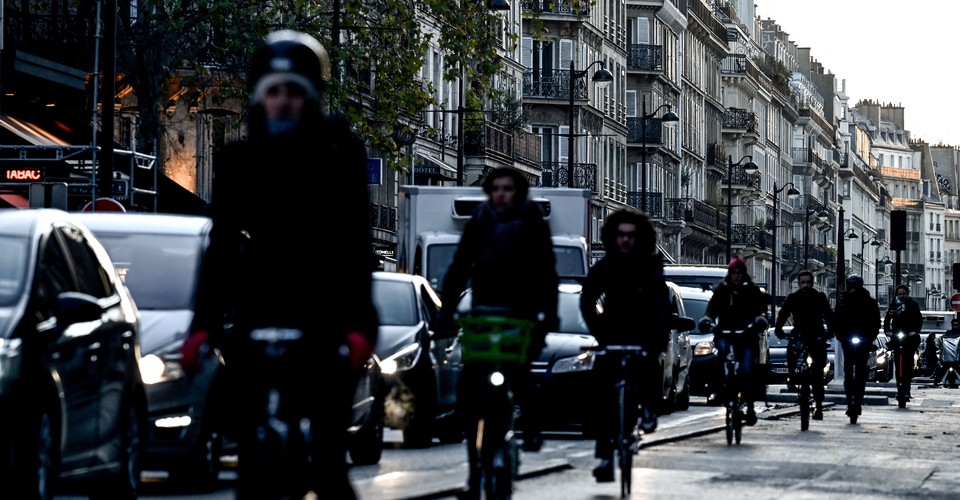
Paris Mayor Pledges a Greener ’15-Minute City’

Paris needs to become a “15-minute city.” That’s the message from the manifesto of Mayor Anne Hidalgo, who is seeking re-election this March. Hidalgo has been leading a radical overhaul of the city’s mobility culture since taking office in 2014, and has already barred the most polluting vehicles from entry, banished cars from the Seine quayside and reclaimed road space for trees and pedestrians. Now, she says, Paris needs to go one step further and remodel itself so that residents can have all their needs met—be they for work, shopping, health, or culture—within 15 minutes of their own doorstep.

Even in a dense city like Paris, which has more than 21,000 residents per square mile, the concept as laid out by the Hidalgo campaign group Paris en Commun is bold. Taken at a citywide level, it would require a sort of anti-zoning—“deconstructing the city” as Hidalgo adviser Carlos Moreno, a professor at Paris-Sorbonne University, puts it. “There are six things that make an urbanite happy” he told Liberation. “Dwelling in dignity, working in proper conditions, [being able to gain] provisions, well-being, education and leisure. To improve quality of life, you need to reduce the access radius for these functions.” That commitment to bringing all life’s essentials to each neighborhood means creating a more thoroughly integrated urban fabric, where stores mix with homes, bars mix with health centers, and schools with office buildings.

Paris en Commun has created a diagram to illustrate the concept of what should be available within 15 minutes of “Chez Moi” (home)

This focus on mixing as many uses as possible within the same space challenges much of the planning orthodoxy of the past century or so, which has studiously attempted to separate residential areas from retail, entertainment, manufacturing, and office districts. This geographical division of uses made sense at the dawn of the industrial era, when polluting urban factories posed health risks for those living in their shadows. Car-centric suburban-style zoning further intensified this separation, leading to an era of giant consolidated schools, big-box retail strips, and massive industrial and office parks, all isolated from each other and serviced by networks of roads and parking infrastructure. But the concept of “hyper proximity,” as the French call it, seeks to stitch some the these uses back together, and it’s driving many of the world’s most ambitious community planning projects.

Barcelona’s much-admired “superblocks,” for example, do more than just remove cars from chunks of the city: They’re designed to encourage people living within car-free multi-block zones to expand their daily social lives out into safer, cleaner streets, and to encourage the growth of retail, entertainment, and other services within easy reach. East London’s pioneering Every One Every Day initiative takes the hyper-local development model in a slightly different direction, one designed to boost social cohesion and economic opportunity. Working in London’s poorest borough, the project aims to ensure that a large volume of community-organized social activities, training and business development opportunities are not just available across the city, but specifically reachable in large number within a short distance of participants’ homes. Continue reading “Paris Mayor Pledges a Greener ’15-Minute City’”

How film was born 125 years ago

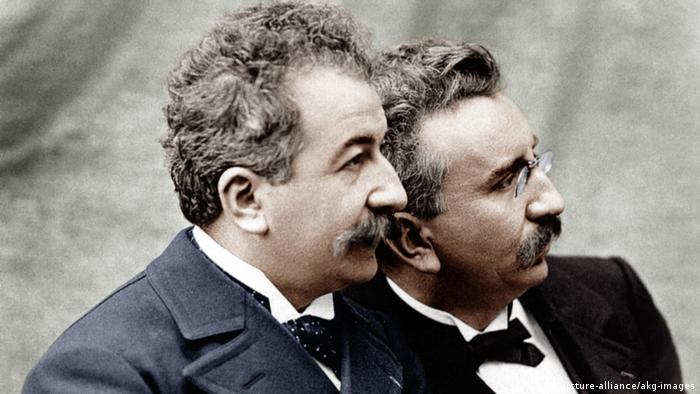
The Lumiere brothers (picture-alliance/akg-images)

In 1895 the Lumiere brothers held one of the first public film screenings. Viewers simply couldn’t believe the moving magic before their eyes. Today fact, fiction and debate continue to swirl around cinema.

The question of who invented film is something of a question for the ages. Was it really the French brothers Auguste and Louis Lumiere, who on February 13, 1895 patented the cinematograph for showing moving images? Or should the brilliant American inventor Thomas Edison with his peephole viewer be credited? And what about German brothers Max and Emil Skladanowsky, who screened films in Berlin on their own movie projector around the same time as the famous French siblings? There are several other American and British cinema pioneers who also deserve a mention.

At the end of the day, it’s probably a matter of how the advent of film is defined: Can a technological development be considered the starting point or should it instead be the first time a group of people sat in front of a screen as a film danced before their eyes?

And let’s not forget about flip books, which in the mid-19th century used layered still images to create the illusion of movement when the viewer rapidly flipped through them. Could this, too, be considered the start of modern movies?

When diving into the early years of cinematography, one encounters a multitude of inventors and technicians, of places and laboratories in which development and experimentation took place, complete with plenty of trial and error. One thing remains certain: In the last decade of the 19th century photography was taking off, and from it, new as it was, film was born.

There were also others aside from the Lumiere brothers (pictured) who contributed to the start of the film industry, including Thomas Edison

The real inventors of cinema

The Lumiere brothers have a prominent position in most accounts on the history of cinema. They are customarily referred to as the inventors of film, despite the extensive preparatory work done by Thomas Edison and despite film screenings happening in other cities at nearly the same time as those of the brothers.

On December 28, 1895, the first commercial, public screening of the brothers’ films took place in the Grand Cafe in Paris. This evening is widely considered the start of moviegoing.

The Lumieres charged admission, and a few dozen visitors turned up to watch ten short films on the so-called cinematograph machine. The apparatus, which was both camera and projector, had been patented by the brothers a few months earlier. Visitors stared at the moving images in front of them, amazed the projections. They had never seen anything like it before.

A scene from 'The Arrival of a Train' (picture-alliance/akg)Those who saw ‘Arrival of a Train’ are rumored to have believed the train was going to run them over

Fact or fiction? Panic at a screening

Legend has it that the following year, the audience panicked at the screening of Arrival of a Train at La Ciotat, a short film made by the Lumiere brothers. The film shows a train entering the station of the town of La Ciotat, growing larger and larger as it hurtles towards the viewers. The camera perspective used makes it appear as if they would be run over.

The oft-told story posits that members of the audience, thinking the train was actually entering the cafe, jumped out of their seats and fled in panic. Whether fact or myth, it is nonetheless a beautiful story about people experiencing an important innovation for the first time.

Read more: ‘Parasite’ thrusts Korean film industry onto international center stage

The uncertain future of film

Today, as we remember the Lumiere brothers and their groundbreaking invention, the future of film, and in particular movie-going, provokes plenty of debate and uncertainty. In which direction will cinema develop? Will it even survive? What will happen to the standard feature film format and the shared experience of movie theater screenings in the face of streaming services like Netflix?

Only time will tell — and this leads back to the beginning of film history. It has always been an overwhelming medium, something spectacular and unbelievable that left people speechless above all else.

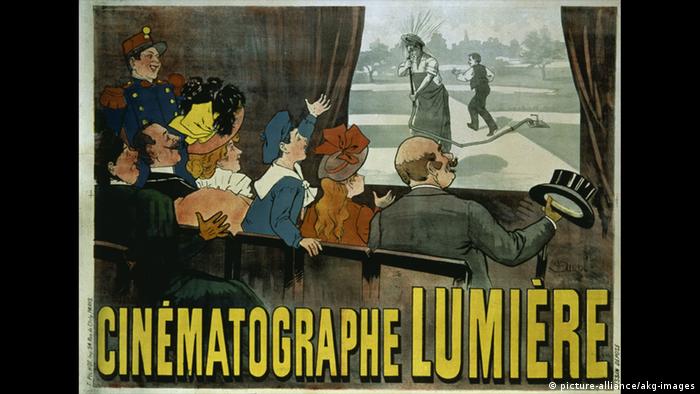
A poster of the Lumiere brothers (picture-alliance/akg-images)The Lumiere brothers are widely considered to be the forefathers of the film industry

Cinema is meant to overwhelm

“The cinema owes virtually nothing to the scientific spirit,” wrote the influential French film critic Andre Bazin in his legendary book What is Cinema? (1967). The fathers of film are not scholars, but rather “monomaniacs, men driven by an impulse, do it-yourself men or at best ingenious industrialists.”

People still thirst for spectacles, surprises and miracles, so the film industry will likely continue to thrive.

Hollywood still excels at meeting these human demands, and while its blockbusters may not be high art and may not attract everyone, the industry is doing well. It still draws viewers to the theaters and achieved record profits in 2019. You can, of course, watch almost all the films later on your smartphone if you like; in today’s film industry, anything is possible.

Source: How film was born 125 years ago | Culture| Arts, music and lifestyle reporting from Germany | DW | 12.02.2020