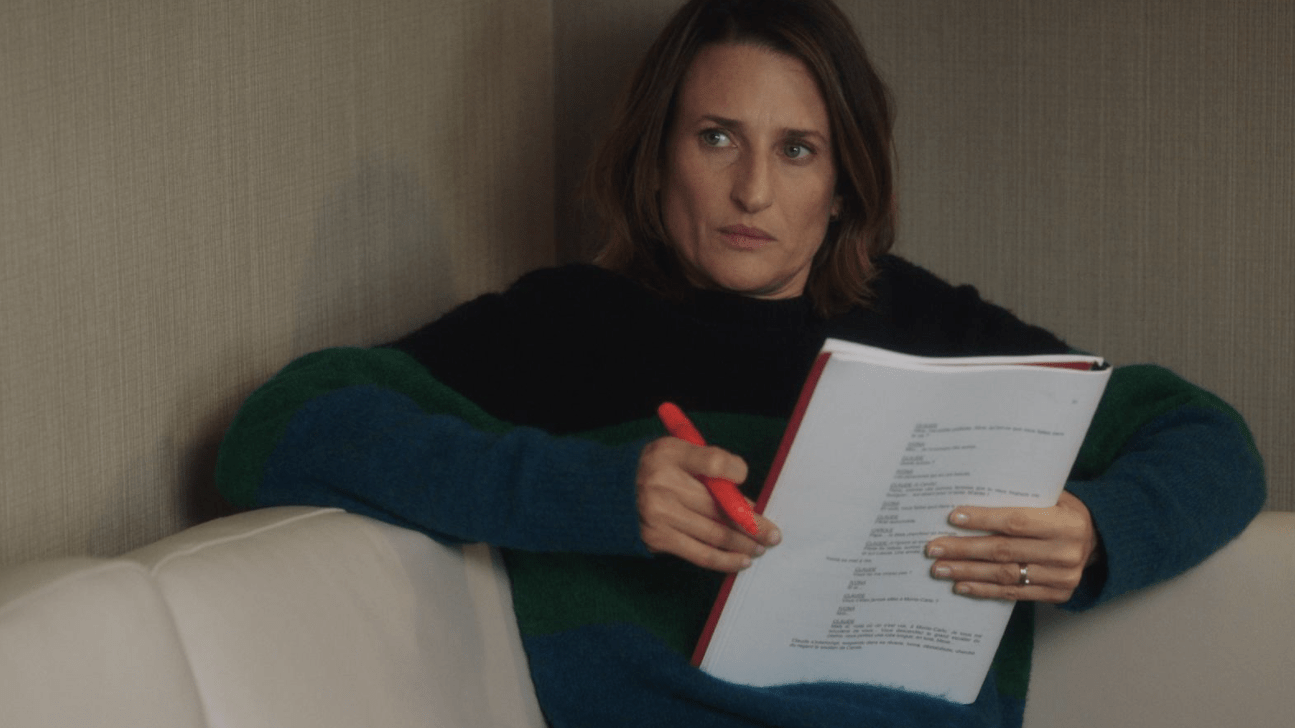
Call My Agent!: A film and a fifth season are in the works

Call My Agent

What will become Andrea, Matthias, Hervé, Noémie and Camille? Although it seemingly ended it in Fall 2020, the show Call my Agent! is making its comeback. Vogue looks over the different projects inspired by the show.

French shows rarely become popular overseas, but with Call my Agent!, creator Fanny Herrero succeeded. With a Parisian office, a pile of scripts, a bunch of famous actors and endless love stories, the series, broadcast on France 2 in France, had all the ingredients for success. The charm of the show was that the stars are not the actors, but their agents, whose job consists of booking them big gigs… and maintaining their chaotic lifesytles. The biggest names of French cinema including Nathalie BayeFabrice Luchini and even Isabelle Adjani, took part in the show with a remarkable sense of humour that seduced the public around the world. Call my Agent! also benefited from being streamed on Netflix, and by Sigourney Weaver‘s presence in the fourth season, to become a Hollywood hit. Viewers were devastated to see the A.S.K agency close down, and the show’s team seemed to agree, as they are already working on the sequel, after the last season left us with so many unanswered questions.


A film in New York?

A few days after the end of the fourth – and for now final – season, Dominique Besnehard declared that the A.S.K agency wasn’t done finished yet. The famous celebrity agent and producer of the show recently hinted at a possible film, as well as a fifth season. The project seems to have taken off, since the production agency Mediawan has officially confirmed it on Twitter.

At Europe 1, the president of Mediawan StudiosThomas Argynos, seems enthusiastic at the idea of creating a film: “We’re making great progress… We want to produce it this year, and we’re looking to air it likely at the end of the year or early next year. And we’ll move forward with a new season for Call My Agent.”

Continue reading “Call My Agent!: A film and a fifth season are in the works”

France’s lockdown vice? Cheese

French households feasted on cheese last year as they turned to home cooking and sought gastronomic comfort during coronavirus lockdowns that shuttered the restaurant trade.

The amount of cheese purchased by French shoppers for at-home consumption increased by more than 8% in 2020, compared with just 2% the previous year, according to figures from farming agency FranceAgriMer and market data firm Kantar.

That was part of a shift in food consumption in many countries last year as the COVID-19 pandemic unfolded, with households initially bulk buying staples like pasta and flour, and later settling into home-eating habits with extra purchases of products like butter.

In France, mozzarella saw the steepest rise in demand among major cheese categories, with a 21% volume jump, followed by a 12% increase for raclette – a winter favourite eaten melted with potatoes and cured meats. Continue reading “France’s lockdown vice? Cheese”

Bertrand Tavernier, veteran French director of Round Midnight, dies aged 79

Acclaimed film-maker won a string of awards for a wide variety of films, including crime and film noir, as well as his celebrated film about a jazz musician

Bertrand Tavernier, the veteran French director of a host of acclaimed films including A Sunday in the Country, Round Midnight and These Foolish Things, has died aged 79. The news was announced by the Institut Lumière, the film organisation of which he was president. No cause of death was given.

Tavernier’s output was prolific: he made his directorial debut in 1974 with The Clockmaker of St Paul and worked continuously until 2013, when he released his final feature film, The French Minister. He also took in a wide variety of material, from crime and noir, to comedy, jazz and historical drama.

Born in Lyon in 1941, Tavernier was the son of magazine publisher René Tavernier, whose anti-Nazi principles would greatly influence Bertrand. Like the generation of French New Wave directors that slightly preceded him, Tavernier grew up as a film obsessive; having moved to Paris after the war, he founded his own magazine and managed to get a job as an assistant director to Jean-Pierre Melville on the 1961 film Léon Morin, Prêtre. By his own admission, he was so bad as an AD that Melville instead made him the publicist for its follow-up, Le Doulos. It was in this role that Tavernier made his first mark in the film industry, working as a publicist on a series of New Wave classics, including Jean-Luc Godard’s Contempt and Agnés Varda’s Cleo de 5 à 7. “We were the first film publicists who were film buffs – we only accepted the films we liked,” he told the Guardian in 2008.

Continue reading “Bertrand Tavernier, veteran French director of Round Midnight, dies aged 79”

Opinion | What France does not understand about racism and safe spaces

In a country where the circles of power are overwhelmingly White and male, the fact that many important decisions are made by exclusively White groups would be a good reason to spark outrage.

Centering spaces around the voices of those who experience oppression is the only way for them to identify strategies to deconstruct structural inequalities.

Mélanie Luce is the first woman of color to lead the UNEF, a progressive student union founded in 1907 in France. When she joined a news show to speak about the precarious social conditions of students, she could not guess that she would soon be the center of national attention. Luce admitted that the union sometimes organized safe spaces to support students of color, and the interviewer labeled the initiative as “closed to White people.”

The outrage quickly spread across the political landscape. Education Minister Jean-Michel Blanquer called the meetings “racist,” “deeply outrageous” and potentially “leading to things that look like fascism.” He added he was exploring the legal grounds to prevent the meetings.

In the Senate, the right-wing party the Republicans drafted a letter to the justice minister, claiming the meetings did not comply with “French values,” as if there were no racial issues in France. Legislator Julien Aubert alerted the Paris prosecutor and said in a statement that the interior minister should consider the dissolution of the UNEF, backing the viral hashtag #dissolutionunef. [ . . . ]

Continue at WASHINGTON POST: Opinion | What France does not understand about racism and safe spaces – The Washington Post