Gauguin paintings at the National Gallery and MFA Boston may be fakes. Fabrice Fourmanoir is out to prove it

Meet the Gauguin obsessive who’s trying to prove that major art museums are showing fakes.

It’s the nude that bothers Fabrice Fourmanoir.

The way she’s painted is “unsightly” and “vulgar,” quite unlike the Polynesian women of his mind’s eye. Nor does he like the way she’s artificially inserted on the canvas, part of what he calls an “uninventive assemblage” with no coherent symbolism. Yet there she stands at the National Gallery of Art in Washington, in a painting titled “The Invocation,” attributed to Paul Gauguin.

But Fourmanoir’s roving, inquisitorial eye doesn’t stop there. He’s similarly bothered by another painting, this one at the Museum of Fine Arts in Boston, titled “Women and a White Horse.” Though it’s labeled as a Gauguin, its signature is “very weak,” he opines. And the background vegetation looks more like Tahiti than the Marquesas Islands, where Gauguin was living when he was supposed to have painted it.

Fourmanoir isn’t your average weekend art sleuth. The life and works of Gauguin have consumed him for many decades. These two paintings make him suspicious, so much so that questioning their integrity has become a personal crusade. He thinks they’re impostors, and he won’t rest until there’s a full investigation.

Born in Calais, France, Fourmanoir, 63, might once have been dismissed as a crackpot, a wannabe who would never be welcomed into the sophisticated enclave of art scholarship. But since January he’s gained some standing in this forbidding world, after playing a leading role in a blush-inducing admission by the Getty Museum in Los Angeles that a Gauguin sculpture, purchased in 2002 for a reported $3 million to $5 million, is not actually by Gauguin. Now, even as some of the most renowned art scholars continue to look with withering skepticism at Fourmanoir’s motives and credentials, he plans to make the most of his newfound status.

Continue reading “Gauguin paintings at the National Gallery and MFA Boston may be fakes. Fabrice Fourmanoir is out to prove it”

Van Gogh’s Literary Influences

“Books and reality and art are the same kind of thing for me.”
– Vincent Van Gogh

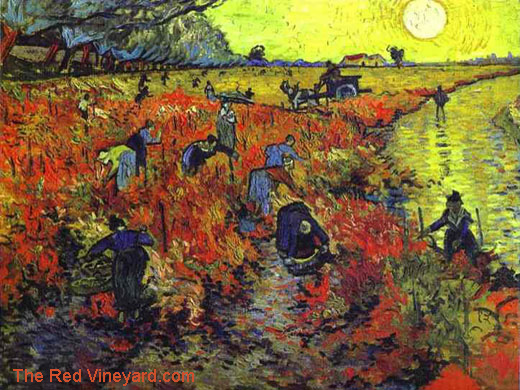
In 1888, Vincent Van Gogh sold The Red Vineyard, a vibrant field of color abuzz with laborers, to an intimate supporter of the hungry artist for today’s equivalent of $2000. These days, a single painting by Van Gogh More

In 1888, Vincent Van Gogh sold The Red Vineyard, a vibrant field of color abuzz with laborers, to an intimate supporter of the hungry artist for today’s equivalent of $2000. These days, a single painting by Van Gogh can go for as much $66m at Sotheby’s, and Van Gogh™ is a billion dollar industry. And the topper is that The Red Vineyard, if sold today, probably would be the single most expensive painting ever bought, not because it was the most popular artist’s best, but because it’s the only one he ever sold in his lifetime. (Wow.)

Over the decades there have been a number of film accounts of Van Gogh’s work and life, from Stanley Kubrick’s Kirk Douglas-driven Technicolor slave revolt from Black-and-White, to the more recent BBC biopic, Painted with Words, starring Benedict Cumberbatch with a script derived solely from Van Gogh’s written words. Continue reading “Van Gogh’s Literary Influences”

Erik Satie “Gymnopédies”

The Gymnopédies, published in Paris starting in 1888, are three piano compositions written by Erik Satie.

Satie was a colorful figure in the early 20th century Parisian avant-garde. He was a precursor to later artistic movements such as minimalism, repetitive music and the Theatre of the Absurd.

Paintings: Édouard Cortès

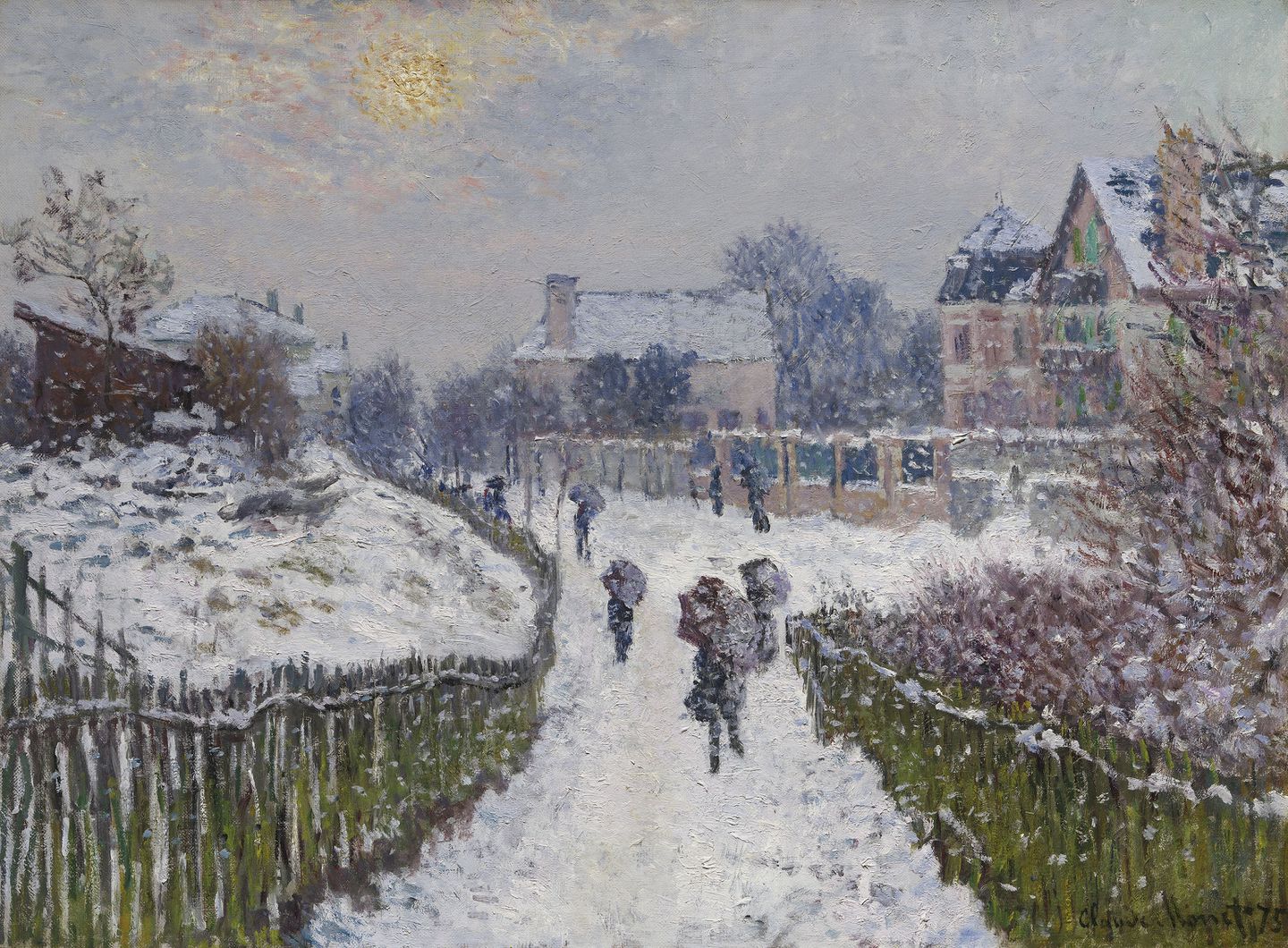
‘Monet and Boston’ will celebrate a strong connection, collection at the MFA

Several Impressionist paintings are coming home for the occasion.

By the standards of even the most feverish of Monet fans, the standing display of the Impressionist master at Boston’s Museum of Fine Arts is pretty damn good. On any given visit, you’re likely to see 10 or 12 at a time — luminous grainstacks, shimmering waterlilies, a mountain glade, and more often than not, that gleefully bizarre portrait of Camille, the painter’s wife, swathed in a demonic kimono.

So how would you feel about seeing, say, 35 Monet paintings all at once? That’s the full complement of the museums’ holdings. Out they’ll come in April, reunited for the first time in a quarter century [ . . . ]

Continue at: ‘Monet and Boston’ will celebrate a strong connection, collection at the MFA – The Boston Globe