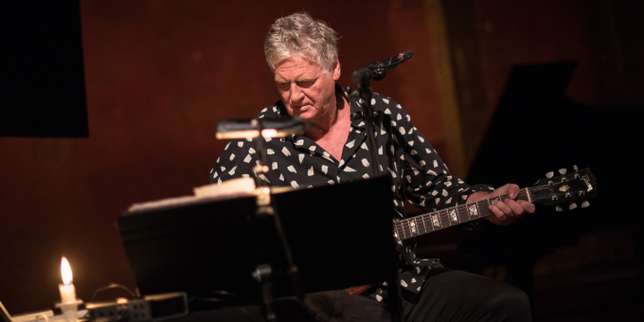
A singular spoken-sung that imposes an intoxicating presence and maintains its music in a state of weightlessness. An ecstatic blues rock and loops with hypnotic reverb, the textual cut-up stowed with saturated and saturated riffs, the guitar considered as one of the fine arts
For thirty years, Rodolphe Burger has written one of the most beautiful pages of popular and literary music. A music that could even qualify as “philosophical pop.” The name seems odd however for the one who led one of the best formations in France with the group Kat Onoma (1986-2002), before continuing his musical adventure solo. The name seems curious for the founder of the festival C’est dans la vallée, who writes for both Alain Bashung and Jacques Higelin, playing with the same spirit in the company of bluesman James Blood Ulmer or singer Rachid Taha.
A philosophical pop music, in spite of everything, because, as Gilles Deleuze said, who launched the formula and wanted to “do a course in philosophy as Dylan organizes a song,” Rodolphe Burger composes albums as books of images and sounds. With Good , his latest album (Last Band, 2017), he mixes this time the acoustics and electronics, thanks to the rhythm of Christophe Calpini.
The texts ? Poetry uttered. On the phrasing of the German romantics (Goethe for “An Lili” or Büchner for “Lenz”), on the grain of the voice of English-speaking authors of the last century (from Samuel Beckett for “Good” to TS Eliot for “Waste Land”) without forgetting the contemporary French writers, Michel Deguy ( “Nothing and nobody”) to Olivier Cadiot ( “golden Poem” and “Providence”) or Pierre Alféri ( “Happy Hour”), Rodolphe Burger made a direct album and learned, sensitive and thinking.
An irresistible pulsation
Good immediately sets the tone and sets the ambition high. An organic scansion, an irresistible pulsation, a Beckettian voice from beyond the grave leaning against a sublime rise of copper-plated strings. In “Cummings”, the guitarist’s voice is intertwined with a recording of that of the poet E. E. Cummings, whose variations and melodic lines he follows. The charm operates and the archive provides immense vertigo [ . . . ]
Read entire story: Rodolphe Burger, the artist with music “philosophical pop”