
Les 36èmes Victoires de la musique ont eu lieu ce vendredi soir (12 février) à la Seine Musicale, à Boulogne-Billancourt, près de Paris. Palmarès, prestations en vidéo, moments marquants… Revivez la cérémonie.
Author: THE HOBBLEDEHOY
Michael Stevenson, aka Dai Bando, Johnny Foreigner, Monsieur Pas De Merde, is a blogger of French and British culture. His blogs "Pas De Merde" and "The Hobbledehoy" have been called "marvelous" by some, and "meh" by others.
Women who speak out celebrated at France’s “Victoires de la musique” awards

Pomme, a singer with sensitive lyrics, who this week spoke out against sexual abuse in the industry was crowned Best Female artist of the year at the 36th annual French music awards. In the new talent category, Yseult, dazzled the scene with her message tackling the taboo of body shape and acceptance of one’s origins.
Due to the Covid-19 health crisis, the 36th Victoires de la musique took place on Friday evening in a strange atmosphere without any audience, at the Seine Musicale concert hall in Boulogne-Billancourt, on the outskirts of Paris.
However, nearly 200 extras were present in the hall to applaud the artists’ performance.
Pomme, the voice of the #MeToo movement in music, won Best Female Artist, her second Victoire, after her album Les Failles won a prize last year.
#MusicToo
This trophy is a big spotlight on the #MeToo movement, still in its infancy in the music industry and named #Musictoo.
Pomme described her “arrival in the music industry” as “traumatic” in an open letter published Thursday by the online medium Mediapart. “From the age of 15 to 17, I was manipulated, morally and sexually harassed, without being aware of it at the time of course,” the 24-year-old artist said.
When she received her award on Friday, she wished for a “safer (music) industry for women”, hoping that they could “overturn the codes” of the business.
Also speaking out for women, and in particular women of colour, was Yseult, who won Best New Female Talent award.
“There is still a long way to go for women, for black women, for fat women,” commented Yseult.
The singer has always explained that she uses the colour of her skin and her body shape as a political weapon through her songs and videos.
Benjamin Biolay was awarded Best Male Artist and Best album for Grand Prix. At the age of 48, he has now won six awards. He didn’t shy away from pointing out how hard the year has been for the culture industry in France due to the pandemic.
“It hasn’t been a very winning year for music,” said Biolay as he received his first trophy of the evening, the trophy for male artist.
He has openly criticized what he describes as the “deafening silence of the public authorities” towards the music industry in general, and of the stage in particular, weakened by the Covid-19 health crisis.

Jane Birkin gets career award
Mais je t’aime, by Grand Corps Malade and Camille Lellouche, was named best song.
The Victory of Best new Male Talent came to Hervé. The best video clip was won by Julien Doré, for Nous, with his two mischievous dinosaurs.
The ceremony, regularly accused of snubbing the big sellers of the moment – from urban music – also highlighted the most streamed title (more than 101 million times) between December 2019 and November 2020, Ne reviens pas, by Gradur and Heuss L’Enfoiré.
Among the other prizes awarded was the Victory of Honour awarded to Jane Birkin for her entire career.
Source: Women who speak out celebrated at France’s “Victoires de la musique” awards
How French comedy of manners ‘Call My Agent’ became an American sensation
That feeling when you have eaten all the candy in the house and you look on the doorstep to find that someone has sent you a 1-pound box of assorted nuts and chews is pretty much how I felt learning that a fourth season of “Call My Agent” had landed on Netflix.
The series, called “Dix Pour Cent” (“Ten Percent”) in its native France, first came to my attention a couple of summers ago, by word of mouth, when the first two seasons were available. It was quickly clear that this was a series that had my name on it, handwritten and bordered in gold, presented on a dish made of silver. Set in a Paris-based talent agency, it is salted, after the manner of “The Larry Sanders Show,” with real French screen stars, including Isabelle Adjani, Juliette Binoche, Fabrice Luchini, Charlotte Gainsbourg and Jean Reno (and in the latest season, American Sigourney Weaver) playing ironic versions of themselves, and shot in real Paris locations. And though it is obviously not completely original — it’s a workplace comedy in more than one television tradition — it’s also different in the way that one language is different from another even when a sentence says the same thing. Continue reading “How French comedy of manners ‘Call My Agent’ became an American sensation”
Drink wine, have sex, advises leading French doctor
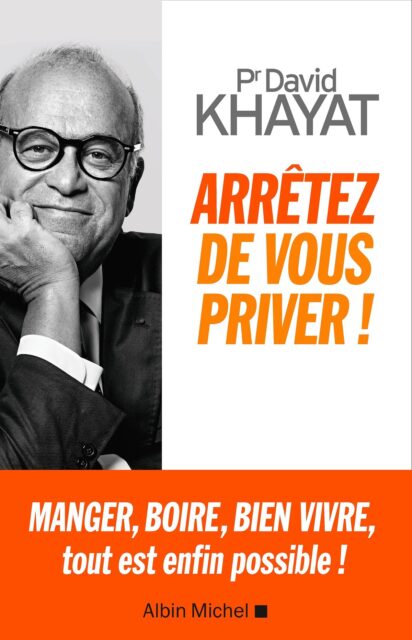
A recently-published book by leading French oncologist, David Khayat, urges people to enjoy life’s pleasures, from sex to wine.
Following the release of his newly-published tome, Arrêtez de Vous Priver (Stop Depriving Yourselves), Khayat has featured in a range of leading French media over the last few days, promoting the message that people should have a “few small excesses, without feely guilty,” as reported by French commercial radio network, RTL.
Such indulgences are necessary for a person’s self-esteem, according to Khayat, who points out that the constant denial being promulgated by organisations, governments and some doctors are in fact harmful to the mind, while making little difference to the body.
Indeed, in an interview with Adam Sage at The Times, which was posted online yesterday, he says that the health risks from enjoying chips, meat and alcohol are being inflated by “rarely very great doctors”, who, he adds, are keen on imposing their “hygienist” vision of society.
While such influential figures suggest that people “will be able to avoid old age, illness and death” by avoiding “excesses” from wine to meat, Khayat says, “but that’s wrong, we are all going to fall ill, and we are all going to die”
In particular, he is critical of the “dogmatic” approach by the World Health Organisation (WHO), dismissing its guidance on risks from electronic cigarettes to processed meat.
Commenting that the former are “not a problem at all”, he then attacks the group’s claim that 50g of processed meat a day raises the risk of colorectal cancer by 18%.
He told The Times, “They tell you the rise in the risk is 18%, but they don’t tell you what your risk is in the first place. In fact, it is 2%. So if you stuff yourself with ham, your risk goes from 2% to slightly over 2%. Is it worth depriving yourself of a slice of ham for that?”
In place of WHO, he suggests people follow the precepts of Epicurus, who advocated enjoying modest pleasures for tranquility of the mind.
In essence, Khayat says that people “need balance”, and, having recommended drinking wine and having sex, he says, “life without pleasure makes no sense”.
Continue reading “Drink wine, have sex, advises leading French doctor”
France’s ‘finest screenwriter ever’ Jean-Claude Carrière dies aged 89

French writer and screenwriter Jean-Claude Carrière, who penned some of the most memorable movies of the last six decades including “The Tin Drum” and “Cyrano de Bergerac”, has died at the age of 89
A prolific writer, Carrière, best known for his work with Luis Bunuel and Milos Forman, created some of the most memorable scenes in European cinema.
Belle de Jour was one of the fruits of his 19-year collaboration with the subversive Spanish director Luis Bunuel, who revelled in shocking audiences.
The pair won an Oscar in 1972 for The Discreet Charm of the Bourgeoisie, adding to the Oscar Carrière had won in 1963 for best short film.
Fascinated by philosophy and belief
Carrière’s work ranged across cultures, religions and historical periods, from Cyrano de Bergerac (1990) — for which Gérard Depardieu gave one of the performances of his career — to Milan Kundera’s The Unbearable Lightness of Being (1988) with Daniel Day-Lewis, to writing a book with the Dalai Lama.
Continue reading “France’s ‘finest screenwriter ever’ Jean-Claude Carrière dies aged 89”
Comme une Française: Fast Spoken French
You can learn all the French vocabulary in the world and watch all the French movies ever created… but you won’t be able to improve your comprehension of real, everyday spoken French unless you practice! And that’s what we’ll do today.
In today’s lesson, we’re going to use a clip from English comedian Paul Taylor, which you can watch here: https://www.youtube.com/watch?v=9ZcxT…. In it, Paul speaks excellent everyday French. Can you understand what he’s saying? Have a listen, and let’s practice together.
Take care and stay safe. 😘 from Grenoble, France.

