The world of tomorrow according to Juliette Binoche, Guillame Canet and Vincent Macaigne

Juliette Binoche, Guillaume Canet et Vincent Macaigne, les acteurs de Doubles vies d’Olivier Assayas, nous racontent ce qu’ils attendent de demain.

What are the double lives of Olivier Assayas’ new film? Most of his characters lead double lives. Because the life of the bourgeois often resembles caricature to bourgeois theater, their double lives are at first conjugal: Alain (Guillaume Canet) cheats his wife Selena (Juliette Binoche) with a young collaborator of his publishing house ; and Selena misleads Alain with one of his best friends, Leonard (Vincent Macaigne). The friendly lives are also double: Alain is the friend of Leonard, but also his publisher, and their friendship does not prevent the first to release the second when the potential of his new novel leaves him skeptical. Double games, double stakes …

Double lives travels with a lot of verve on the tracks of satirical marivaudage and the chronicle as amused and inspired by the mores of a social environment and an era. But the title of the film is itself double. The true object of investigation of Doubles lives , it is first of all what which doubles the life, the duplicate, deploys it in a more virtual space than current. This power of duplication is the great digital switch of the world that affects our lives in their smallest ramifications, revolutionizes the world of work, transforms relations between people. Double livesinspected with great precision and irony – but also with tenderness and delicacy of human understanding – the way everyone negotiates with the principle of transformation of the world, alternates between resistance and adaptation. To begin an issue mainly dedicated to the coming year, we wanted to bring together the three main performers of the beautiful film by Olivier Assayas to project further and ask them the question posed by the film: what are the reasons to fear or hope in the world that is coming?

Is technological progress a source of worry or excitement for you?

Guillaume Canet – On these questions, I feel pretty close to my character in Doubles Lives. I want to welcome progress with a lot of curiosity and yet it mixes a little skepticism. I want to live in my time, but I sometimes freak out at the implications in creating this digital revolution. The way art is consumed, that is to say as a content, delivered at home, among many others, interferes with the way it is conceived. It affects thought at work in every creation. To satisfy these new modes of consumption, there is an injunction to make simpler, shorter. Here, for example, I finish the postproduction of my new film, and the mixer explains to me, about a replica which I wanted it to be really whispered, that it will go to the trap with the compressed sound smartphones. What are we doing ? Do we consider it or not?

Vincent Macaigne – I think that in terms of VOD, you would have to invent media where the films disintegrate as you see them … (laughs). No, but I’m not kidding! On streaming sites, I myself watch bits of movies, which do not really exist as works, and from which I take fragments. When the ritual of the hall jumps, bending to the rhythm of the one who thought the work becomes something more restrictive. And yet, for me it really is what defines the aesthetic experience: to bend to the rhythm of another. Basically, I find it odd that the viewer has control of the progress of the work. It creates a somewhat strange spectator grammar. But yet, I do it. For example, I watch some series focusing only on one character. All the related intrigues, I pass them in fast forward, and I stop only when my character comes back (laughs) .

Continue at LesInRocks https://www.lesinrocks.com/2019/01/09/actualite/binoche-canet-et-macaigne-entretien-avec-les-acteurs-de-doubles-vies-111157342/
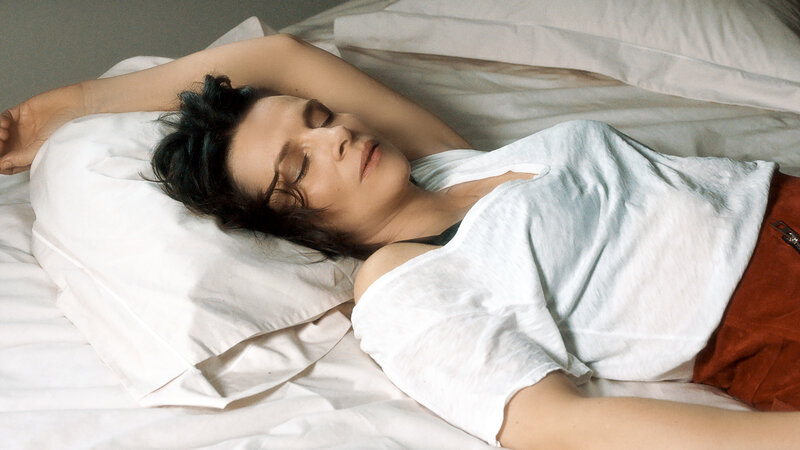
‘Let The Sunshine In’: A Soulful French Comedy Of Carnality

[ NPR ] Let the Sunshine In is the poorly translated title (more on that later) of the new film by French director Claire Denis. It opens with a scene that has launched many a tale of female romantic travail.

Isabelle, a Parisian painter played with characteristic heart and soul by Juliette Binoche, lies beneath her lover, waiting for him to achieve climax and to stop asking her, for heaven’s sake, if she’s there yet. With his own mission accomplished the lover, an oafish banker played to the nasty hilt by filmmaker Xavier Beauvois, wants to know if Isabelle has enjoyed more efficient orgasms with other men. She slaps his face and turns her back, then agrees to meet the oaf that weekend.


Needless to say he doesn’t show, and that will prove true of several other unsatisfactory, mostly married men who, one way or another, can’t or won’t give Isabelle the enduring love she seeks, yet won’t let her be either. A self-absorbed actor (Nicolas Duvauchelle) insists he’s leaving his wife but, having allowed Isabelle to inveigle him into staying the night, wallows in morning-after regret. There’s pain aplenty here, but though the movie runs up and down the mood register from hilarity to saxophone-fueled sadness to despair and back up to hard-won irony, the tone is never mawkish or self-pitying. If anything Denis, who co-wrote the wittily cascading — and, from time to time, coruscating — dialogue with the novelist Christine Angot, has cooked up a fresh sub-genre: the looking-for-love comedy procedural.

In another kind of movie Isabelle would bravely soldier on through cad after cad until Mr. Sensitively Woke makes his grand entrance and pouf! fin. Not here: Let the Sunshine In is the sum of its moments, of Isabelle’s inner and outer processing of her predicament with only hope to buoy her flagging spirits.

What energizes the movie and makes it delightful is that the guys are not all jerks, and that Isabelle is no picnic herself. Her needy insecurity renders her vulnerable and all too easily unsettled by facile judgments from others, which among other fruitful inquiries treats us to a very funny exchange with the great Josiane Balasko, who plays Isabelle’s powerhouse gallerist.

Teasing genre is not new for the bracingly innovative Denis, who has dabbled in horror (Trouble Every Day), though she’s famous for her political dramas (Beau Travail, White Material) set in Africa where she spent her childhood. Her next film, starring Robert Pattinson, will be set in space.

For a film that’s clearly meant to be experimental and fragmentary — it was worked up between other projects from Angot and Denis’s own histories, with the late French cultural theorist Roland Barthes poking his head in from a great distance — Let the Sunshine In moves between dialogue and carnal interludes with rhythmic fluidity. The mostly nocturnal settings and sumptuous black and red palette intensify Binoche’s soulful sensuality. Her eyes are black orbs of infinite depth, and she wears so many leather jackets and thigh-high boots that the filmmakers might be hearing from PETA, but those clothes exert a magical, if temporary hold on the men who love and leave her. “Take care of me a little bit,” she beseeches a man who manifestly takes care of nobody but himself.

What redeems Isabelle even as it gets her into hot water is her devastating candor with everyone, from the banker who envies her boho lifestyle yet constantly puts her down, to the stranger (Paul Blain) from the wrong side of the tracks who dances her into quiet ecstasy, to the cab driver about whose happiness she inquires at the end of a day that leaves her emotionally drained. She’s frank about herself too: Even her former husband (Laurent Grevill), with whom she has a child, gets roundly scolded when he makes a wrong move in bed. If Denis sometimes skates close to making a virtue of Isabelle’s honesty, it’s refreshing to hear such straight talk from a woman on screen.

Still, something has moved in Isabelle. Enter Gerard Depardieu, speaking words of wisdom and beauty. It’s not what you think, but his lovely speech about her predicament clues both Isabelle and us into acceptance of life’s enduring ambiguities. And then, he reminds her, there’s her work. Has Isabelle learned at last to let the sunshine in? According to the film’s French title, Un Beau Soleil Interieur (A Beautiful Sun Inside), which was inexplicably inverted for its stateside release, it was there in her heart all along.

UniFrance presents a French Cinema Award to Juliette Binoche

On January 19, during the official opening of the 20th Rendez-Vous with French Cinema event in Paris, UniFrance presented a French Cinema Award to Juliette Binoche at the French Ministry of Culture. The award was handed to the actress by French Culture Minister Françoise Nyssen in the presence of a large number of movie industry professionals [ . . . ]

More at source: UniFrance presents a French Cinema Award to Juliette Binoche – uniFrance Films