Back to Black: The Charcoal Trend in French Cooking

Black Bread

A local baker and a Michelin-starred chef have mastered the dark force of charcoal. Patrice Bertrand finds out more. 

On a beautiful autumn morning, at the market in the picturesque spa village of Montbrun-les-Bains, in the Drôme Provençale, baker Norbert Jouveau cuts a few slices of a deep black-coloured bread in front of a group of intrigued onlookers. He hands out some slices to them, saying, “Taste this. It’s made with vegetable charcoal. It’s delicious and it’s good for your health.” At first sceptical, a woman tastes it, and then says: “It’s really good. I’ll take a loaf!”.

Eye of the Beholder

“It’s often like that,” jokes Norbert. “The visual effect is very important. Sometimes people are first repelled by the colour but when they taste the bread, they quickly change their mind. Charcoal is known for its many virtues: it reduces cholesterol, it regulates intestinal transit and balances kidney function. In addition, it’s good for the breath!” he says.

Norbert started making charcoal bread five years ago, in the tiny village of Curel, near Sisteron, where he also runs a guesthouse called L’Auberge du Vallon des Amoureux (The Lovers’ Valley Inn). “I was curious to use this ingredient,” he says. “I first tested it on myself and I realised that it was very effective for the gastric system. Then I started selling it.

“Of course, the charcoal I use is not the charcoal we use for grilling,” says Norbert, who makes about 30kg or a hundred loaves a week. “It is made from light wood, in my case poplar, which is purified, controlled and does not contain indigestible elements. I use 10g per kilo of flour and mix directly. This is enough to give the bread its black colour. Any less, it does not provide any benefit for digestion and, any more, we get a doughier bread that bakes quite poorly.”

Artisan baker Norbert Jouveau wows market-goers. Photo © Christophe Constant

Marvellous Monochrome

Known since Antiquity for its purifying and digestive properties, vegetable charcoal has recently been making a real comeback in French bakeries, pizzerias and upscale restaurants.

Further north in the Alps, at Le Chabichou-Courchevel, an upmarket Relais & Châteaux resort in the Tarentaise Valley, vegetable charcoal is more about colour. With this ingredient, Stéphane Buron, the chef at its two Michelin-starred restaurant, creates dishes as delicious as they are spectacular-looking.
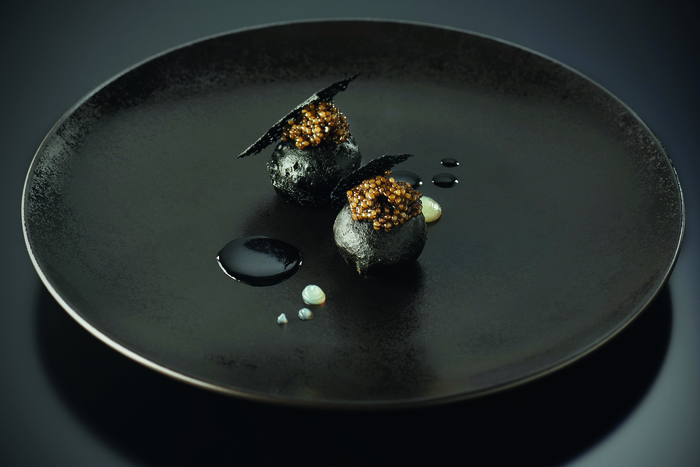
 

Stéphane Buron uses charcoal to create breathtaking dishes. Photo © Chabichou-Courchevel

“In terms of taste, vegetable charcoal does nothing but, in cooking, I love everything that is monochrome,” he explains. “For example, it allows me to make black truffle tartlets with a thin and crispy charcoal dough. Or tricoloured ravioli of poultry liver, black trumpet mushroom tartlets with black jelly, smoked mozzarella with charcoal in the breadcrumbs.”

Added to this list are, among others, a puffed bread with vegetable charcoal, a fera (local lake fish) foam smoked with Ossetra caviar and black radish cream. The effect is stunning.

Stéphane Buron says: “I have been using charcoal for three years. Before, I used squid ink which has strong colouring power but coagulates and is sticky. However, vegetable charcoal is a completely dry ingredient. You can mix it with bread dough and get beautiful monochrome colours. The customers love it.”

Chef Stéphane Buron. Photo © Chabichou-Courchevel

Source: Back to Black: The Charcoal Trend in French Cooking

Joël Robuchon, A Giant In French Cooking, Dies 

Robuchon won more Michelin stars than any other chef. He embraced his role as a steward of France’s cultural treasures and rejected pretentiousness. After all, his signature dish was potato puree.

“I believe it’s necessary for them to live like all other children and to discover a little of all these cuisines. They loved it because, at a certain age, all children love McDonald’s for its ambience. It corresponds to the taste of children.

“Myself, I drink Coca-Cola. Now, someone is going to say a grand chef who drinks Coca-Cola, that can’t be. But I also use ketchup. One must be open to everything. Sometimes, you feel like eating a pizza; the next day, you may feel like couscous or paella, then, the day after, you eat some more refined cuisine. All of it is necessary.”

Read full story at NPR: Joël Robuchon, A Giant In French Cooking, Dies : NPR


Read more about Food & Wine at Pas de Merde
Bon Appétit!

Tasting Paris: A Chat with French Food Connoisseur, Clotilde Dusoulier

Food is at the heart of French culture – it is quite literally the bread and butter of their way of life. Clotilde Dusoulier, a French food writer based in Paris, knows just how important it is. She’s passionate about the fresh, wholesome foods that have influenced her lifestyle and career; she writes about it on her blog, Chocolate & Zucchini

We got the chance to speak with Clotilde about French food and culture, her writing, and the importance of learning to cook. Keep reading to find out more!

SIGNATURE: When did food become such an important part of your life? Did you always know you wanted to be a food writer?

CLOTILDE DUSOULIER: I grew up in a French family where fresh, seasonal food was important, but we didn’t make a big deal out of it. It’s only as a young adult, when I moved to California after graduating, that I took stock of my culinary heritage, and became fascinated with food, and what it says about us. I started to cook with increasing passion, as a creative outlet and a way to reconnect with home.I always knew I wanted to write, and I stumbled upon food writing specifically when I decided to start a blog in 2003 to share my passion for cooking. I realized it was a topic that inspired me endlessly, and allowed me to connect with others in a genuine and meaningful way.

Clotilde Dusoulier
Chef and author Clotilde Dusoulier


“My mission is to give my readers fresh ideas that keep them excited and motivated to cook on a day-to-day basis.” 

CD: It’s a toss-up between a baguette and a croissant! Both are iconic products of French baking, and neither is as beautifully crafted as they are in France, and in Paris specifically (pardon my Parisian bias). On my food walking tours, we spend time discussing and appreciating what makes a stellar baguette and croissant, where to buy 


SIG: If someone were traveling to France for the first time, what would be the first thing you recommend to eat?

CD: It’s a toss-up between a baguette and a croissant! Both are iconic products of French baking, and neither is as beautifully crafted as they are in France, and in Paris specifically (pardon my Parisian bias). On my food walking tours, we spend time discussing and appreciating what makes a stellar baguette and croissant, where to buy them, and how to recognize them.

SIG: How does food impact French culture? What are some traditions that have stood the test of time? [ . . . ]

Continue Interview at SIGNATURE: Tasting Paris: A Chat with French Food Connoisseur, Clotilde Dusoulier