
Laetitia Dosch
Tag: Laetitia Dosch
Actresses turned directors are all the rage in 2025.

By Violaine Schütz, Jordan Bako
It was one of the key trends in recent years—and at the last Cannes Film Festival. And it’s likely to shape the next one, too. In 2024, many actresses debuted films as directors. Céline Sallette appeared on the Croisette with Niki, a biopic about artist Niki de Saint Phalle; Noémie Merlant unveiled Les Femmes au balcon (set in a heatwave-stricken Marseille); Laetitia Dosch presented Le Procès du chien; and Ariane Labed introduced September Says. Judith Godrèche premiered Moi aussi, a short film addressing sexual violence. Even the festival’s jury president, Greta Gerwig, is an actress-turned-director.
Noémie Merlant, Laetitia Dosch… a growing number of actresses head behind the camera
The growing number of women stepping behind the camera to express their own vision—beyond the male gaze—is no coincidence. This trend aligns closely with the momentum of the #MeToo movement. Women no longer want to be objects of male desire or perspective—they’re creating their own stories, populated with heroines often far more nuanced than those imagined by male directors.
As filmmaker Anissa Bonnefont recently put it: “There have been—and still are—men who tell women’s stories beautifully. But today, more and more female directors are beginning to make space for a different representation of women in cinema. It’s reassuring to witness this, even though we’re still very far from gender equality in our industry. Now we’re seeing films made by women where female characters are portrayed in all their complexity and strength—and that needs to stop being frightening.”

The end of the actress as an object in the hands of an all-powerful director?
The emergence of actresses-turned-directors signals the closing of an era—the actress as an object, a mere instrument wielded by a powerful auteur. As Juliette Binoche once said in Libération about her early career: “When a young actress, mutable and hesitant, gives herself through a role, she turns to her director for approval. She is wholly his, hers, the world’s. Doesn’t that yearning from the young actress give the director the illusion that everything belongs to him? Has he not sensed that this extreme longing hides another, not necessarily carnal, but invisible, unreachable—a yearning for the absolute that transcends them both?”
A movement spreading across the Atlantic
This shift is not entirely new. Asia Argento, Valeria Bruni-Tedeschi, Nicole Garcia, Hafsia Herzi, Monia Chokri, Mélanie Laurent, Emmanuelle Bercot, Zabou Breitman, Sophie Marceau, Agnès Jaoui, Julie Delpy, Valérie Donzelli, Sandrine Kiberlain, Valérie Lemercier, and Maïwenn have all leaped from acting to directing.
And the movement has long since taken root in the U.S. Angelina Jolie made her directorial debut as early as 2007 with the documentary A Place in Time. Last September, the Girl, Interrupted star showcased Without Blood, a drama she wrote and directed, starring Salma Hayek, at the Toronto International Film Festival.
After two years of media quiet, Zoë Kravitz returned to the spotlight—not as an actress, but as a director. Blink Twice marks her directorial debut, a project starring Channing Tatum and Naomi Ackie that’s been in development since 2017. Scarlett Johansson, Kate Winslet, and Kristen Stewart are also preparing to release their first features. Stewart’s debut, The Chronology of Water, stars Imogen Poots and has yet to receive a release date. Both this film and Scarlett Johansson’s Eleanor the Great could potentially be featured at the 2025 Cannes Film Festival.
More and more actresses becoming producers
It’s not just about directing—many actresses are also taking control as producers. Speaking to Numéro about the release of The Outrun, Saoirse Ronan shared: “I wanted to be more creatively involved and bring my own perspective to a project centered on me. After producing this film, I believe more actresses should step into action.”
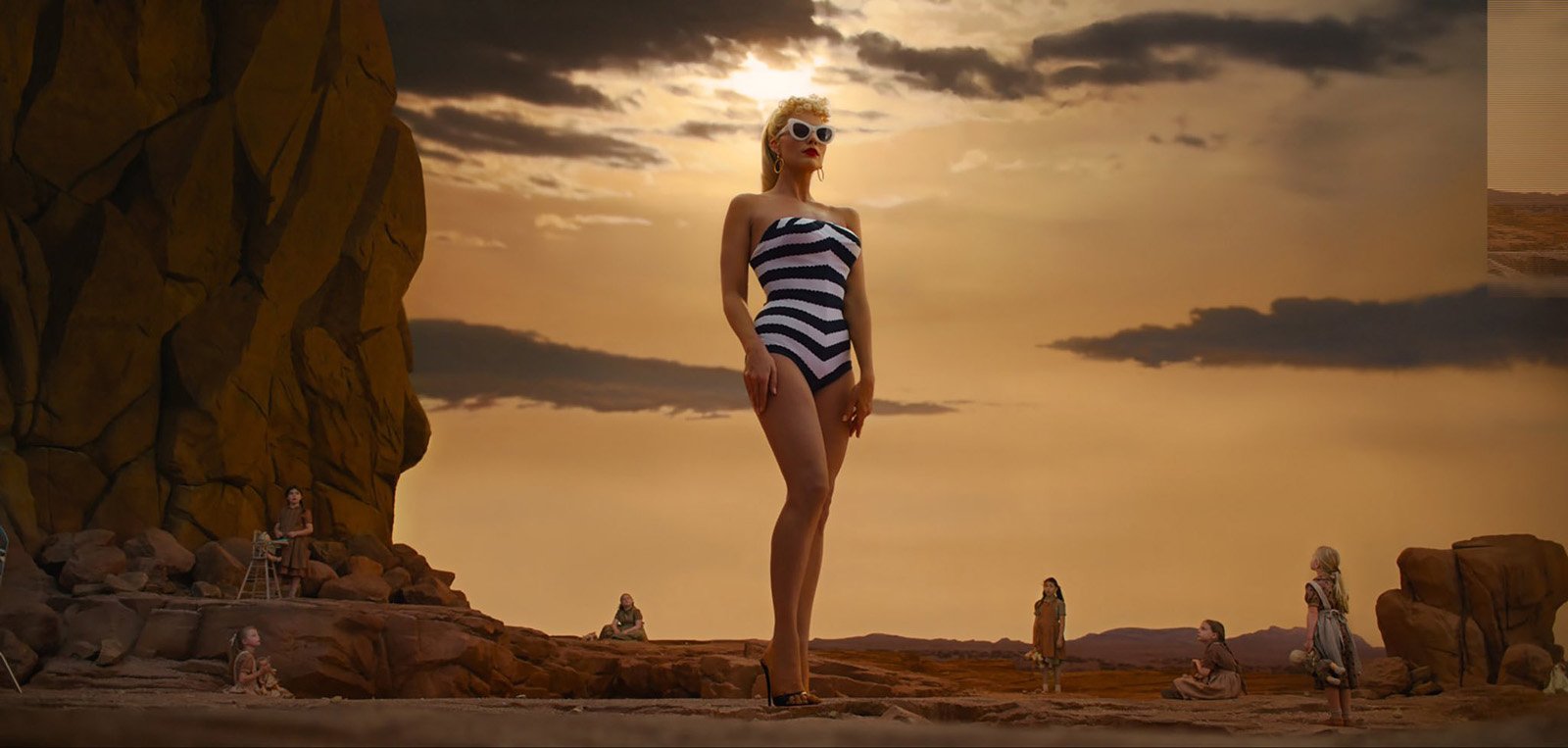
Actresses have increasingly made their mark as producers in Hollywood—think Reese Witherspoon or Viola Davis. In 2024, by taking up the camera and embracing production roles, actresses are clearly reclaiming power. Just as Margot Robbie declared in the metaphysical final scene of Barbie (2023): “I don’t want to be an idea anymore.”
Source: Actresses turned directors are all the rage in 2025.
‘Dog on Trial’ Review: Zany Courtroom Comedy With a Canine Star Turn

Laetitia Dosch’s ‘Dog on Trial’ delivers what its title promises, but surprises with its tonal swerves and the magnetic presence of its non-human MVP.
By Gut Lodge
Can animals act? Sensible people would say not: Our four-legged friends can’t read a script or construct a character, and if they come across charismatically on screen, that’s simply down to obeying commands, plus the deft touch of an editor. The more whimsically accommodating among us would say those last two points are true of some human actors too; Hitchcock, with his infamous “actors are cattle” quip, suggested as much. Either way, it’s hard to watch Kodi, the ragged, hungry-eyed canine star of “Dog on Trial,” without sensing, whether by sheer good fortune or some mysterious process of empathy, a genuine performance afoot.
Called upon to jump, slump, tremble and even (sort of) sing, with an expressive range spanning untethered aggression and resigned melancholy, the biscuit-colored crossbreed hits every mark required of him by Laetitia Dosch‘s endearingly eccentric directorial debut, and emerges as its most compelling element. On many films, that would seem a slight; in the case of this one, an earnest animal-rights parable in the guise of a broad knockabout farce, it’s surely the intention for this particular dog to have his day. (Rarely has a film seemed so precision-engineered to win the Palme Dog award for best canine performer at Cannes, and sure enough, following “Dog on Trial’s” Un Certain Regard premiere in May, Kodi duly and deservedly took the prize.)
Dosch, the French-Swiss actor who broke through with her delightful star turn in 2017’s “Jeune Femme,” ostensibly plays the lead as Avril, a frazzled, kind-hearted Swiss lawyer with a penchant for hopeless cases, in both the personal and legal sense. This time, unusually, it’s woebegone mongrel Cosmos (Kodi) and his equally hangdog human Dariuch (Belgian actor-comedian François Damiens), who’s facing legal action after Cosmos bit and injured three women. Separate from Dariuch’s debt to the victims, the law states that the dog should be put down. Avril successfully argues that, as an autonomous being, Cosmos should be tried independently, and so “Dog on Trial” proceeds.
This may sound like a premise from a more naïve era of family-friendly Hollywood creature comedies (“Beethoven’s Sixth Amendment,” perhaps), but Dosch’s script, co-written with “My Everything” director Anne-Sophie Bailly, leans hard into the absurdity of the idea while shooting for scathing adult satire. The case escalates fast — as does everything in a frenetic, incident-crammed film, clocking in at just 80 minutes — into a national cause célèbre, inspiring rowdy public demonstrations for and against Cosmos’s right to live, while a procession of professed experts weigh in on the morality and soul of the common mutt. Much of this is witty, as Dosch’s exuberant, up-for-anything direction dips into animation and faux-documentary stylings to convey the barrelling rush of a media circus, while there’s some considered philosophical reflection on animal behavior and ethics amid all the hijinks.
At times, however, “Dog on Trial’s” brash, busy approach leashes its impact. It’s top-heavy with story for such a slender-framed work, as sketchily developed strands involving Avril’s colleagues and her lonely young neighbor jostle for screen time with the more substantial and immediately relevant subplot of the lawyer’s growing attachment to Cosmos’s charming, court-appointed handler Marc (a winning Jean-Pascal Zadi), and the mistreated animal’s gradual softening under his care. Any dog lover will be thoroughly disarmed by this development, and by Kodi’s irresistible enactment of this arc. But they’ll be vulnerable to the next of the film’s emphatic tonal lurches, as its zanier storytelling impulses ran into some sense of duty to the realities of Switzerland’s legal system.
Consider it the shaggy misfit in the litter of recent French-language legal studies, from “Anatomy of a Fall” to “The Goldman Case” — for all its hectic tragicomic slaloming, “Dog on Trial” ultimately takes the shape of a procedural, interested in how justice is determined, and for whom. Dosch is, as ever, an appealingly off-kilter presence before the camera; behind it, she doesn’t have complete control over her film’s wriggling ideas and restless formal execution. Yet there’s something quite suitably untamed about it too. Knowing not all viewers will be on its side, “Dog on Trial” throws its lot in with the animals, barking and clawing and occasionally behaving badly to make its point — and generously throwing the spotlight on its hairier hero to bring that home.
Source: ‘Dog on Trial’ Review: Zany Courtroom Comedy With a Canine Star Turn
Laetitia Dosch interview on Dog on Trial at Cannes Film Festival 2024
Laetitia Dosch interview on Dog on Trial at Cannes Film Festival 2024
“Simple passion”, stars Laetitia Dosch
“From September last year, I did nothing but wait for a man to call me and come to my house.
The singular voice of Laetitia Dosch recites the words written by Annie Ernaux in “Simple Passion”, novel from which this film is adapted. How to put in images the expectation, the amorous obsession?
By choosing this promotional subscription path, you accept the deposit of an analysis cookie by Google.
To give substance to the tenuous sentences of Ernaux, Danielle Arbid dwells on the bodies. That of Laetitia Dosch, in particular, filmed as Deneuve in “Belle de jour”. Blonde, bourgeois, submissive to her desire for a man who is not even her type: she is a teacher; he, Alexander (played by Russian dancer Sergei Polunin), likes cars and Putin.
More than in the sex scenes, it is in the moments of solitude that the passion radiates, transfiguring the face of the actress. To the point of resembling, disturbingly in some shots, Annie Ernaux. A solar and sensual film.
Source: California18
Review: ‘Our Struggles’ (Nos Batailles)’

Romain Duris is the factory worker struggling to balance his responsibilities
Dir: Guillaume Senez. Belgium-France. 2018. 98mins
Available on Amazon
A hardworking husband and father with solid social convictions and major responsibilities on the floor of a gargantuan dispatching warehouse in provincial France is obliged to recalibrate every corner of his life after an abrupt change at home in Our Struggles (Nos Batailles).
Co-writer/director Guillaume Senez stakes a legitimate claim to his chosen narrative territory
A thoughtfully structured indictment of the creeping precariousness of steady work and exploration of the balancing act of a man suddenly left entirely in charge of his two young children, this modest but convincing film benefits from a fine ensemble cast and a committed central performance by Romain Duris.
Trendy articles praise the concept of “disruption” and bow down before the supposed value that “disruptors” lend to the marketplace, but most people probably have a soft spot for stability in their work and home lives. One such man, Olivier (Duris), is about to get thrown for a loop he could definitely have done without.
There’s not an overabundance of “human” qualities in Agathe (Sarah Le Picard) from Human Resources when she tells Olivier that one of the older workers under his supervision can’t keep up the pace anymore. Olivier defends the man in question, but the employee’s contract isn’t renewed and bad things result. Continue reading “Review: ‘Our Struggles’ (Nos Batailles)’”

