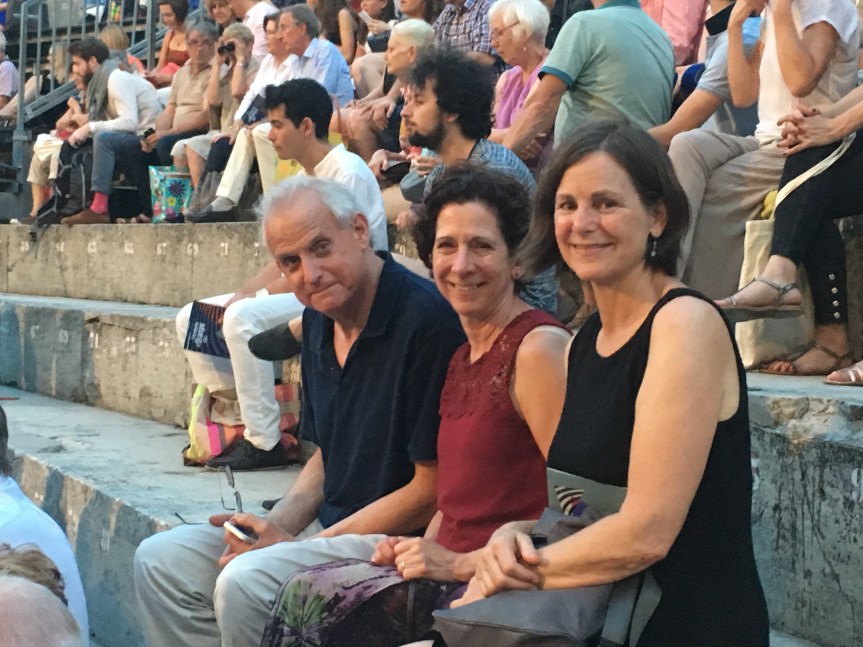
So much winning.
Tired of winning.
The baguette switched pockets with the cherries

So much winning.
Tired of winning.
The baguette switched pockets with the cherries
Originally a railroad station built in 1810, The Musée d’Orsay was our destination for a Cezanne exhibit. The giant clock on the top floor restaurant is a work of art as well.

And what time does the clock say? Beaudelaire:
Always be drunk.
That’s it!
The great imperative!
In order not to feel
Time’s horrid fardel
bruise your shoulders,
grinding you into the earth,
Get drunk and stay that way.
On what?
On wine, poetry, virtue, whatever.
But get drunk.
And if you sometimes happen to wake up
on the porches of a palace,
in the green grass of a ditch,
in the dismal loneliness of your own room,
your drunkenness gone or disappearing,
ask the wind,
the wave,
the star,
the bird,
the clock,
ask everything that flees,
everything that groans
or rolls
or sings,
everything that speaks,
ask what time it is;
and the wind,
the wave,
the star,
the bird,
the clock
will answer you:
“Time to get drunk!
Don’t be martyred slaves of Time,
Get drunk!
Stay drunk!
On wine, virtue, poetry, whatever!”

Where would I be on a rainy day in Paris? The used record shop of course! I visited this Sainte Germain neighborhood shop last year, and it is even more disorganized this time around. However, the prices are great and I was able to grab a handful of CDs that would be hard to find in the states, each for $1.50.

When we listen to this UFO pop with singular voice, impossible not to think about the universe of Björk, Portishead but also Ravel or Debussy. Laura mixes with elegance and imagination a deep groove with the most dreamlike textures, from pictorial to narrative, the spontaneity of live to the electronic hack that she loves so much [ . . . ]
Read More Laura Perrudin: a delicate touch of harp at Jazz in Vienna
Today we visited Paris’ Pompidou Museum for their new exhibit of the great American photographer, Walker Evans. Awesome event, brilliant photography. My wife expressed how crazy it is to travel to France to better appreciate an artist so quintessentially American.
Walker Evans (1903-1975) is one of the most important American photographers of the 20th century . His photographs of America in crisis in the 1930s, his projects published in Fortune magazine in the 1940s and 1950s and his “documentary style” have influenced generations of photographers and artists. By his attention to the details of everyday life, to the urban banality and the people of little, it has largely contributed to define the visibility of American culture of the 20th century. Some of his photographs have become icons.A retrospective of the work of Evans, the exhibition presented by the Center Pompidou proposes a thematic approach and unpublished through three hundred photographs of time. It highlights the obsession of the photographer for certain subjects such as roadside architecture, storefronts, signs, typographical signs or faces. It invites the public to better understand what is undoubtedly the heart of Walker Evans’ work: the passionate search for the fundamental characteristics of American vernacular culture. In an interview in 1971, the photographer explains this appeal in these terms: “You do not want your work to come from art; You want it to originate in life? It is in the street. I do not feel at ease in a museum anymore. I do not want to visit them. I do not want anyone to tell me anything. I do not want to see “accomplished” art. I am interested in what is called the vernacular. For example, the architecture accomplished, I mean , does not interest me, I prefer to seek the American vernacular. “
In the United States, the vernacular defines forms of popular expression used by ordinary people for utilitarian purposes: everything that is created outside art, outside the circuits of production and legitimation, everything that ends up Constitute a specifically American culture. These are all small details of the everyday environment revealing a form of “americanism”: the wooden barracks of the roadside, how the merchant disposes of the goods in his shop window, the silhouette of the Ford T, typography Pseudo-cursive of the Coca-Cola banners. It is a central notion to understand American culture. The vernacular was present in the literature as early as the 19th century, but it was only at the end of the 1920s that it was the subject of an initial analysis in the field of architecture.
After an introduction devoted to the modernist beginnings of Evans, the exhibition brings together, in a first part, the main subjects that Evans has never stopped tracking: the typography of a sign, a display, a shop front … Then, the journey reveals how Evans himself adopted the operating modes or the visual forms of vernacular photography by becoming, during a project, architectural, catalog, street photographer, while explicitly claiming an approach artist.
This exhibition is the first major retrospective devoted to the work of Walker Evans in a French museum. She retraces, from the first photographs of the late 1920s to the Polaroids of the 1970s, The entire career of the artist through an unprecedented collection of period photographs from the most important American public collections (Metropolitan Museum and Museum of Modern Art in New York, J. Paul Getty Museum in Los Angeles, Art Institute Of Chicago, the National Gallery of Art in Washington, etc.) and about fifteen private collectors. Through a hundred documents and objects, it also places a great deal of importance on the whole of postcards, enamelled plates, cut-out images and ephemera graphics that Walker Evans has collected throughout his life. ) And about fifteen private collectors. Through a hundred documents and objects, it also places a great deal of importance on the whole of postcards, enamelled plates, cut-out images and ephemera graphics that Walker Evans has collected throughout his life. ) And about fifteen private collectors. Through a hundred documents and objects, it also places a great deal of importance on the whole of postcards, enamelled plates, cut-out images and ephemera graphics that Walker Evans has collected throughout his life.

Not Walker Evans.
Our first full day in Paris began with a unexpected trip to the Apple Store in the fashionable Saint Germain neighborhood, where Miles Davis once romanced actress/singer Juliet Greco and where Linda was now romancing the cash registers at several dress shops. I mistakenly left my MacBook power adapter on the plane, so I needed to get a replacement. Voila! We were in and out of the Pomme Store with a brand new power adapter tout de suite, but the rain downpour made us seek shelter for an early lunch and glass of wine. Our meal of lamb, cheese and ratatouille was lovely, and although the rain wouldn’t stop, the way it made her look made me hope it rained some more (merci, John Sebastian).
Rain On the Roof was a great sixties-era tune. Best French song about the rain? How about this one sung by Jane Berkin with help from the great gypsy/punk band Les Negresses Vertes – La Gadoue.
After lunch, we did some shopping and then onto the Musée d ‘Orsay for their fantastic Portraits of Cézanne exhibit. More on that tomorrow!