
Category: Movies
Why Agnes Varda Is the Coolest Oscar Nomineev

This year, director Agnès Varda became the oldest Academy Award nominee in history when her documentary, Face Places, about street artist JR, was nominated in Best Documentary Feature category this year. This is just one of the many reasons that Varda is one of––if not THE––coolest Oscar nominee of all time. More thoughts below [ . . . ]
Source: Why Agnes Varda Is the Coolest Oscar Nominee | French Culture

Vincent Lindon in Xavier Giannoli’s “The Apparition” – illuminated film about faith

[ English translation] The subject of faith refers to “Men and Gods” (2010) Xavier Beauvois, whose Giannoli is not very far in his approach to an ambitious French auteur cinema. If their approach to the faith is different, the first referring to the assassination of the monks of Tibhirin (1996), Giannoli deals with an apparition of the Virgin Mary, as a fact, as it is documented. The starting point is an investigation launched by the Vatican to determine the veracity of a case of “appearance”. The following is realistic, precise. As at Beauvois.
Veracity and faith rarely go hand in hand. The second is not rational, lived as an inner conviction, the first is an accumulation of evidence. Giannoli’s scenario puts both in the balance. The opportunity to project a form of mysticism in the light of a skeptic (Vincent Lindon), facing the clairvoyant (amazing Galatea Bellugi), a priest (excellent Patrick d’Assumçao), a fanatic (disturbing Anatole Daubman) and to a crowd of pilgrims no less exalted.
Earth time and eternity
Beautiful equation, that all the sobriety of Vincent Lindon serves perfectly. Just like the staging of Xavier Giannoli. The subject, the apparition of the virgin to a witness, is rare in cinema (despite some seven biopics of Bernadette Soubirous); Therese of Lisieux, it is something else (The sublime “Thérèse” of Alain Cavalier). We will also mention “Fellini Roma”, with its long sequence of the appearance of the virgin with two children, rather sulphurous … with which “The Apparition” has connivances in the vision of the fanatics around the visionary child.
“The Apparition” finds this acuity of observation and analysis of Xavier Giannoli of “At the origin”. The filmmaker takes his time to account for earthly time in relation to eternity. He finds this crossroads to express doubt, in a scenario written in chapters, with his digressions (the episode of the icon). A war reporter has just lost his best friend in the field and is facing the afterlife. Beautiful subject, perhaps the main one, a film with drawers. A fair vision, ascetic, honest, and ambitious, in a fiction based on an investigation, so the suspense tense, dramatic, until an effective coup de theater. Pure in more than one way, “The Apparition” raises more questions than it answers: the mark of a work.
Source: Vincent Lindon in Xavier Giannoli’s “The Apparition” enlightened film about faith
Comedy genius, Jacques Tati: France’s answer to Mr Bean – in pictures
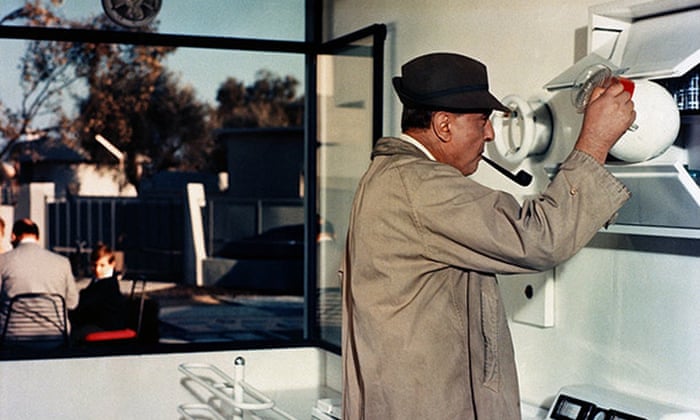
Jacques Tati became one of France’s best-loved film directors and actors with his bumbling character Monsieur Hulot. Here, we feature stills from some of his best-loved films [ . . . ]
See all pictures at: Comedy genius, Jacques Tati: France’s answer to Mr Bean – in pictures | French Film First | The Guardian
Juliette Binoche : Le film de sa vie
At the presentation of the French Cinema Award to Juliette Binoche on January 19, 2018, UniFrance offered the actress a short film that sums up thirty years of her outstanding career in France and abroad.
Why does Pope Francis want us to watch the movie “Babette’s Feast”?
Last night at Maison de Pas De Merde, we watched one of our favorite films Babette’s Feast, to celebrate Valentine’s Day. My wife Linda introduced me to this film some 25 years ago, and we both still love it.
This film is also a favorite of Pope Francis, to whom we also offer a Valentine’s Day kiss.
Read more about Francis’ admiration for Gabriel Axel’s masterpiece in this column from Aleteia
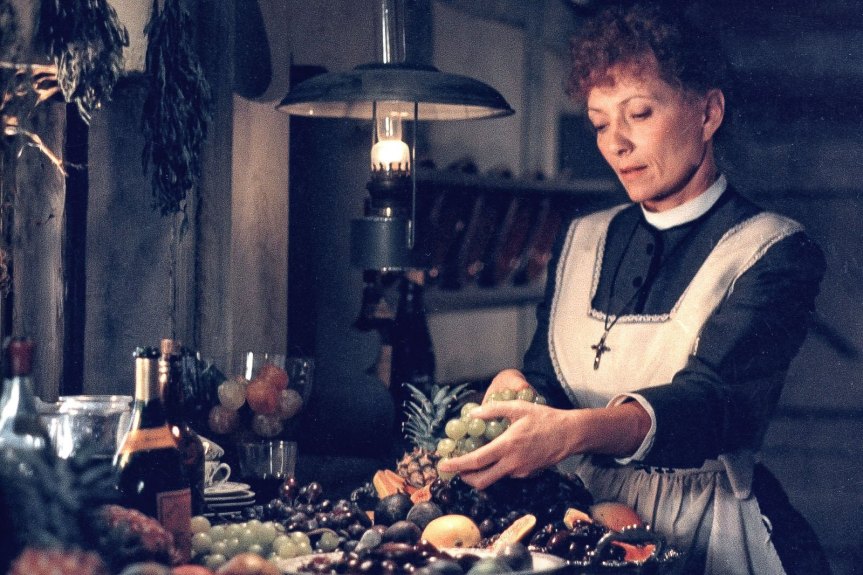
Babette prepares her feast
In a recent interview Pope Francis again brought up his favorite movie, the 1987 film Babette’s Feast. He mentioned the Danish film while speaking with Avvenire, bringing it up in response to questions about those who criticized his ecumenical endeavors. Pope Francis compared the rigid behavior of those opposed to his ecumenical outreach to the rigid townspeople portrayed in Babette’s Feast.
This is the not the first time Pope Francis has referenced his favorite film. He even referenced it in Amoris laetitia, making Babette’s Feast probably the first film ever to be mentioned in a papal document.
So why does Pope Francis love this movie so much and continue to recommend it? What are the spiritual lessons we can learn from this movie? Continue reading “Why does Pope Francis want us to watch the movie “Babette’s Feast”?”

