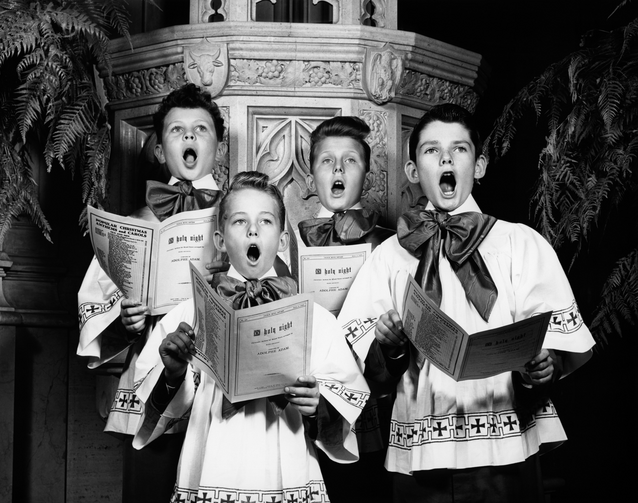
A brief history of ‘O Holy Night,’ the rousing Christmas hymn that garnered mixed reviews

“It might be a good thing to discard this piece whose popularity is becoming unhealthy,” one early critic wrote.

Twenty-six years ago, George W. Hunt, S.J., then editor in chief of America, wrote that “O Holy Night” was one of his favorites among Yuletide songs, modestly adding: “I’ve sung it countless times in choir (the dull second tenor part).”

Our fond memories of “O Holy Night” are closely associated with the familiar English words translated from the original French by the Unitarian minister John Sullivan Dwight. Former director of the school at the 19th-century Brook Farm commune in Massachusetts, Dwight witnessed the conversion to Catholicism of a number of his fellow commune members, including Isaac Hecker—later a Roman Catholic priest and founder of the Paulist Fathers, the first religious community of priests created in North America. Continue reading “A brief history of ‘O Holy Night,’ the rousing Christmas hymn that garnered mixed reviews”

WE are at war, yes!

By CharlElie COUTURE December 11, 2020

WE are at war, yes!

WE, the non essentials, WE, the useless, WE, the nothing, WE, the lights diving in the shadows, WE, the People of the Spirit and Culture,

WE, the restaurant owners, those of mouth pleasures and very short pleasure,

Yes, WE are at war,

WE, the show staff and technicians, theaters and cinemas, WE, the Actors and comedians put to forced arrest, WE, the Musicians, ALL of us who you consider to be sloths but only dream of working,

And all those of the night, this world that lives at night, that dark night that you associate with evil, that medieval fear that accompanies the night when the devil returns, that evil that grows when the sun has set,-now after 20 h -, this viral evil whose definition changes according to your moods, this invisible threat first defined as lethal, but whose danger is now considered in terms of ‘ case s’ (hence the suggestion to resort to massive tests to get impressive large numbers), with the intention of submitting an increasingly sceptical public opinion to be vaccinated as a matter of urgency, despite the ongoing pressure from the media, themselves under surveillance.

WE, whom you deal with an outrageous detachment,

Yes, WE are at war with YOU!

Against the Janus who repeats that he ′′ assumes “, he thinks he’s gifted with absolute super power of seduction, which allows him to spell and foolish all those he meets like a camelot, he the Little Prince so condescending to Screw of the People and the Middle Class,

Yes, yes. We are at war You

Against this orphéon of opportunistic subfives who improvise a cacophonic choir day-to-day, this ribambelle of cynical technocrats feigning to coldly ignore the drama that those concerned with these unexpected decisions,

YOU, whose lenifying and versatile speeches combine both ignorance and absurd,

Against YOU, whose inconsistencies flood us like acid rain on our forest of dreams,

Against your fake promises and announcement effects as a permanent bluff, claiming things one day, and the opposite the next day with the same Trumpist,

Against your inept fanfaronnades and your unannounced decisions,

Against your laws passed in Catimini,

We are at war yes!

Against billionaire mafias and other giants of Big Pharma,

Against your actual denial of climate threats to capricious consumption and pollution of unnecessary items distributed by the giant Amazon,

At war with an economy of cavalry and racing forward that ′′ invents ′′ virtual billions, and takes us in the short term towards the delusion of an unreal economy, like a dive into a bottomless well.

France is not serene, drowned in a kind of chaos and disgusting caused among others by overprotection of a repressive police and intestine disputes between illuminated specialists as unhealthy as street brawls between bands of alcoholic supporters.

France is not at peace with itself, when the same ones who denounced the laws of the caliphate imposing silence and veil, yes, the same have been banning in the same way for months both theatre, music, the museums, popular meetings (sporting or artistic), and then restaurants, happy and friendly party gatherings, and now Christmas with family and Silvestre…

Aware that the children in schools are learning to go crazy, yes, we are at war, a secret war, an internal war, yet still implosion, but the consequences will be serious.

We guess the rumbling anger and desperate people are ready to explode, ready to blow themselves up, suicidal.

A power so powerful is only by the people’s acceptance or refusal to obey.

From now on WE are at war yes,

To defend our right to continue living with dignity,

To defend our legitimate freedom and our right to think otherwise!

CharlElie Couture

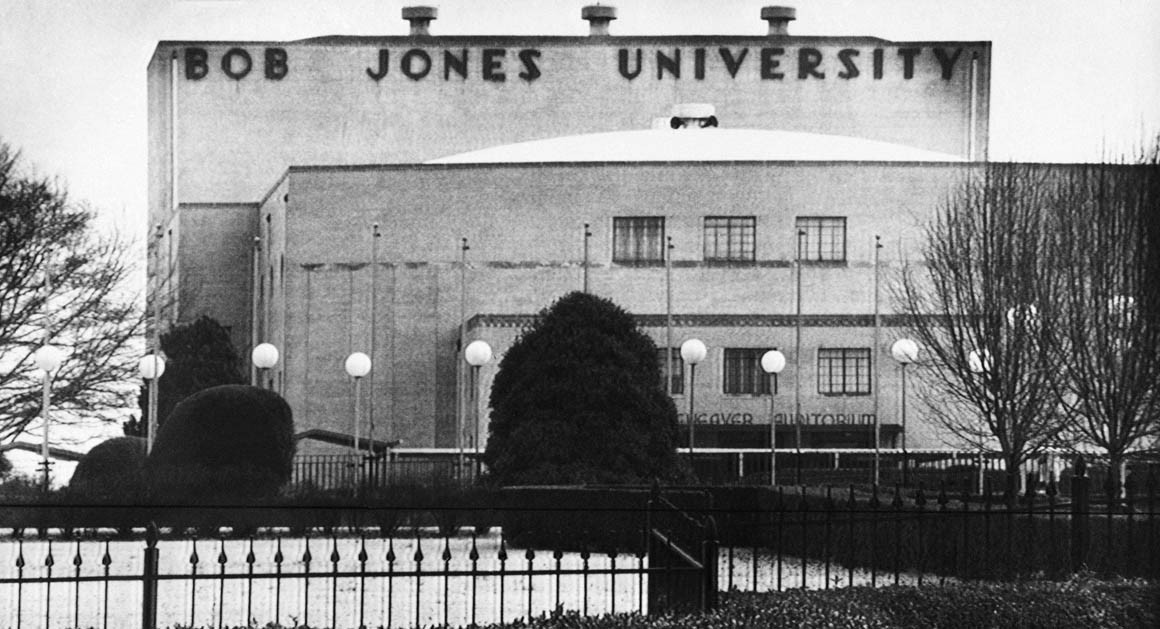
The Real Origins of the Religious Right

Bob Jones University

They’ll tell you it was abortion. Sorry, the historical record’s clear: It was segregation.

One of the most durable myths in recent history is that the religious right, the coalition of conservative evangelicals and fundamentalists, emerged as a political movement in response to the U.S. Supreme Court’s 1973 Roe v. Wade ruling legalizing abortion. The tale goes something like this: Evangelicals, who had been politically quiescent for decades, were so morally outraged by Roe that they resolved to organize in order to overturn it.

This myth of origins is oft repeated by the movement’s leaders. In his 2005 book, Jerry Falwell, the firebrand fundamentalist preacher, recounts his distress upon reading about the ruling in the Jan. 23, 1973, edition of the Lynchburg News: “I sat there staring at the Roe v. Wade story,” Falwell writes, “growing more and more fearful of the consequences of the Supreme Court’s act and wondering why so few voices had been raised against it.” Evangelicals, he decided, needed to organize.

Some of these anti- Roe crusaders even went so far as to call themselves “new abolitionists,” invoking their antebellum predecessors who had fought to eradicate slavery.

But the abortion myth quickly collapses under historical scrutiny. In fact, it wasn’t until 1979—a full six years after Roe—that evangelical leaders, at the behest of conservative activist Paul Weyrich, seized on abortion not for moral reasons, but as a rallying-cry to deny President Jimmy Carter a second term. Why? Because the anti-abortion crusade was more palatable than the religious right’s real motive: protecting segregated schools. So much for the new abolitionism.

***

Today, evangelicals make up the backbone of the pro-life movement, but it hasn’t always been so. Both before and for several years after Roe, evangelicals were overwhelmingly indifferent to the subject, which they considered a “Catholic issue.” In 1968, for instance, a symposium sponsored by the Christian Medical Society and Christianity Today, the flagship magazine of evangelicalism, refused to characterize abortion as sinful, citing “individual health, family welfare, and social responsibility” as justifications for ending a pregnancy. In 1971, delegates to the Southern Baptist Convention in St. Louis, Missouri, passed a resolution encouraging “Southern Baptists to work for legislation that will allow the possibility of abortion under such conditions as rape, incest, clear evidence of severe fetal deformity, and carefully ascertained evidence of the likelihood of damage to the emotional, mental, and physical health of the mother.” The convention, hardly a redoubt of liberal values, reaffirmed that position in 1974, one year after Roe, and again in 1976.

When the Roe decision was handed down, W. A. Criswell, the Southern Baptist Convention’s former president and pastor of First Baptist Church in Dallas, Texas—also one of the most famous fundamentalists of the 20th century—was pleased: “I have always felt that it was only after a child was born and had a life separate from its mother that it became an individual person,” he said, “and it has always, therefore, seemed to me that what is best for the mother and for the future should be allowed.”

Although a few evangelical voices, including Christianity Today magazine, mildly criticized the ruling, the overwhelming response was silence, even approval. Baptists, in particular, applauded the decision as an appropriate articulation of the division between church and state, between personal morality and state regulation of individual behavior. “Religious liberty, human equality and justice are advanced by the Supreme Court abortion decision,” wrote W. Barry Garrett of Baptist Press.

***

So what then were the real origins of the religious right? It turns out that the movement can trace its political roots back to a court ruling, but not Roe v. Wade.

In May 1969, a group of African-American parents in Holmes County, Mississippi, sued the Treasury Department to prevent three new whites-only K-12 private academies from securing full tax-exempt status, arguing that their discriminatory policies prevented them from being considered “charitable” institutions. The schools had been founded in the mid-1960s in response to the desegregation of public schools set in motion by the Brown v. Board of Education decision of 1954. In 1969, the first year of desegregation, the number of white students enrolled in public schools in Holmes County dropped from 771 to 28; the following year, that number fell to zero. Continue reading “The Real Origins of the Religious Right”

Pope Francis’ Covid message: We must let ourselves be touched by others’ pain.

Pope Francis is the head of the Catholic Church and the bishop of Rome

By Pope Francis

In this past year of change, my mind and heart have overflowed with people. People I think of and pray for, and sometimes cry with, people with names and faces, people who died without saying goodbye to those they loved, families in difficulty, even going hungry, because there’s no work.

Sometimes, when you think globally, you can be paralyzed: There are so many places of apparently ceaseless conflict; there’s so much suffering and need. I find it helps to focus on concrete situations: You see faces looking for life and love in the reality of each person, of each people. You see hope written in the story of every nation, glorious because it’s a story of daily struggle, of lives broken in self-sacrifice. So rather than overwhelm you, it invites you to ponder and to respond with hope.

These are moments in life that can be ripe for change and conversion. Each of us has had our own “stoppage,” or if we haven’t yet, we will someday: illness, the failure of a marriage or a business, some great disappointment or betrayal. As in the Covid-19 lockdown, those moments generate a tension, a crisis that reveals what is in our hearts.

Continue reading “Pope Francis’ Covid message: We must let ourselves be touched by others’ pain.”

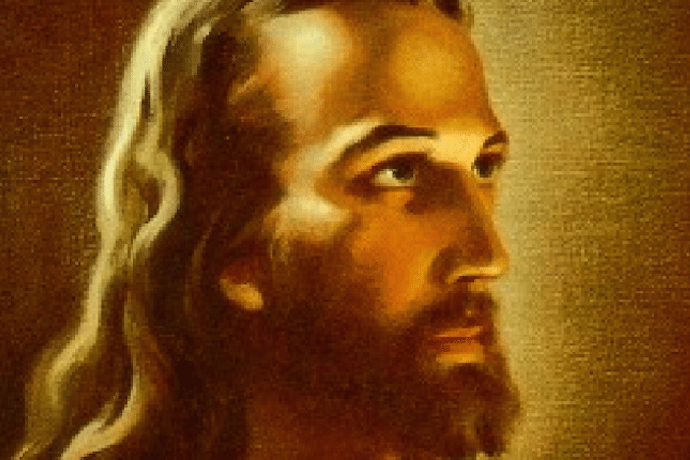
Conservative Evangelical Eric Metaxas, Doing Twitter Theology, Claims ‘Jesus Was White’

When Eric Metaxas tweeted that “Jesus was white” on Monday the small corner of Twitter in which Metaxas is sometimes a conversation piece erupted quickly, and with wild speculation. Is he looking for attention? Being provocative? No one actually believes that Jesus is white, do they? Surely Metaxas is smart enough to know that this claim is easily refuted. But, it appears that he didn’t misspeak; he said what he meant to say.
Continue reading “Conservative Evangelical Eric Metaxas, Doing Twitter Theology, Claims ‘Jesus Was White’”

Catholic Bishop Robert Barron speaks on “traditionalism”

What Is Your Opinion on Catholic Traditionalism? — Bishop Barron on Vatican II

Friends, I’m a traditionalist—I stand with Christian revelation and the entirety of the Church’s teaching, from the Council of Jerusalem through Nicaea, Chalcedon, and Trent. Since the Church’s tradition includes the Second Vatican Council, it’s therefore impossible to repudiate Vatican II and claim to be a faithful traditionalist. There’s nothing traditional about rejecting an ecumenical council. Watch this video for more:

– Bishop Robert Barron