U.S. bishops will cease refuge resettlement work with government after Trump funding freeze

Catholic Church

The U.S.C.C.B. said it would not renew its cooperative agreements with the federal government related to children’s services and refugee support after its longstanding partnerships with the government in those areas became “untenable.”

By Kate Scanlon

WASHINGTON (OSV News) — The U.S. Conference of Catholic Bishops said it would not renew its cooperative agreements with the federal government related to children’s services and refugee support after its longstanding partnerships with the federal government in those areas became “untenable.”

Earlier this year, the Trump administration suspended a federal refugee resettlement program as part of its broader effort to enforce its hardline immigration policies. The ensuing halt in federal funding for the USCCB’s refugee resettlement services is the subject of ongoing litigation, and it prompted the conference to lay off about a third of the staff in its Migration and Refugee Services Office in February.

A spokesperson for the USCCB told OSV News the bishops were seeking reimbursement of $24,336,858.26 for resettlement services (PRM and ORR programs) that was still pending payment as of April 7.

“This situation has been brought to us by the decisions of the government,” Anthony Granado, associate general secretary for policy and advocacy for the USCCB, told OSV News.

Despite decades of partnership with the USCCB’s Migration and Refugee Services, across administrations of both parties, including the first Trump administration, Granado said, “we’ve been placed in an untenable position now.”

“It is clear that the government has decided that it wishes to go about doing this in a different way that doesn’t include us, and so we were kind of forced into this position,” Granado said.

Archbishop Timothy P. Broglio, president of the USCCB and head of the U.S. Archdiocese for the Military Services, said in an April 7 statement it was “heartbreaking” to announce the bishops’ conference would not renew its “existing cooperative agreements with the federal government related to children’s services and refugee support.”

“This difficult decision follows the suspension by the government of our cooperative agreements to resettle refugees,” he said. “The decision to reduce these programs drastically forces us to reconsider the best way to serve the needs of our brothers and sisters seeking safe harbor from violence and persecution. As a national effort, we simply cannot sustain the work on our own at current levels or in current form.”

Citing the government’s suspension of the cooperative agreements to resettle refugees, Archbishop Broglio said that the conference has “been concerned with helping families who are fleeing war, violence, and oppression find safe and secure homes.”

“Over the years, partnerships with the federal government helped expand lifesaving programs, benefiting our sisters and brothers from many parts of the world,” Archbishop Broglio said. “All participants in these programs were welcomed by the U.S. government to come to the United States and underwent rigorous screening before their arrival. These are displaced souls who see in America a place of dreams and hope. Some assisted American efforts abroad at their own risk and more seek a place to worship and pray safely as they know God calls them.”

He said, “Our efforts were acts of pastoral care and charity, generously supported by the people of God when funds received from the government did not cover the full cost.”

Federal law requires that unaccompanied refugee minors be cared for, and the Department of Health and Human Services’ Office of Refugee Resettlement historically has turned to faith-based organizations, including the USCCB, to carry out this work.

A spokesperson for HHS did not immediately respond to a request for comment from OSV News about its cooperative agreement with the USCCB.

Granado said the conference’s cooperative agreements with the federal government were “really about people.”

“From the church’s perspective, this is about responding to the Gospel command — Jesus says in the Gospel, ‘I was a stranger and you welcomed me,’” he said, referencing Jesus Christ’s words in Matthew 25:35-40 regarding his final judgement. “This has been a blessing and a beautiful part of the USCCB and the Catholic Church in the United States.”

The children and refugees impacted “are real people, real families” as well as “the staff whose work will be impacted,” Granado said.

As the agreements end, Archbishop Broglio added, “we will work to identify alternative means of support for the people the federal government has already admitted to these programs. We ask your prayers for the many staff and refugees impacted.” The USCCB, Archbishop Broglio said, “will continue advocating for policy reforms that provide orderly, secure immigration processes, ensuring the safety of everyone in our communities.”

“We remain steadfast in our commitment to advocating on behalf of men, women, and children suffering the scourge of human trafficking,” he said. “For half a century, we have been willing partners in implementing the government’s refugee resettlement program. The Gospel’s call to do what we can for the least among us remains our guide. We ask you to join us in praying for God’s grace in finding new ways to bring hope where it is most needed.”

Source: U.S. bishops will cease refuge resettlement work with government after Trump funding freeze | America Magazine

Daily Meditations with Matthew Fox: Ways to Ground Oneself in Fierce Times of Apocalypse & Antichrist

Do not deny the darkness in you or the darkness of the times.  Denial is not a healthy response.  “God is the denial of denial.” (Eckhart)

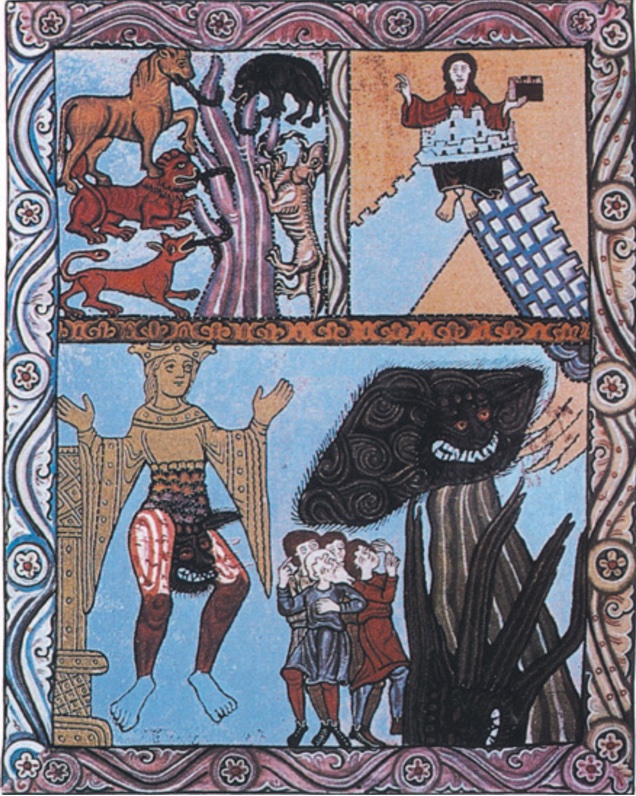
It is no secret that we are living in a time of apocalypse and antichrist.  Hildegard of Bingen painted such times as an unraveling of order.  But also how Christ arrives to challenge Evil and bring peace.

Thus, breakthroughs and revelations occur amidst the darkness.  “Apocalypse” also means “Revelation.”

How turn Apocalypse into Revelation?  How stay grounded during such fierce times?  I offer here some practices for surviving spiritually during times like these.

1.    Do not deny the darkness in you or the darkness of the times.  Denial is not a healthy response.  “God is the denial of denial.” (Eckhart)


Continue reading “Daily Meditations with Matthew Fox: Ways to Ground Oneself in Fierce Times of Apocalypse & Antichrist” →

Interview: Pope Francis’ presence at COP28 climate conference in Dubai is ‘without precedence’ 

By Gerard O’Connell

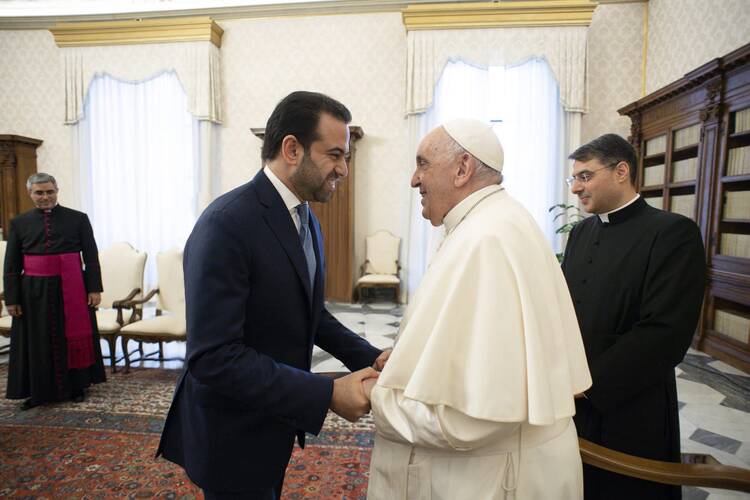
“The pope’s presence at COP28 will be a historic event and without precedence in the history of COP,” Judge Mohamed Abdel Salam, a chief architect of the visit, said in this exclusive interview with Gerard O’Connell.

Pope Francis will travel to Dubai, the most populated city of the United Arab Emirates, from Dec. 1 to Dec. 3 to participate in COP28, the U.N. Climate Change Conference. He will address the summit on Dec. 2, as will the grand imam of Al-Azhar and chairman of the Muslim Council of Elders, Ahmed Al-Tayeb. On the following day, Dec. 3, the pope and the grand imam will take part in the inauguration of the Faith Pavilion, the first-ever hub for interfaith programming and engagement at COP.

“The pope’s presence at COP28 will be a historic event and without precedence in the history of COP,” Judge Mohamed Abdel Salam, the secretary-general of the Muslim Council of Elders, told me in an exclusive interview by Zoom from the U.A.E. on Nov. 4. The judge has played a key role along with the leaders of the COP28 presidency, the United Nations Environment Program and the Holy See in bringing faith leaders to COP28

“His Holiness is one of the pivotal players at the international level and one of the prominent faith leaders dedicated to this issue of climate change,” the judge said. He recalled how Pope Francis “issued the encyclical on the care of our common home [“Laudato Si’”] in 2015, on the eve of the Paris conference on climate change, and on Oct. 4, on the eve of COP28, he issued an important update document on this same topic, ‘Laudate Deum.’” For all these reasons, he said, the pope was invited to COP28, an invitation Francis willingly accepted.

COP28 stands for the 28th Conference of the Parties and brings together the countries that signed on to the U.N. framework convention on climate change launched at the Rio conference in 1992. Today, 198 Parties (197 countries plus the European Union) have signed on to the convention. They come together, usually every year, to determine responsibilities and assess measures taken in the fight against climate change. COP21, held in Paris in 2015, led to the Paris Agreement, which mobilized international action to limit the global temperature increase to 1.5 degrees Celsius above pre-industrial levels and to adapt to the existing effects of climate change.

Source: Interview: Pope Francis’ presence at COP28 climate conference in Dubai is ‘without precedence’ | America Magazine

How can I reconcile the good and evil of Jean Vanier?

I can no longer in good conscience call Jean Vanier a saint, but I cannot accept the disturbing truth about him as proof, as some have understood it, that sanctity does not exist.

By Colleen Dulle

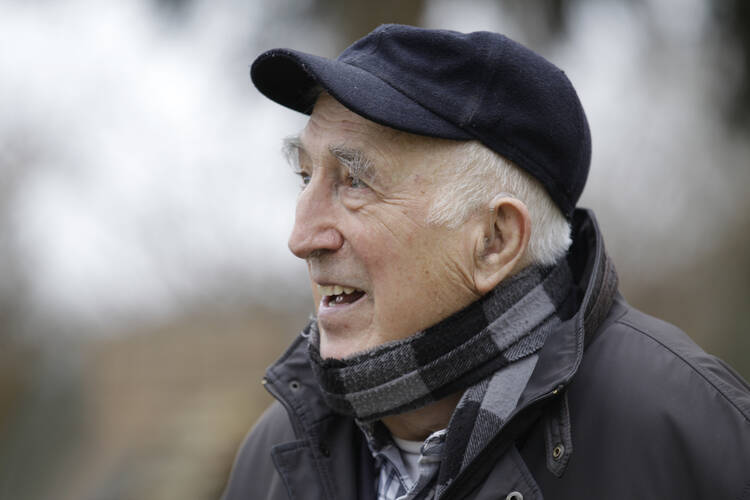
I keep a photo of Jean Vanier on my desk. It is painful to look at today.

I’ve written almost completely uncritically about the founder of L’Arche several times at America: I called him a “revered spiritual master and prophetic voice” whose messages “always bear repeating” in a review of his last book; I wrote America’s obituary of Vanier; I teared up on camera while talking with Tina Bovermann of L’Arche USA about Vanier’s life.

Now, L’Arche has released an internal report detailing credible allegations of sexual abuse against Vanier by six non-disabled women. The report says that Vanier initiated sex in the context of spiritual direction and offered “highly unusual spiritual or mystical explanations used to justify these behaviors.” This kind of behavior echoes the sexual abuse perpetrated by Vanier’s spiritual mentor, Father Thomas Philippe. The new L’Arche report also shows that Vanier lied about how much he had known about accusations against Father Philippe.

Ms. Bovermann, the L’Arche spokeswoman I interviewed just after Vanier’s death, spoke to my colleague Michael J. O’Loughlin about the abuse allegations against Vanier: “I can’t wrap my head around it,” she said.

Nor can I.

I don’t mean that I disbelieve the women who brought these accusations forward. The public excerpts of their testimonies were harrowing, and I trust the thoroughness of the third-party investigation. What I mean is that it is difficult for me to reconcile Vanier’s abuse with my long-held image of him as a saint.

I was introduced to Jean Vanier’s thought as a senior in college, when I was stressed about my impending graduation to “the real world.” Would I make enough money? Would I move up quickly in my career? Would people think well of me?

One night, I sat with my friend Katie, who had recently returned from a year at a L’Arche community in Ireland. In response to my anxieties, she asked if I’d ever heard of Jean Vanier. She explained to me his idea that, while society tells us we will only find happiness by climbing the ladder of wealth and prestige, true Christian happiness comes from climbing down the ladder, choosing to give up power and money in order to live in community and solidarity with the poor and outcast.

The idea was a revelation. I chewed over it for hours in my prayer and writing and tried to apply it, however poorly, in my decision-making. I deeply wanted the true happiness Vanier pointed to. I read his books and listened to his interviews slowly and meditatively and urged others to do the same. After he died, I hung a photo of him on my desk. Like many, I believed he was a saint.

Part of me wonders now if I was foolish, if I should have known better than to valorize any Catholic this way after watching Theodore McCarrick’s precipitous fall from grace in 2018 or even watching St. John Paul II’s record on sexual abuse be called into serious question after hearing the crowds chant “Santo Subito” in 2005. If such widely respected men could commit decades of abuse or turn a blind eye to allegations, why should I have believed Jean Vanier could not do the same?

I think of the women who had to endure the trauma of hearing a man who had sexually manipulated them be called a “living saint” when he was alive and as the world eulogized him. Although none of the women’s allegations were public until this morning, perhaps if those of us praising him had thought more critically about Vanier’s relationship with Father Philippe, we would at least have been more hesitant to canonize Vanier in our popular imagination.

This kind of critical thinking will be vital as those of us who admired Vanier struggle to reconcile the good he did with the abuse he perpetrated. It is difficult, but possible and necessary, to hold the truth of both Vanier’s good and evil at the same time. Holding these facts in tension both invites, as the leaders of L’Arche International wrote, “mourn[ing] a certain image we may have had of Jean” and raises important concerns about who holds power in the church, the ways that power can corrupt those who hold it and the disturbing links between spiritual and sexual abuse in so many similar cases in the church. L’Arche, especially, faces a long road ahead of reimagining its past and protecting against future abuses.

Mourning and grappling with the upsetting paradox of Jean Vanier has made me angry, but I am trying to resist letting it drive me to despair. I can no longer in good conscience call Jean Vanier a saint, nor will I hypothesize about any conversion he may have had before or after his death, but I cannot accept the disturbing truth about him as proof, as some have understood it, that sanctity does not exist. Rather, I think it challenges us to consider our own and others’ simultaneous capacity for profound goodness and evil, to seek models of holiness away from the world’s spotlight and to pursue holiness ourselves far from the spotlight, at the bottom of the ladder.

Source: How can I reconcile the good and evil of Jean Vanier? | America Magazine

Pope Benedict XVI’s secretary, advocate and confidant: What you need to know about Georg Gänswein

Archbishop Georg Gänswein is publishing a memoir of his years with Pope Benedict. But the archbishop is a compelling figure in and of himself.

By Jim McDermott

One of the central figures in the days surrounding Pope Benedict’s wake and funeral has been Archbishop Georg Gänswein, the pope’s longtime private secretary. It was Archbishop Gänswein who was at Benedict’s bedside when he died and reported that a nurse had heard Benedict say, “Jesus, I love you,” a few hours earlier; he also greeted mourners who came to visit Benedict’s body when it lay in state at St. Peter’s Basilica.

Later this week, he will be publishing a memoir of his years with Pope Benedict, Nothing But the Truth: My Life Beside Pope Benedict XVI. And while the book promises to tell the story of Benedict’s papacy from behind the scenes, Archbishop Gänswein is a compelling figure in and of himself. He has an amateur pilot’s license, loves the outdoors and plays tennis. As a young man he had long hair and listened to Cat Stevens and Pink Floyd. Working for Benedict, he aspired to be a “pane of glass,” allowing the “sunlight” of Benedict in without becoming visible himself. Yet his own good looks inspired fashion shows, magazine covers and stories around the world. After Benedict’s resignation, he worked simultaneously for both Benedict and Pope Francis in key positions, leading La Stampa to suggest he was “almost a ‘third pope.’” But in 2020, he was relieved of most of his Vatican duties after seeming to use Benedict to publicly undermine Francis.

Who is this paradoxical, controversial figure?

A childhood spent mining for meaning

Georg Gänswein was born in 1956 in a village in southwestern Germany. The oldest son of a blacksmith active in local politics, Gänswein saved for college by working as a mailman and dreamt of being a stockbroker. “My idea was that there was a lot of money being made and that you had to be bright and fast,” he told Süddeutsche Zeitung in 2007. But the more he considered that career, the more he wondered about what kind of meaning it would offer him. “I thought, O.K., if I can do all that and have money, what happens then?”

“Suddenly, existential questions took center stage,” he told the German magazine, leading him to the study of philosophy and theology. And the more he dug in, the more he came to believe that only as a priest could he fully enter into the deeper investigations of theology. “At some point I felt that I couldn’t drive at half speed, either I’d do it completely or I’d quit,” he said. “A little theology, that’s not possible. So, step by step, I approached the priesthood.” In 1976, he entered the seminary for the Archdiocese of Freiburg.

Gänswein: ‘The study of canon law felt to me as dry as working in a dusty quarry where there is no beer.’

After being ordained in 1984, Father Gänswein worked for a time as an associate pastor in his diocese before being assigned to get a doctorate in canon law at Ludwig Maximilian University of Munich. He initially hated it. “I had always studied gladly and easily,” he told Süddeutsche, “but the study of canon law felt to me as dry as working in a dusty quarry where there is no beer. You die of thirst.” With the help of a good director, he produced a dissertation in 1993 on the ecclesiology of the Second Vatican Council.

Father Gänswein’s predecessor, then-Archbishop Stanislaus Dziwisz, had warned him that his most important job was as the pope’s gatekeeper, and in the early going, Father Gänswein admitted that navigating “the countless requests for private audiences and other encounters” was difficult. But a more unexpected and complex challenge for Father Gänswein was the massive media attention that he found himself receiving.

Almost from the start of Benedict’s papacy, commentators made a point of remarking on Father Gänswein’s good looks.

Almost from the start of Benedict’s papacy, commentators and others made a point of remarking on Father Gänswein’s good looks. The Italian press dubbed him “Gorgeous Georg”; in 2007, fashion icon Donatella Versace used him as an inspiration for her 2007 Clergyman Collection. And his handsome features frequently became a focus of stories during papal visits.

In describing a papal visit to the United Kingdom, John Hooper at The Guardian describes Father Gänswein as “A tall, athletically built man wearing a broad pink sash over his priestly black garb…the pope’s good-looking private secretary, who will no doubt become one of the stars of the four-day visit.” That same year, the Irish author Colm Tóibín called Father Gänswein “remarkably handsome, a cross between George Clooney and Hugh Grant, but, in a way, more beautiful than either.” When consecrated bishop early in 2013, the Italian edition of Vanity Fair put him on the cover of their January 2013 issue, with the headline “Father Georg—it’s not a sin to be beautiful.”

Benedict’s papacy suffered through a number of significant controversies—his citation in a speech at Regensberg of a 14th-century emperor who argued that the only thing that the prophet Muhammad “brought that was new…[were] things evil and inhuman”; clergy sexual abuse scandals; and the Vatileaks scandal, which would reveal that the pope’s own butler had for years been stealing correspondence between Benedict and Father Gänswein and then sold some of it to the press, out of a concern that Benedict himself was being kept in the dark about “evil and corruption” in the church. And Father Gänswein was always at his side.In 2007, he called the Regensberg speech “prophetic” and the protests that ensued around the world “crude reactions.” In recent days, he has said that Benedict was the “father of transparency” and “the decisive figure” in matters of sexual abuse.

And in his new book he describes Benedict’s papacy as frequently attacked by the devil. In an excerpt from La Reppublica about the Vatileaks scandal, he writes, “It’s obvious, as Pope Francis would say, that the bad guy, the evil one, the devil doesn’t sleep.”

Pope Francis: divided and dividing loyalties

In December 2012, Father Gänswein was appointed the head of the papal household and appointed to the rank of archbishop. This brought with it an even larger role in the Vatican—responsibility for every public papal audience in Rome, papal visits with heads of state and bishops, any papal travel within Italy and care for many of the Vatican’s buildings. It seemed to signal an ever deeper trust on the part of Benedict.

But behind the scenes Father Gänswein had been privy to a secret that no one else yet knew: Benedict was planning to resign. Over the last week, Archbishop Gänswein has begun to reveal details of Benedict’s last few months and how he pleaded with Benedict not to resign. “Holy Father, it’s impossible,” he recalls telling the pope. But Benedict would not be swayed. “This is a decision I’ve made…it’s not a thesis to be discussed,” the late pope said.

For some, that cast Archbishop Gänswein’s promotion into a different light. John Cornwell wrote in Vanity Fair that the appointment was a way for Benedict to be able to remain informed on what was going on in the Vatican. “Since this was one of Benedict’s last big appointments before his resignation,” Mr. Cornwell notes, “it would be difficult for the new Pope to countermand it without seeming disrespectful.”

In his early years working with Francis, his opinion of him seemed generally positive.

As it turns out, upon his election Pope Francis decided not to live in the papal apartments or to hold his normal meetings there, but instead took a room at the Casa Santa Maria guest house. And while Archbishop Gänswein remained the head of the papal household after Benedict’s resignation, he moved with the pope to the converted monastery in the Vatican Gardens that served as Benedict’s retirement home.

In his early years working with Francis, his opinion of him seemed generally positive. In 2015, while noting “a degree of unpredictability in [Francis’] action…the surprises at the last moment that are never lacking,” Archbishop Gänswein praised Francis’ work ethic, saying: “He is an extraordinary phenomenon. He works for two, and is 78 years old.” He also praised his spiritual life; “the coherence between his very active life and the time he dedicates to prayer is impressive; it is a contemplative life.”

A year later, Gänswein gave a talk at the Pontifical Gregorian University in which he argued that Francis and Benedict represented a new vision of the papal office, “a de facto extended Petrine ministry—with an active member and a contemplative member.” When questioned about this, Francis corrected the idea, telling reporters, “There is only one pope.”

That moment captured well the apparent conflict within Father Gänswein in his new position. As Pope Benedict’s private secretary, Father Gänswein made it his mission to “be transparent as glass so as not to conceal Benedict XVI in any way.” He came to identify with Benedict so intimately that when meeting a writer critical of Pope Benedict, he said, “Oh, you don’t like us.” Now he was being asked to serve a new pope with his own vision while also being the main caretaker of the well-being and legacy of his predecessor.

Archbishop Gänswein has spoken critically of the pope’s Synod on Synodality, saying he believes the texts generated “will not be fruitful.”

In 2017, he read a letter from Benedict at the funeral of Cardinal Joachim Meisner, who had criticized Francis’ apostolic exhortation “Amoris Laetitia,” praising Cardinal Meisner’s faith “even if the boat [of Peter] has taken on so much water as to be on the verge of capsizing.” It was widely interpreted as an attack on Francis. Some wondered whether it and other moves like it truly came from Benedict at all. Just a year earlier, Benedict had reaffirmed “my obedience to my successor” and said he felt “a sense of deep communion and friendship” with Francis.

Speaking to the puzzling contradiction of this, David Gibson recently noted in Slate that Benedict “continued to write, to send letters. But how much of that was Gänswein? Especially in the last couple years, it’s hard to tell how much of that was Gänswein pulling the strings.”

In 2020, Cardinal Robert Sarah and Pope Benedict together put out a book pushing for clerical celibacy at exactly the time Francis was publicly considering the possibility of married clergy in discussions at the Amazon synod. When the publication of this book made waves, Archbishop Gänswein insisted Benedict was not a co-author; he had simply contributed a chapter to the book. But in fact, other than a preface and conclusion, the book had only two chapters, the first of which was by Benedict.

Almost immediately, Archbishop Gänswein vanished from public functions of the papal household. This was explained at the time as “due to an ordinary redistribution of the various commitments and duties of the prefect of the Papal Household.” Later Archbishop Gänswein revealed that Francis had effectively removed him from the job, asking him to devote all his energy to caring for Benedict, which Archbishop Gänswein said “pained” him and felt like a “punishment.”

In February 2022, Archbishop Gänswein spoke critically of the pope’s Synod on Synodality, saying he believes the texts generated “will not be fruitful,” and implied that the concept behind the synod was not Catholic. “If I want a different Church that is no longer based on revelation, so to speak, if I want a different structure of the Church that is no longer sacramental but pseudo-democratic, then I must also see that this has nothing to do with Catholic understanding, with Catholic ecclesiology, with the Catholic understanding of the Church.”

In his new book—advance copies of which began to be sent out just hours after Benedict’s funeral—Archbishop Gänswein seems ready to issue more criticism of Francis alongside defending Benedict’s legacy. He told the German paper Die Tagepost that Francis’ restrictions on the Latin Mass hit Pope Benedict “very hard”: “I think it broke Pope Benedict’s heart to read that motu proprio.” He also writes that Benedict did not agree with the way that Francis answered questions on abortion and homosexuality in his 2013 interview with La Civiltà Cattolica editor in chief Antonio Spadaro, S.J., and said that he himself was never able to achieve “a climate of trust” with Francis.

The theologian Massimo Faggioli said of Archbishop Gänswein’s decision to do a tell-all book and publish it within days of Benedict’s death “[at] the very minimum, it’s very bad taste.” Mr. Gibson, who has written a book about Pope Benedict, agrees: “He’s being incredibly divisive. But Benedict took a lot of flak, and he’s going to defend his man.”

Source: Pope Benedict XVI’s secretary, advocate and confidant: What you need to know about Georg Gänswein | America Magazine

Theologian Matthew Fox on Pope Benedict XVI’s complicated legacy

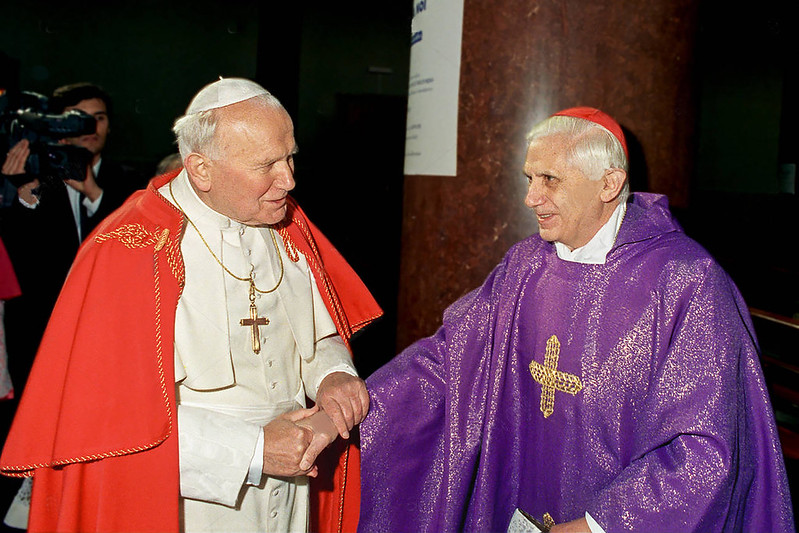
History will remember Pope John Paul II as the person who brought back the Inquisition and who handpicked Cardinal Ratzinger to be its chief Inquisitor as head of the Congregation of the Doctrine of Faith, CDF, formerly known as the Office of the Sacred Inquisition.

The name was changed after the Second Vatican Council under Pope Paul VI.  Though the Council had called for freedom of expression and opinions among theologians, all that came to an abrupt halt under JPII and Benedict XVI who as head of CDF and then as Pope Benedict XVI, managed to silence, suppress or expel 107 theologians from countries all around the world, myself included.

I list the names of these persons in my book on Ratzinger, The Pope’s War: Why Ratzinger’s Secret Crusade Has Imperiled the Church and How It Can Be Saved. 

As I know from my experience with him, Cardinal Ratzinger was a bully of the first order.  His brother, who was a priest in Germany, admitted to physically abusing boys in his choir though denied he was part of the sexual abuse of the boys that also occurred in that same choir.

NBC News’ Joshua Johnson and Boston Globe former Spotlight editor Walter Robinson discuss Benedict’s admission of presence at a 1980 meeting on priestly pedophilia.

Yale psychology professor Young Shin Kim, an expert on bullying, says 85% of bullying cases happen for the benefit of an audience.  That is clearly a big part of the raison d’etre for Benedict’s actions against Leonardo Boff in Brazil, Eugene Drewermann in Germany and myself in North America.  This same psychologist observes that “bullying is often used to maintain the social pecking order” and there was plenty of that going on in JP II and Benedict’s Vatican.

Criminologist William Black tells us that Bullies play a well known game.  Their strategy is to intimidate…They must be confronted….Bullies are cowards…Giving in to bullies guarantees that they will act ever more abusively…An adult who repeatedly gives in to a bully is a coward. 

Matthew Fox’s archival records, packed up to go to the University of Colorado. Photo by Matthew Fox.

When it comes to Ratzinger and myself, a big synchronicity occurred for me last Friday.  On the exact day that Cardinal Ratzinger died, I finished a major task of sorting my papers and loaded them up in a U Haul for shipping to the University of Colorado in Boulder, where they will be digitized and made available for future generations to study.

A relative of mine who is a practicing Catholic pointed out the special synchronicity of that day because a chunk of my papers (two boxes of 36) holds correspondence twixt Rome, my provincial and myself.  Also, thousands of letters of support written to the Vatican or to Dominican headquarters by Catholics and people of other and no faith traditions supporting my work.

That that journey happened on the same day that Pope Benedict’s soul took its journey is, well, surprisingly synchronistic.

Source: Pope Benedict XVI’s Legacy, continued – Daily Meditations with Matthew Fox