His figures capture the most universal of human emotions – passion, contemplation, despair. Auguste Rodin is known as the father of modern sculpture, an artist who managed to convey the drama of life in stone and in bronze. His talent and monumental works have been celebrated for a century now at the Rodin Museum in Paris. FRANCE 24 brings you a special programme on Rodin’s artistic legacy.
This week, France in Focus heads to the southern port city of Toulon, which is home to the French Navy’s main base. It was here on August 15, 1944, that the Allied invasion of southern France began. We take a closer look at just what happened and explore the various efforts being made today, 75 years later, to ensure the memory of those events lives on.
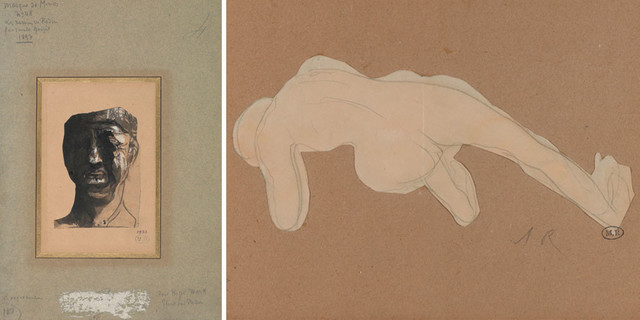
Rodin would it be a precursor of the papers glued, announcing the modernity of Matisse? A new facet of the work of the master of sculpture is to be discovered at the Musée Rodin: one realizes that all his life he cut figures, variations of his drawings that he glued, assembled, with a great freedom (until 24 February 2019).
Auguste Rodin (1840-1917) is a bit like Picasso, his inventiveness seems limitless and we always discover new aspects of his work. Beyond his drawings, full-fledged works that are not preparatory studies for his sculptures, Rodin has always cut and pasted figures.
The Musée Rodin retains some 7,500 drawings. “I have a great weakness for these little sheets of paper,” said Rodin. 250 are presented in the exhibition, including a hundred or so cut papers. “I have exposed almost all the paper cut, all that we have, and there is almost no outside (of the museum),” says Sophie Biass-Fabiani, heritage curator in charge of drawings at the museum Rodin and Commissioner of the [ . . . ]
Two hours north east of Paris is a famous battlefield. The defeated French leader was called Napoleon, but the battle was not Waterloo. It was Sedan, and lining up against the French, the Prussians. The defeated French leader was Napoleon’s nephew, le petit Napoleon, otherwise known as the emperor Napoleon III. This battle, in 1870, set up the dynamic that led to two world wars. | Audio
In the final Invention of France, Misha Glenny explores a crucial year for all western Europe. France was invaded, Paris bombarded, and Alsace occupied. January 18th 1871, a humiliating event – the proclamation of a new German empire, announced not in Germany but in the Palace of Versailles. Europe would never be the same.
With contributions from Thomas Kielinger, Jonathan Fenby, ambassador Sylvie Bermann, Andrew Hussey, Jeremy Black and Agnew Poirier. Plus contrubutions from Emile Zola’s novel, Le Debacle.
Police firing tear gas and water cannons clashed in Paris on Saturday with thousands of protesters angry over rising car fuel costs and President Emmanuel Macron’s economic policies, the second weekend of “yellow vest” protests across France.
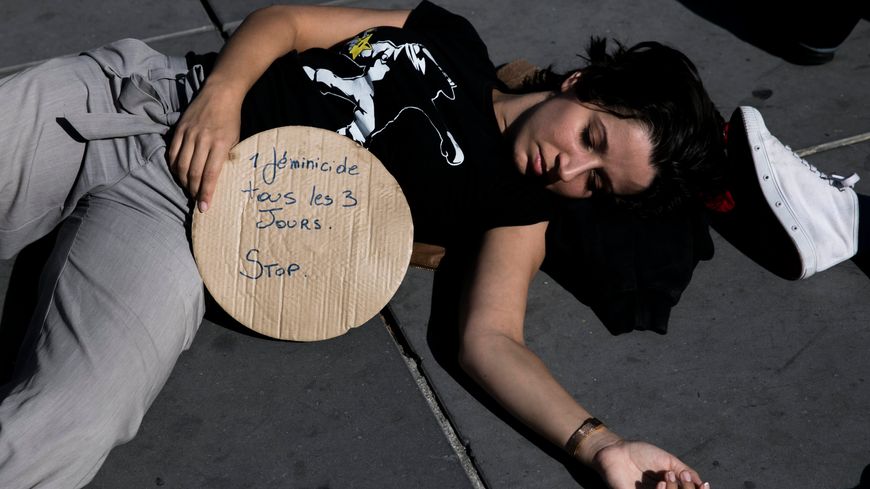
Des milliers de personnes sont attendues ce samedi dans une cinquantaine de villes en France pour dire “stop” aux violences contre les femmes. Un collectif citoyen est à l’origine de cet événement, soutenu par des célébrités, plus de 400 femmes journalistes et une centaine de syndicalistes
Thousands of people are expected this Saturday in fifty cities in France to say “stop” to violence against women. A citizen collective is behind this event, supported by celebrities, more than 400 women journalists and a hundred trade unionists.


 Pas De Merde