Bastille Day: How literary writings see the French Revolution

The storming of the Bastille prison on July 14, 1789, is seen as a defining event in the French Revolution. But how does the revolution affect writers, poets, painters and other creative minds?

By Mohammad Asim Siddiqui

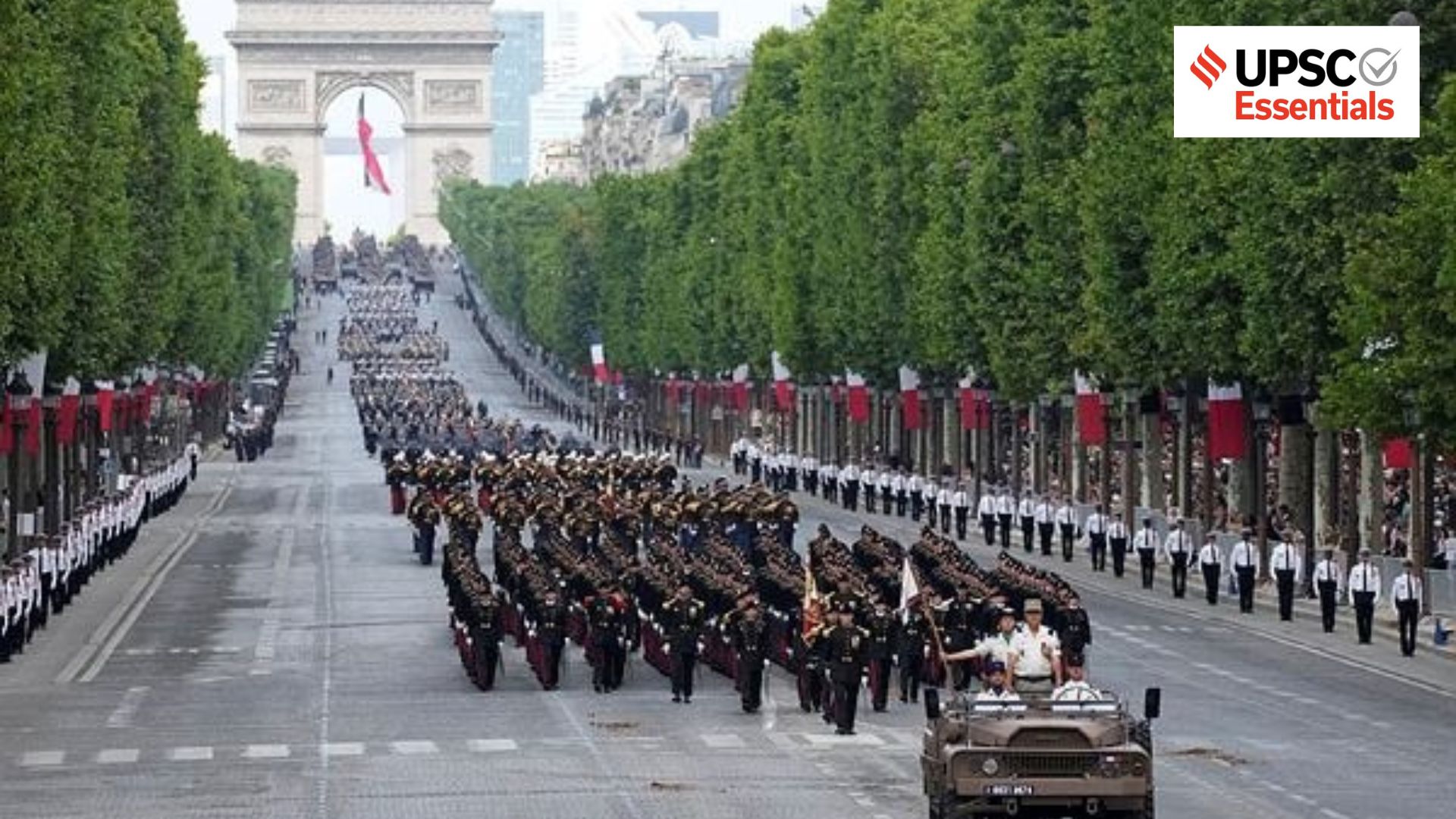
France celebrates Bastille Day to commemorate the storming of the Bastille prison on July 14, 1789, a defining event in the French Revolution. The Bastille was originally built as a castle in Paris in the 14th century to protect the city. But it was later used as a prison and came to symbolise the brute and arbitrary powers of the king.

The historiography of the French Revolution offers varied perspectives on the events, with some celebrating its revolutionary character and others highlighting the violence that accompanied it. For instance, British historian Eric Hobsbawm in Echoes of the Marseillaise: Two Centuries Look Back on the French Revolution (1990) focuses on the positive takeaways of the Revolution – Liberté, Égalité, Fraternité (liberty, equality and fraternity), the spirit of the Enlightenment, and the overthrow of aristocracy by the middle class.

He also laments many historians’ and writers’ emphasis on the violence and destruction associated with the Revolution. Hobsbawm considers historian Simon Schama’s bestselling book Citizens: A Chronicle of the French Revolution (1989), which highlights the violent nature of the Revolution through an engaging narrative. He sees it as part of a tradition in England established by Edmund Burke’s Reflections on the Revolution in France (1790), Charles Dickens’ A Tale of Two Cities (1859), and many other popular works.

But how do Romantic poets like William Blake, William Wordsworth, and P B Shelley depict the French Revolution? Why does Albert Elmer Hancock say that the French experience “humanised” Wordsworth? Why does Jane Austen deliberately avoid discussing directly the events of the French Revolution that so disturbed her world, but incorporate many of her responses to those events in her writing? Continue reading “Bastille Day: How literary writings see the French Revolution”

This is fascism

[Propaganda images by Trump supporter Jon McNaughton]

Fascism starts with talk, not tanks. With democratic elections, not a coup. And it takes hold thanks to people who think things won’t move quickly—until they do just that.

By Rosan Smits

Fascism starts with talk, not tanks. With democratic elections, not a coup. And it takes hold thanks to people who think things won’t move quickly—until they do just that.

On February 18, 2025, a video appeared on X. An officer from Enforcement and Removal Operations can be  The sky over the Seattle airport is overcast. Jet engines can be heard idling in the background.

Then: the clinking of chains. We see a blue plastic crate, filled with metal restraints. Someone lays them out on the tarmac—one set of cuffs per person. People are cuffed tightly, hands and feet. The camera shows no faces, only bodies and steel. The video ends with a shackled prisoner climbing the boarding stairs with difficulty, his restraints hitting against the metal steps.

The title of the post: “ASMR: Illegal Alien Deportation Flight 🔊”. The abbreviation is a jarring reference to the type of YouTube video that soothes and  Distant whispers, the rhythmic patter of raindrops, the rustling of leaves in the wind. And in this case, the sound of heavily chained men being deported.

Fascism is back. This time no swastikas, Nazi flags, or deadly bureaucracy, but MAGA hats, right-wing extremist memes, and a triumphant fist held high. No ghettos or concentration camps, but data-driven manhunts and “detention facilities” in El Salvador and Guantanamo Bay. No SS officers or brownshirts, but  and a Capitol mob.

It’s perfectly clear: the US president, Donald Trump, is putting together a fascist regime. And fast. Not only Trump’s   But what’s more, internationally renowned scholars—the indisputable experts when it comes to fascism—are now 

Their warnings still meet with resistance. For many, the label “fascism” is inextricably tied to the Holocaust and should be left in the past out of respect for the six million murdered Jews. Others see the term as exaggerated and alarmist: every fascist so far pales in comparison to Adolf Hitler. Accusing Trump of fascism, they feel, is like yelling “FIRE!” just because someone, somewhere has lit a small flame—a distraction from the very real challenges facing the United States.

And yet it’s precisely that resistance to using the word fascism that’s typical of how fascism works. Fascism thrives by playing down what was previously seen as extremist. And once that happens, any warnings get dismissed as overly alarmist.

Trump takes it to the next level: anyone who accuses him of being fascist  It’s a tried and true tactic to sap language of meaning: If everyone calls their adversaries “fascist,” the word loses its power to warn people about actual fascism.

Instead of continuing to debate whether or not Trump can be called a fascist, it’s better to understand why experts are alerting us. To do that, it’s essential we understand how fascism works, so we can recognize today’s variants, in the US and beyond.

The function of fascism

Fascism conjures up images of the death and destruction of the Third Reich, Benito Mussolini’s Blackshirts, Francisco Franco’s generals, or perhaps the white hoods of the Ku Klux Klan. When you think of fascism, you think of its most visible and extreme outgrowths. But while everyone has some idea of what fascism means, there’s no clear definition.

In order to recognize fascism as a wider phenomenon, we shouldn’t look to those visible extremes, says Professor Emeritus Robert Paxton, author of the seminal work The Anatomy of Fascism (2005). According to Paxton, we should look at what function fascism serves for politicians 

That function is strategic. Fascism is a way to take political grievance, shared by members of a dominant group in society, and mobilize it against some supposed “enemy,” often aided by a degree of societal breakdown during a time of crisis. It’s similar in that sense to sometimes called 

But where populist leaders stretch the ground rules of democracy, fascists take things further. They change the rules, seize absolute power, and destroy those seen as foes, using violence if need be.

Fueling this strategy is emotion, not some coherent set of ideological convictions. Ultranationalism and an unshakable belief in the “survival of the fittest” are always part of fascism, but aside from that, there’s no unifying story.

“A fascist just has to be a storyteller,”  The fascist’s words matter, in the sense that they must provoke rage. But what he says, and whether it’s true, matters a great deal less. The fascist simply has to “find a pulse and hold it.”

Continue reading “This is fascism”

The Call to Return the Statue of Liberty to France, Explained

Statue of Liberty

“The statue is yours, but what it embodies belongs to everyone,” said French politician Raphael Glucksmann in a sharp rebuke of Trump’s attacks on democracy.

By Isa Farfan

A call that could easily have gone unnoticed for the Statue of Liberty to be repatriated to France has generated a media swarm over the sculpture and sparked a war of words between a European Parliament member and the White House press secretary.

Raphaël Glucksmann, one of France’s 79 members of the European Parliament, called for Frédéric Auguste Bartholdi’s Statue of Liberty to be returned to its sender, citing President Trump’s allegiance to “tyrants” and gutting of scientific research institutions at a center-left convention on Sunday, March 16.

While it was a passing remark made at a French political event, the comment nonetheless found itself at White House Press Secretary Karoline Leavitt’s podium on Tuesday when a reporter asked her head-on whether the infamous gift would be returned.

So will the Statue of Liberty, which has sat in the New York Harbor since October 1886, be uprooted, dismantled, and shipped across the Atlantic back to France?

“Absolutely not,” Leavitt said. “My advice to that unnamed, low-level French politician would be to remind them it’s only because of the United States of America that the French are not speaking German right now, so they should be grateful to our great country.”

Responding to Leavitt’s jabs, Glucksmann posted a statement on X, in English, clarifying his calls for the “symbolic” repatriation of the statue.

“No one, of course, will come and steal the Statue of Liberty,” Glucksmann said. “The statue is yours, but what it embodies belongs to everyone. And if the free world no longer interests your government, then we will take up the torch, here in Europe.”

The statue, a fixture of the New York Harbor horizon, was conceived as a gift to commemorate the centennial of the Declaration of Independence and the abolition of slavery the year prior.

France dug into public funds to construct the statue and Americans fundraised to construct the foundational pedestal through benefit art exhibitions and auctions and a direct call for donations by Joseph Pulitzer in his newspaper, New York World. 

The American-funded pedestal is marked by a 1903 bronze plaque inscribed with Emma Lazarus’s 1883 sonnet “The New Colossus,” which imagines the “mighty woman with a torch” declaring: “Give me your tired, your poor, Your huddled masses yearning to breathe free … I lift my lamp beside the golden door!”

However, Glucksmann argues, the United States has strayed from the values the statue’s inscription purports.

“We are counting on you,” Glucksmann wrote.

Source: The Call to Return the Statue of Liberty to France, Explained

Macron and Le Pen to face off in crucial live TV election debate

Emmanuel Macron and Marine Le Pen

Far-right challenger out to avoid repeat of 2017 ‘failure’ in two-and-a-half hour clash with incumbent

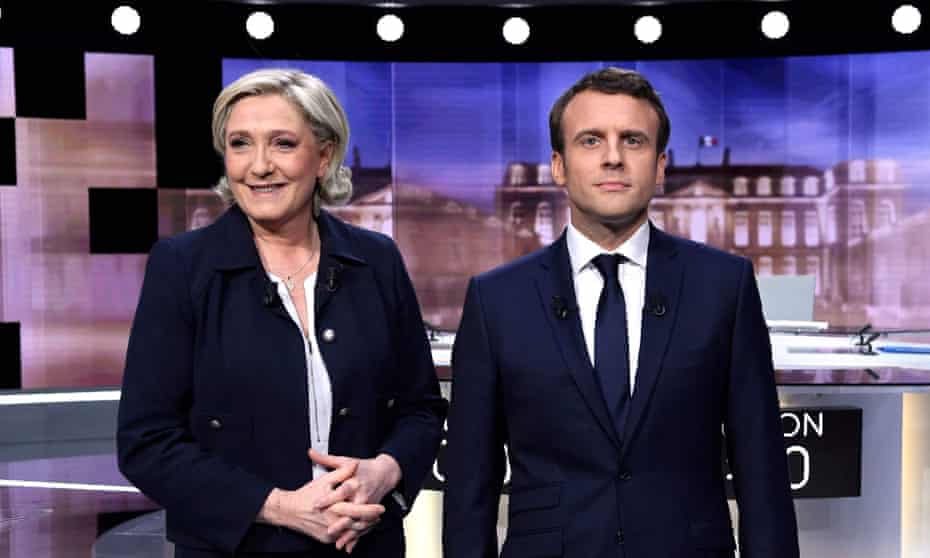
Emmanuel Macron and Marine Le Pen will go head to head in a live TV debate on Wednesday night that could prove crucial in making up the minds of undecided voters four days before the French presidential runoff.

The high-stakes, two-and-a-half-hour confrontation, the only direct clash between the two candidates, has been a tradition of French presidential campaigns since 1974, often confirming or dashing electoral ambitions.

With recent polls giving Macron a lead of up to 12 points before Sunday’s vote, Le Pen will be keen not to reproduce the poorly prepared, muddled and aggressive performance that sealed her eventual defeat in 2017  [ . . . ]

Continue at source: Macron and Le Pen to face off in crucial live TV election debate | French presidential election 2022 | The Guardian

Musician Tim Dup on upcoming French election

by Tim Dup (translated)

We don’t love it when artists talk about politics, do we? With this being said, we can often thank them for converting their sensitivity to the concrete photograph of a time, to put words, to make them speak, from within, what they look around. I was a little hesitated before writing something in that order. And I am sure, because I know you, that you will be able to do the part of things with my creation, the one you follow me for, but who is still inherently connected to what I will tell you.

Since September, we take the road, every week, to come and meet you. Thousands of miles, different people in every room. All generations. Big cities, mediums, villages, crazy hybridism. Metropolis, small territories, urban areas, countryside, connected or sometimes more isolated. After every concert, it’s an hour and a half of meetings, to a little bit of who we are. Before each concert, there are regular meetings, with colleges, centers, young people, associations, clubs, schools, conservatives, high schools, high schools, impaired public. And all this makes me think that I’m starting to know a bit what France really looks like. And that everywhere, we are great, connected, with the same needs, and often the same desires. We are not that original. Sure, we are different, single, but our lives are quite the same. Even if we don’t have the same chances, that things separate us, we want good for each other. When I look at you, this wonderful audience is everything. There are especially all ages, so I can’t help but think that behind our families, there is a consciousness of tomorrow, the transmission, what we leave, what we build. This sentence transmitted from age to age, that my grandfather told me and you know, is exactly the opposite of the desire. Plant flowers, others will pick them for you.

This is the starting point; I’m relating this sentence: humanity has less than three years to reverse the curve of greenhouse gas emissions, who are responsible for climate change, if it wants to preserve a world livable. It seems little concrete, vertical, very intangible. But yet there it is. A reality. What do we do about it?

If you too have doubt before Sunday, I believe that out of respect for the essence of our existence, living, a small key to voting is to turn to a program that does not take it lightly. And there are only two, such programs.

Regardless of what is in my sense, makes a peaceful society.

Weather. Education. Culture. Health. Sustainable economy. Wake up.

The dam of social sacking, excessive neoliberalism, sufficiency, on one hand; the reproach on oneself, the hatred on the other, the populist and demagogical denial of what the world and this country looks like today, on the other side.

The world’s chaos only tends to multiply, exacerbated by the climate crisis. Migrations, energy tensions, territorial, social crisis, international conflicts, insecurity… In the end, I don’t know much, fundamentally, nor specifically, about these. I receive them, weigh them, understand them, but I’m not an expert, naturally. I’m not looking to teach lessons, I’ll be unable to. The networks are full of noise of opinions, and I have one.

But it seems obvious to me, that the media issues of this election cannot be discussed anyway, if we do not know, at last, that the fight for the living under all the rest. So there you go, I guess the contents of these words are imperfect. But please let’s take a shot of humility and empathy for each other and those around us before this first round. Let’s think about our parents, especially our children. To our humanities, this is what it is about first, because the planet has to do with our existence, it will be fine without us. Giving yourself the right and the duty to care, in every way. A bulletin, a prosecutor’s office, it’s simple, and it’s from our source.

Some thought tips here, that helped me make a decision, because it’s not obvious either, we agree.

On adore pas quand les artistes parlent de politique, n’est-ce pas? Ceci dit, on peut les remercier, souvent, de convertir de leur sensibilité la photographie concrète d’une époque, de mettre des mots, de faire parler, par leur intérieur, de ce qu’ils regardent autour. J’ai un peu hésité avant d’écrire quelque chose de cet ordre là. Et je suis sûr, parce que je vous connais, que vous saurez faire la part des choses avec ma création, celle pour laquelle vous me suivez, mais qui pourtant est intrinsèquement liée à ce je vais vous dire.

Depuis septembre, nous prenons la route, chaque semaine, pour venir à votre rencontre. Des milliers de kilomètres, des gens différents dans chaque salle. Toutes les générations. Des grandes villes, des moyennes, des villages, une hybridité folle. Des métropoles, des petits territoires, des zones urbaines, de campagne, connectées ou parfois plus esseulées. Après chaque concert, c’est une heure et demi de rencontres, à palper un peu qui nous sommes. Avant chaque concert, c’est aussi régulièrement des rencontres, avec des collèges, des centres, des jeunes, des associations, des clubs, des écoles, des conservatoires, des lycées, des publics empêchés. Et tout ceci me permet de penser que je commence un peu à savoir à quoi ressemble vraiment la France. Et que partout, nous sommes formidables, en lien, avec les mêmes besoins, et souvent les mêmes envies. Nous ne sommes pas si originaux. Bien-sûr, nous sommes différents, singuliers, mais nos vies se ressemblent pas mal. Même si nous n’avons pas les mêmes chances, que des choses nous séparent, nous nous voulons du bien. Quand je vous regarde, ce public merveilleux, il y a de tout. Il y a surtout de tous les âges, alors je ne peux m’empêcher de penser que derrière nos familles, existe une conscience de demain, de la transmission, de ce qu’on laisse, ce qu’on construit. Cette phrase transmise d’âge en âge, que mon grand-père m’a dite et que vous connaissez, est à l’exact opposé du dérisoire. Plante des fleurs, les autres les cueilleront pour toi.

Voilà le point de départ; Je relis cette phrase en boucle : l’humanité dispose de moins de trois années pour inverser la courbe des émissions de gaz à effet de serre, principales responsables du changement climatique, si elle veut conserver un monde vivable. Ça paraît peu concret, vertigineux, bien intangible. Mais pourtant c’est là. Une réalité. Qu’en fait-on?

Si vous aussi le doute vous habite avant dimanche, je crois que par respect pour l’essence de nos existences, du vivant, une petite clé pour aller voter est de se tourner vers un programme qui ne prend pas cela à la légère. Et il n’y en a que deux, de tels programmes.

Sans compter ce qui à mon sens, fait société pérenne.

Climat. Éducation. Culture. Santé. Économie soutenable. Éveil.

Le barrage au saccage social, néolibéralisme à outrance, la suffisance, d’un côté; le repli sur soi, la haine de l’autre, le déni populiste et démagogique d’à quoi ressemble aujourd’hui le monde et ce pays, d’un autre côté.

Les désordres du monde ne tendent qu’à se multiplier, exacerbés par la crise climatique. Migrations, tensions énergétiques, territoriales, crise sociale, conflits internationaux, insécurité… Je ne connais finalement pas grand chose, fondamentalement, ni précisément, à ces sujets. Je les reçois, les pèse, les comprends, mais n’en suis pas expert, naturellement. Je ne cherche pas à donner de leçons, j’en serais incapable. Les réseaux se chargent du bruit des opinions, et j’en ai une.

Mais il me paraît évident, que les enjeux médiatisés de ces élections ne pourront de toute façon être discutés, si l’on ne saisit pas, enfin, que la lutte pour le vivant sous-tend tout le reste. Alors voilà, j’imagine que la teneur de ces mots est imparfaite. Mais s’il nous plaît, reprenons un shot d’humilité et d’empathie pour l’autre et ce qui nous entoure avant ce premier tour. Repensons à nos parents, et surtout à nos enfants. À nos humanités, c’est de ça dont il s’agit d’abord, car la planète n’a que faire de notre existence, elle s’en démerdera bien sans nous. Se donner le droit et le devoir de prendre soin, à tous les égards. Un bulletin, une procuration, c’est simple, et c’est de notre ressort.

Quelques pistes de réflexion ici, qui m’ont aidé à prendre une décision, car elle n’est pas évidente non plus, nous sommes d’accord.