Musicalarue in Luxey, the story of a village festival that has become a big festival

The 29th edition of the Musicalarue festival ends this Sunday, August 12th. Once again this year, the 700 inhabitants of the small village of Luxey (Landes) perpetuated a festive tradition started in the 60s. The village festival has become a festival that attracts more than 45,000 people attracted by the state of mind and by a poster that mixes Big Flow and Oli, Pierre Perret or Shaka Ponk.

Musicalarue is certainly one of the oldest festivals in France, one of the most convivial too. It all started in 1968. At the time, young people from Luxey (pronounced “Luxeille”!) Decided to organize a village party around August 15th which mixed music of all kinds, street shows and carnival parade.

“It’s a family!”

From one thread to another, the patronal feast became a festival in the 90s but without losing this spirit “great artistic country buffet” as François Garrain describes it. Today president of the association Musicalarue and director of the festival, he was part of the group of young people who launched this adventure. “Musicalarue is a different kind of party, with the live performance in high point and the meeting between all the generations,” he explains. “It’s a family” added Johanna Turpeau, one of the 150 volunteers mobilized for the festival. “Once we’ve done one, we all do it!”
/Watch video

Reportage: Mr. Vial / J.-C. Duclos / J. Michaan / E. Goldstein

Watch full concert: Camélia Jordana

Camélia Jordana a un credo : “prouver que l’on peut sortir d’une émission populaire et faire de la vraie musique”. Propulsée sur le devant de la scène grâce à La Nouvelle Star, la chanteuse a vite su s’entourer de la crème de la chanson française. Cette famille de coeur – composée notamment de Matthieu Boogaerts, Babx et Raphaële Lannadère – est à l’origine de Camélia, un premier album ayant charmé public et critique. Quelques années plus tard, elle nous ravie de nouveau avec Dans la peau, opus pour lequel Camélia s’est mise à l’écriture. Des chansons qui explorent les thèmes de l’amour et du voyage, où la voix de jeune femme change d’âge au grès des mots. Après avoir mis à l’épreuve ses talents de comédienne pour le grand et le petit écran, l’artiste a récemment brillé dans Mimi – une relecture de La Bohème de Puccini mise en musique par Frédéric Verrières et mise en scène par Guillaume Vincent. De quoi convaincre les plus récalcitrants.

Live at Vanves – Decembre 2014
00:00 Comment lui dire
04:56 Madi
10:09 La fuite
14:56 Brigitte dit vrai
19:27 Miramar
23:14 Illégale
27:10 Sarah sait
32:52 Dans la peau
37:23 A l’aveuglette
42:23 Moi c’est
46:25 Colonel chagrin
50:27 Ma gueule
55:36 Retrograde (James Blake cover)
59:23 Jeune homme
01:02:59 Berlin
01:06:50 J’aime l’orage

Jean Cocteau

Cocteau

Jean Maurice Eugène Clément Cocteau (5 July 1889 – 11 October 1963) was a French poet, writer, designer, playwright, artist and filmmaker. Cocteau is best known for his novel Les Enfants Terribles (1929), and the films The Blood of a Poet (1930), Les Parents Terribles (1948), Beauty and the Beast (1946) and Orpheus (1949).

His circle of associates, friends included Kenneth Anger, Pablo Picasso, Joan Miró, Salvador Dalí, Gertrude Stein, Jean Hugo, Jean Marais, Henri Bernstein, Yul Brynner, Marlene Dietrich, Coco Chanel, Erik Satie, Ernst Jünger, Albert Gleizes, Igor Stravinsky, Marie Laurencin, María Félix, Édith Piaf, Panama Al Brown, Colette, Jean Genet, and Raymond Radiguet. (Wikipedia)

Modigliani
Modigliani’s portrait of Cocteau 1916

Syrian anti-Assad May Skaf actress buried in Dourdan, suburbs of Paris

The actress May Skaf, one of the first Syrian artists to take a stand against the regime of Bashar al-Assad, who died at the age of 49 last weekend in the suburbs of Paris, was buried Friday in Dourdan (Essonne) to the south West of Paris.

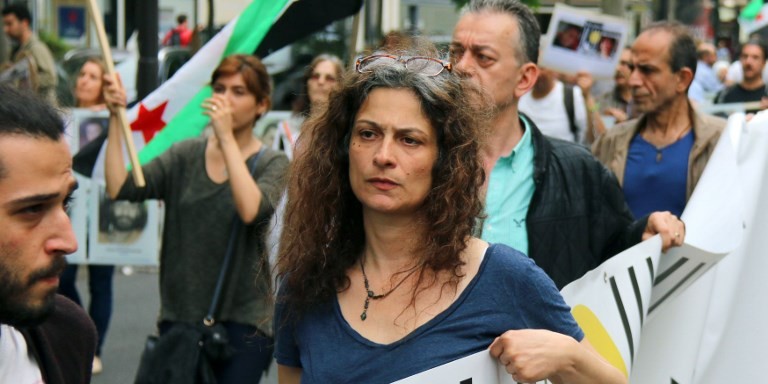
Five to six hundred people, including Syrian figures from the world of cinema and culture, attended the funeral Friday afternoon at the cemetery of the commune of Dourdan, where many flags of the Syrian opposition floated. The coffin of this famous artist, who had left her country after a brief detention in 2013, in Jordan, then in France where she lived with her son Jude al-Zoabi, was covered with the green-white-black flag with red stars. “It will be a temporary resting place (…) until we all enter our Syria, democratic, fair and free,” said Jude al-Zoabi a few days ago on Facebook.

“I’m sure May never imagined where her path would take her, she believed in her ideas and took the path that respects her principles, I do not know if she knew she would have to give up her artistic career and to his interests in Jordan, “he said in his eulogy.A whole woman”May has become a star because she refused the glory, she refused to make money and to work with people who exploit her,” he added. 

The actress was found dead in the night from Sunday to Monday at her home in Dourdan. His home was immediately sealed and an investigation opened, but the autopsy found a natural death, due to aneurysm, we learned from his relatives. 

May Skaf had been living in Dourdan since 2015, living in the city with his son, like several other Syrian refugees, according to Mayor Maryvonne Boquet.

Syria has been ravaged by war since 2011. More than 350,000 people have been killed since 2011 in this conflict, which has become more complex with the involvement of foreign countries and jihadist groups in a fragmented territory.

Source: Syrian anti-Assad May Skaf actress buried in Dourdan, suburbs of Paris