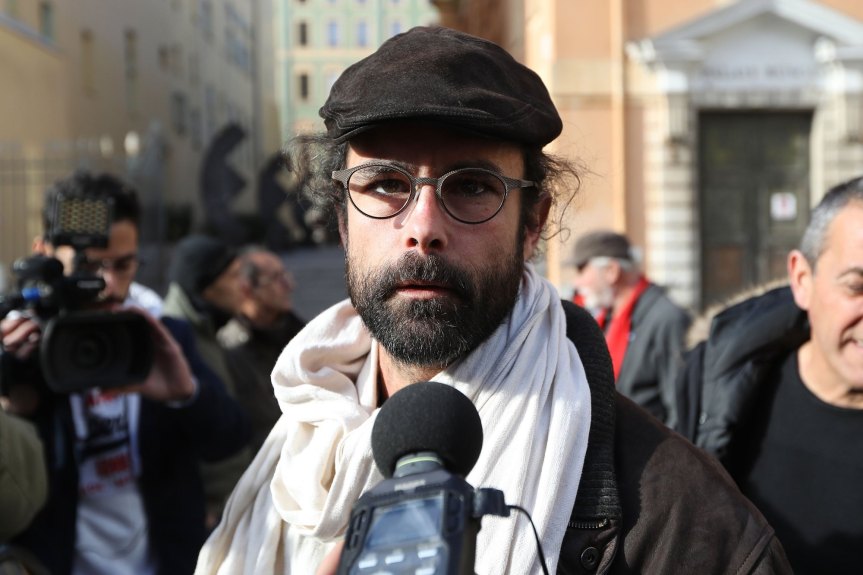
VENTIMIGLIA, Italy—Welcome to the sunny but chilly last stop on the Italian Riviera before you reach France. Rich tourists from across the border, who’ve been hanging out in Nice or Cannes or Monaco flock to the big street market here every Friday looking for cheap but chic Chinese-made jeans, leather goods and designer knockoffs.In the afternoon, they take the train or drive back with their treasures to glittering Monte Carlo or the Côte d’Azur resorts just 30 or 40 minutes away. Mostly they are oblivious to the so-called “mini Calais” of Syrian, Afghan and sub-Saharan African migrants that surrounded them here—not to mention an intricate underground network of smugglers, some working for free, some for profit between the borders. And they’re more apt to keep up with Monaco’s Prince Albert, Princess Charlene and their toddler twins than France’s new folk hero, a humble 37-year-old farmer named Cédric Herrou who lives in the rocky French hinterlands above Ventimiglia.But it’s Herrou who’s become a symbol of a new kind of anti-government resistance in France as the third year of mass migration across the Mediterranean to Europe begins.
“Paris is an ocean. Explore it, and you still won’t know its depths.” – Honoré de Balzac
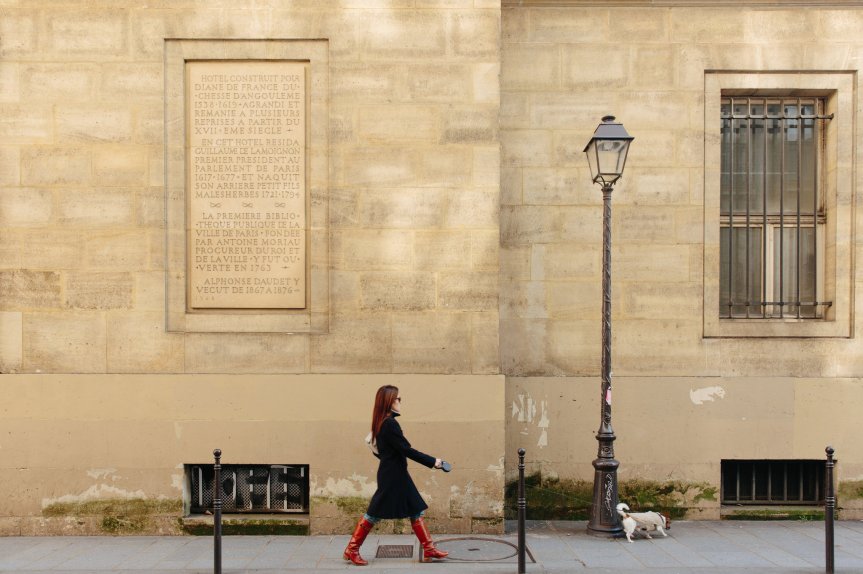
The streets of the Marais are narrow enough in some places that sunlight pierces the shadowy canyons between its soaring Renaissance-era buildings for just a few hours a day. At night the lanes take on a mysterious, medieval air when streetlamps sputter to life, casting a sheen on timeworn turrets, carved doors and stone mansions.
Slip into a cobbled alley off the Rue des Francs-Bourgeois, a main artery, and you’ll find yourself standing where the Duke of Orleans was assassinated in 1407 by a power-hungry rival’s henchmen. Around the corner, the magnificent 18th-century Hôtel de Soubise palace, home to France’s national archives, showcases the last, anguished letter written by Marie Antoinette, bidding “adieu” to her sister before heading to the guillotine.
Strolling amid the steep walls and angular slate roofs always transports me back to a bygone era — a storied past that vibrates beneath the ferment of the chic international crowds, designer boutiques, neo-bistrots, kosher delis and L.G.B.T. clubs.
Fifteen years ago, I was lucky enough to find a quaint apartment on a small rue in the central Marais. I’d just moved from Washington, D.C., to be the bureau chief for a financial news agency covering the birth of Europe’s new currency, the euro, which I would go on to write about for the former International Herald Tribune and The New York Times. In short order, that historic project burst into a Continentwide financial, social and political crisis, the aftershocks of which I continue to report about today. [ . . . ] Full Story
Marine Le Pen, France’s far-right presidential candidate, has formally launched a campaign echoing many of the themes that propelled Donald Trump to the White House
At the annual New Years Day celebration at Providence’s Casa DeLillo, we were delighted to see our old friend Stan, who once again entertained the revelers with piano renditions of Gershwin, Rogers & Hart and Hoagy Carmichael’s standards. While Linda and I helped drain several bottles of Monsieur Jim’s French wine, we all shaaangalong to Stan’s Tin Pan Alley tributes. Accompanied by Monsieur Jim playing his standup bass, Stan closed the evening this wonderful love song from the 1964 French film Umbrellas of Cherbourg. All of us recognized the Michel Legrand melody, but I noticed only our friend Anna who grew-up in Poland knew the words to the song, which she sang in English. Linda, Belkys and I (below, right to left) provided the applause.
More likely Anna learned the lyrics to “I Will Wait For You” from Euro-star Nana Mouskouri rather than Cher, both of whom recorded the song.
Mouskouri sang versions in English, French, German, Spanish, Italian and Japanese, while Cher sang only in Cherenglish – presumably with an exposed tummy on the record jacket. Mouskouri usually wore a simple blouse along with her signature Buddy Holly frames, and unlike Cher, she could perform without always turning her vocal dial to “11.” Check out Nana’s version dueting with composer Legrand below.
As well as Mouskouri and Cher, “I Will Wait For You” has been covered by iconic vocalists Frank Sinatra, Astrud Gilberto, Tony Bennett, and Vikki Carr, as well as instrumental versions from jazz greats Oscar Peterson, Gil Evans, Donald Byrd, and Louis Armstrong.
I’ve discovered that lyrical translations from French to English are problematic at best, but you can get the general je ne sais quoi of this song from this English verse:
My love I will wait for you all my life
Stay close to me, come back I’m begging you
I need you and I want to live for you
Oh my love don’t leave me
A bit desperate, “non?” Makes Dusty Springfield’s “You Don’t Have to Say You Love Me” sound like Alanis Morisette’s “You Oughta Know.”
American lyricist Norman Gimbel translated the lyrics, as he did with Toots Thielemans‘ jazz classic “Bluesette.” and Jobim’s bosso nova standard “The Girl from Ipanema.”
The film Umbrellas of Cherbourg (“Les Parapluies de Cherbourg”) was directed by Jacques Demy, starring Catherine Deneuve and Nino Castelnuovo.
The film was nominated for the Academy Award for “Best Foreign Language Film” and aslo “Best Song.”


 At the annual New Years Day celebration at Providence’s Casa DeLillo, we were delighted to see our old friend Stan, who once again entertained the revelers with piano renditions of Gershwin, Rogers & Hart and Hoagy Carmichael’s standards. While Linda and I helped drain several bottles of Monsieur Jim’s French wine, we all shaaang along to Stan’s Tin Pan Alley tributes. Accompanied by Monsieur Jim playing his standup bass, Stan closed the evening this wonderful love song from the 1964 French film Umbrellas of Cherbourg. All of us recognized the

