
France’s national scientific council is urging leaders to act now to counter the spread of the disease, which saw 10,000 new cases in a single day on Thursday. However, questions remains whether the French will be willing to heed new restrictions.
Category: covid-19
Paris Is About to Change

The city was hit hard by the pandemic, but French leaders know transformation is necessary.
The pandemic hit Paris hard. It hit poor Paris suburbs harder. Paris had already staked its future on merging with a wide ring of banlieue towns to form the new Metropolis of Grand Paris—an environmentally resilient 21st-century capital. But the coronavirus made clear how urgent that transformation really is.
Last year, more than 38 million people visited Paris. This summer, international travel bans sent hotel occupancy down 86 percent. The greater Paris metropolitan area has seen economic activity fall by more than 37 percent during the pandemic compared with the same period last year. In Île-de-France, the region that metropolitan Paris calls home, 100,000 jobs have been lost since mid-March.
The strict national lockdown from mid-March to mid-May did succeed in reducing infections, hospitalizations, and deaths. But after it was eased, the virus began to spread once more. Though current hospitalization rates remain manageable and death rates are relatively low, the number of new cases has risen alarmingly in recent weeks, with cases surging in the Paris metropolitan area. On August 27, Prime Minister Jean Castex declared 21 of France’s 101 administrative departments, including Paris and its neighboring departments, COVID-19 “red zones.”
Continue reading “Paris Is About to Change”
Marion Cotillard: It was a ‘relief’ being in lockdown

The ‘Inception’ actress really enjoyed staying home during the coronavirus pandemic as she felt ”really connected to the rest of the world”.
She said: ”I found this period very interesting. For everybody to be locked down, and for time to stop, I found something of a relief. I felt really connected to the rest of the world, and I think many human beings felt that way. No FOMO [fear of missing out] any more! But I also had a lot of thoughts about the world, about what’s going on socially and environmentally.”
And the 44-year-old actress recently visited Antarctica and admits she was ”disturbed” to find out there were less penguins and more plastic there.
She added: ”It’s definitely one of the most beautiful places I’ve seen in my life. It’s almost untouched; its energy is really fed by the fact that you can’t buy anything, you can’t sell anything. But we saw a decreasing population of penguins, and plastics in a place where no man goes, so that was very disturbing. The whole trip, from pole to pole, was to try to open the public’s eyes to what could happen if we don’t set rules for these places.”
Meanwhile, Marion also opened up about her childhood, admitting she was ”just fascinated by her parents’ life” as they were both actors too.
She told Harper’s Bazaar magazine: ”I was just fascinated by my parents’ life. There was a lot of energy in the house, and then I started to have my own experience of acting. Right away I felt it was something that was really strong in me. The first time was in a summer camp. I did this play at the end, and I felt something that shook me. I was playing an old housekeeper and the reaction of the audience, people laughing, and then coming up to me afterwards … That was the first time I felt it would be my life.”
Source: Marion Cotillard | Marion Cotillard: It was a ‘relief’ being in lockdown | Contactmusic.com
As Coronavirus Infections Rise, Masks In Paris Become Mandatory In All Public Places : Coronavirus Live Updates : NPR
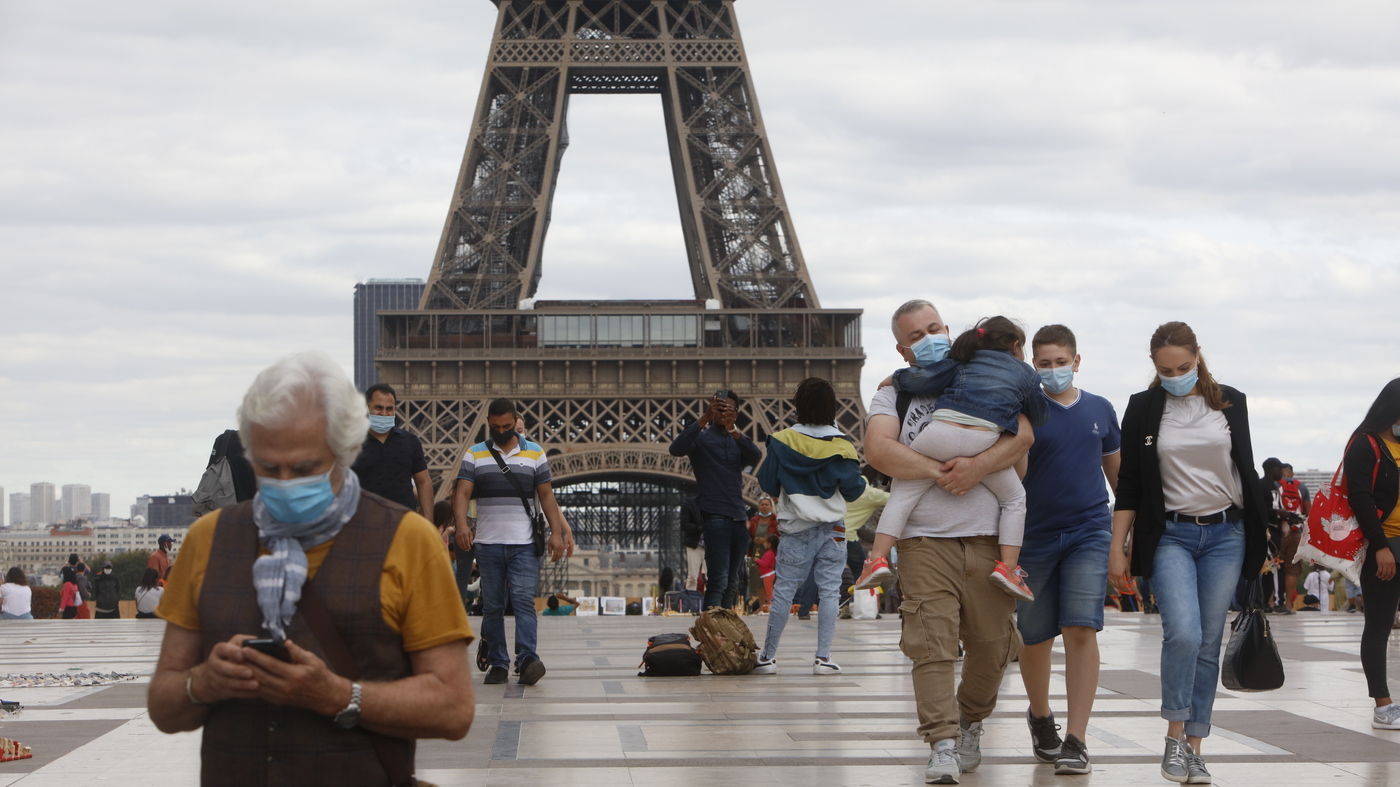
“We are in a period of epidemic growth,” Prime Minister Jean Castex said. “We want to do everything to avoid a new lockdown.” The order goes into effect Friday.
The French government announced Thursday that face masks will become mandatory everywhere in Paris and its suburbs, including all outdoor public spaces. The heightened mask requirement comes as the number of new COVID-19 cases in France jumped to more than 5,000 in the previous 24 hours — the highest increase since the country came out of lockdown in mid-May.
The order goes into effect at 8 a.m. Friday. The Paris region is one of 21 high-risk “red zones” in France. But until now, masks were largely mandatory only inside shops and on public transportation. People were not required to wear them outdoors, except at street markets and in certain densely packed areas. The new rule means that now cyclists and scooter users will have to mask up as well.
Prime Minister Jean Castex, speaking at a press conference Thursday morning, said France had reached a critical threshold of 50 infections per 100,000 residents, a red line.
“We are in a period of epidemic growth,” said Castex. “We want to do everything to avoid a new lockdown.” [ . . . ]
More at NPR: As Coronavirus Infections Rise, Masks In Paris Become Mandatory In All Public Places : Coronavirus Live Updates : NPR
Opinion | I’ve eaten at restaurants, gone to a mall and attended concerts. That is life in France

It’s time to follow Europe.
What France, like virtually all of Europe, has shown is that following standard expert recommendations for dealing with covid-19 works. France had a massive outbreak of covid-19 in the spring, almost as soon as anyone realized the novel coronavirus had reached Europe. The deaths began occurring late March and reached more than 24,000 by the end of April — a higher death rate than even the United States at the time.
But while the outbreak occurred primarily in only two parts of France, French President Emmanuel Macron imposed a severe, nationwide lockdown on March 16. And during that lockdown, the government put extensive testing and contact tracing in place. Almost exactly two months later, France mostly reopened. And for the last two and a half months, the country has functioned in a primarily open status with around 500 new cases per day and only about 450 deaths in the last month.
The French lockdown was severe. People were only allowed out, after filling out a form, to take care of elderly relatives or to go grocery shopping. To buffer the economic impact, the government directly paid a portion of salaries for those who could not work. And, voila, it worked.
I’m in France because I was farsighted enough to marry a French woman 30 years ago, who was farsighted enough to save our marriage license, which let me fly to France with her in early June to visit her elderly parents even as other Americans are barred. For two weeks, we kept to ourselves, speaking to my in-laws only across a garden. With an easy-to-get doctor’s prescription, we were also able to get tested for covid-19 at a parking lot drive-up with no wait and received (negative) results in two days (now down to one day for others).
France’s love affair with cinema tested by the virus
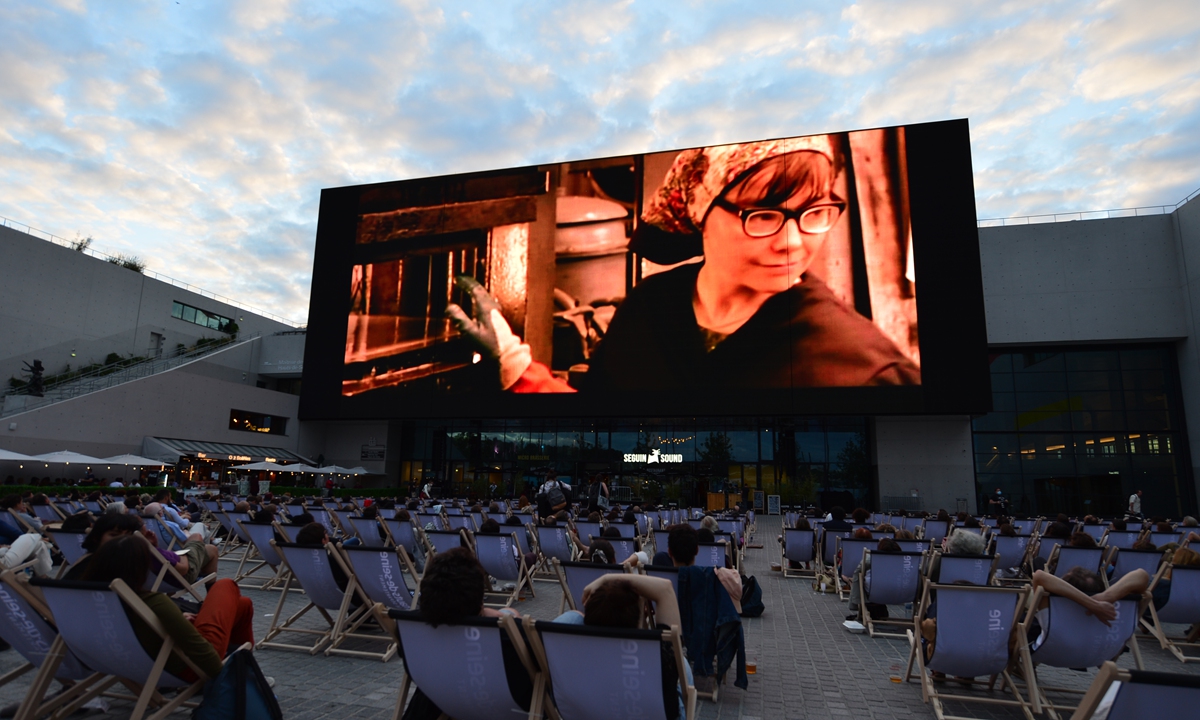
“I am sick of Netflix. I am sick of an algorithm serving me up the same old thing,” said Anne-Sophie Duchamp as she put on her face mask to enter an arthouse cinema on Paris’ Left Bank.
“We’ve been stuck at home for months” because of the lockdown, she added, as she bought her ticket to see British director Mike Leigh’s acerbic 1988 comedy, High Hopes.
“Why should I stay at home any longer when in Paris you can find a whole century of masterpieces showing in little cinemas every day.”
While cinema audiences across the world have been reluctant to venture back into the dark, not for the first time the French were seen as something of an exception.
As one of the most cinephile countries in the world, filmmakers and cinema owners have been counting on the French love affair with the silver screen to help save their skins.
Duchamp, who is in her 40s, insisted that going to a socially distanced cinema was “no more dangerous than going to the supermarket.”
A poll late in June just before cinemas reopened after an eight-week lockdown showed that 18.7 million people – almost a third of the population – planned to go to see a film in August.
Hollywood no-shows
But the reality has turned out to be rather more disappointing for cinemas, who are only allowed to be half full, with a free seat either side of each filmgoer.
With Hollywood delaying the release of blockbusters like Tom Cruise’s Top Gun 2 and Wonder Woman 1984 that would normally drive summer ticket sales, multiplexes in particular are suffering.
There was a further blow Thursday when Christopher Nolan’s spy drama Tenet was put back for a third time by Warner Brothers until August 12.
“It is much tougher than we imagined,” said Aurelie Delage, manager of the six-screen Cinemascop Megarama at Garat in western France.
It is so grim in fact that “I am not looking at figures,” she told AFP.
“This can’t last.”
Only small art house cinemas seemed to be bucking the trend, although there was some good news Wednesday as weekly admissions broke the 1 million mark for the first time since the end of the lockdown, helped by the success of the French comedy Divorce Club.
Encouraging as the 13 percent week-on-week rise was, it is still only a third of the business cinemas were doing this time in 2019.
“People have been stuck inside during the lockdown and now they want to be out in the air, on a bar or restaurant terrace when the weather is good,” Delage argued.
Yet the French have been far more enthusiastic than their neighbors, with German cinema entries down to just 17 percent of normal levels and the situation in Spain even more catastrophic at just 13 percent.
Chance for small films
Only the Dutch have been as phlegmatic, according to a study by Comscore.
This has given hope to independent filmmakers who see a chance of stepping into the gap, insisting that the public are hungry for new movies.
US director Michael Covino will release his cycling bromance The Climb, a big hit at 2019’s Cannes film festival, in France next week, having resisted the temptation to put it out on a streaming service.
“The best place to see a comedy is in a cinema with other people,” he said.
The clear run has also probably helped the black comedian Jean-Pascal Zadi’s broad satire Tout simplement noir (Very Simply Black) become a hit.
Some half a million people have flocked to see him take a hammer to racial stereotypes in a fortnight.
French actor-director Mathieu Kassovitz – who has a walk-on role in the comedy – is also going ahead with the 25th anniversary of the re-release of his classic, La Haine, with race and police violence once again in the spotlight.
Kassovitz is convinced there is pent-up demand “to go out to see films.”
“That is why there is a quite a lot of re-releases this summer to rekindle that desire,” he told AFP.
But what cinema owners across Europe really want, said Marc-Olivier Sebbag of the French Cinemas Federation, is for the big Hollywood studios to start releasing their new movies in Europe without waiting for cinemas on the other side of the Altantic to reopen.
“I hope we will be listened to,” he added.
In the meantime Hugo Benamozig, co-director of the French adventure flick send-up, Terrible Jungle, starring Catherine Deneuve, is gung-ho about its release next week.
If they waited till after the summer, “our film might be drowned” by the dam-bust of US blockbusters which have been held back by the coronavirus, he said.
Source: France’s love affair with cinema tested by the virus – Global Times
 Pas De Merde