
We’re at the Tate Modern in London for a preview of the exhibition “Modigliani” with the show’s curator, Nancy Ireson.
Category: Musée
Naked attraction: art and tragic tales in Modigliani’s Paris

As Tate Modern prepares a new exhibition of his work, including 12 of his famous nudes, Louise Roddon explores the artist’s haunts around Montmartre and Montparnasse
Poor Amedeo Modigliani, what a tough life he led. I’m thinking this as I climb the steps to his last studio in Montparnasse. It’s a classic artist’s garret with peeling paint and poor lighting, and climbing the countless floors on a narrow stone tread, leaves me winded. It wouldn’t have been easy for a man with advanced tuberculosis. With Tate Modern about to stage its Modigliani exhibition, I’ve come to number 8 Rue de la Grande-Chaumière, his final home before he died tragically young in 1920. At 35, he wasn’t just a victim of TB, but was suffering the toll of a lifetime’s enthusiasm for alcohol and drugs [ . . . ]
More: Naked attraction: art and tragic tales in Modigliani’s Paris
Chagall’s Romantic Love Story Leads Sotheby’s Impressionist Sale

There was an unmistakable disconnect at Sotheby’s auction Tuesday evening that reinforced the results at Christie’s the night before: despite a low-energy salesroom and few bidders on each lot, some people spent a lot of money on art.
Marc Chagall was the man of the night, with his “Les Amoureux” — depicting the artist in a loving embrace with his first wife, Bella Rosenfeld — which sold for $28.4 million with fees, a high for the artist, over a top estimate of $18 million. It went to a client bidding on the telephone represented by Irina Stepanova, head of Sotheby’s Moscow office [ . . . ] More at NYTimes
A good exhibition is a lesson for the look – Saint-Merry

The Center Georges Pompidou offers a great retrospective of a major photographer Walker Evans (1903-1975) who spent most of his life as a photographer interested in the vernacular, in everyday life, in urban banality. He examined the American soul through its roads, advertisements, ordinary buildings, cars, pedestrians, and so on. It has marked generations of photographers.And at the end of the exhibition, a splendid text that questions less our look than the pleasure to look and evokes the spring of the artist.In this malicious parallel between church and museum, a question and then an affirmation come to mind: “What did you go to see in the desert? ”
Matthew 11: 7-9. As they were going away, Jesus began to say to the crowd about John, “What have you gone to see in the wilderness?” A reed stirred by the wind? But what did you go to see? A man dressed in precious clothes? Behold, those who wear precious garments are in the houses of kings. What have you gone to see? A prophet? Yes, I tell you, and more than a prophet”
Can we establish a parallel between the prophet and the artist?
Troubled question around the see.
John Deuzemes.
[ . . . ] Original French Translation: A good exhibition is a lesson for the look – Saint-Merry
Marais and Cocteau: the whole universe of a mythical couple in 50 photos
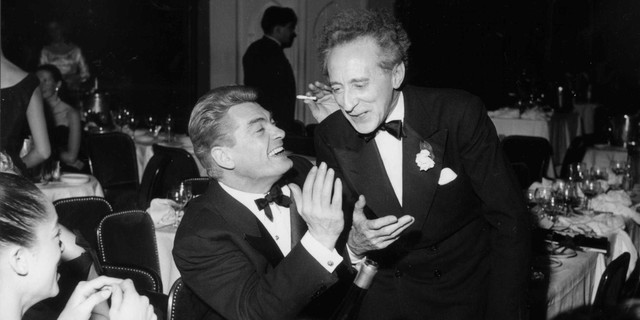
Until August 20, the hotel “Les Bories”, in Gordes in the Luberon, hosts the exhibition “Marais and Cocteau – Luck was at the rendezvous”.
A dive into the singular universe of the couple in 50 photos displayed in the gardens of this luxurious establishment, exceptionally open to the general public
Read More: Marais and Cocteau: the whole universe of a mythical couple in 50 photos
The clock atop Musée d’Orsay
Originally a railroad station built in 1810, The Musée d’Orsay was our destination for a Cezanne exhibit. The giant clock on the top floor restaurant is a work of art as well.
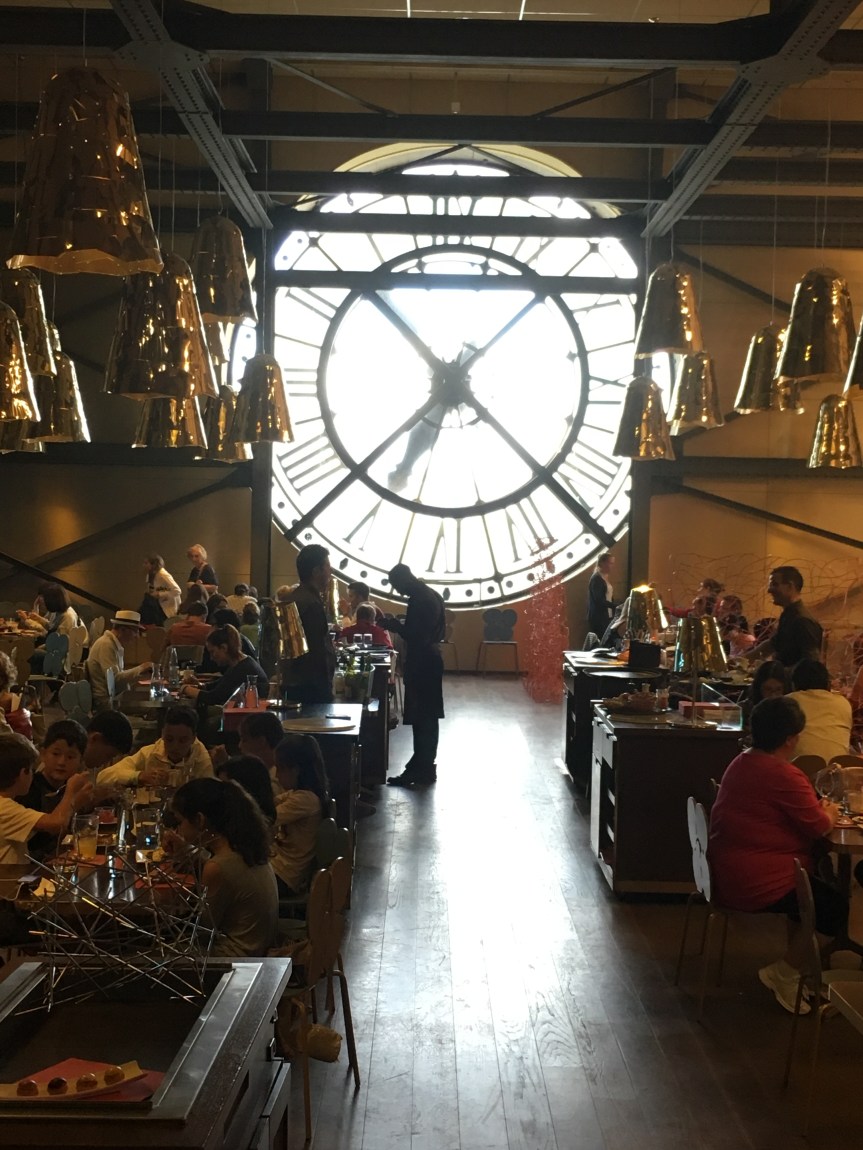
And what time does the clock say? Beaudelaire:
Always be drunk.
That’s it!
The great imperative!
In order not to feel
Time’s horrid fardel
bruise your shoulders,
grinding you into the earth,
Get drunk and stay that way.
On what?
On wine, poetry, virtue, whatever.
But get drunk.
And if you sometimes happen to wake up
on the porches of a palace,
in the green grass of a ditch,
in the dismal loneliness of your own room,
your drunkenness gone or disappearing,
ask the wind,
the wave,
the star,
the bird,
the clock,
ask everything that flees,
everything that groans
or rolls
or sings,
everything that speaks,
ask what time it is;
and the wind,
the wave,
the star,
the bird,
the clock
will answer you:
“Time to get drunk!
Don’t be martyred slaves of Time,
Get drunk!
Stay drunk!
On wine, virtue, poetry, whatever!”
 Pas De Merde