
Otto Preminger’s classic ushered in a new wave of vibrant, Technicolour film-making
By John Patterson
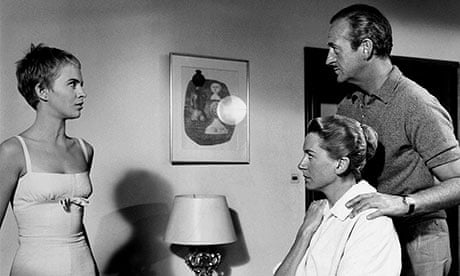
Renewed acquaintance with Otto Preminger’s Bonjour Tristesse, after 30 years, compels me now to re-rank it above Anatomy of a Murder as the Austrian exile’s supreme masterpiece. Based on Francoise Sagan’s scandalous novel about an enfant terrible and her forbidden games on the sun-drenched French Riviera, it offers the most compelling performance the brittle and tragic Jean Seberg ever gave; and it showcases all of Preminger’s virtuosity with CinemaScope framing and three-strip Technicolor.
Seberg is Cecile, half jaded sophisticate and seasoned casino denizen, half teenage naif and plotter, the over-indulged daughter of meretricious playboy Raymond (David Niven). Their emotional intimacy borders on the incestuous: they have “the perfect marriage,” says Raymond’s blowzy mistress Elsa, a remark humming with possibilities. The arrival of Raymond’s new lover, Anne (Deborah Kerr), who clearly sees herself as a replacement for Cecile’s dead mother, stirs up an intense and tragic sexual jealousy on Cecile’s part. Where this will all lead we can only imagine, but from the film’s wintry black-&-white framing sequences, set half a year after that Technicolor summer, we know it can’t be good (look out for the first, shocking dissolve to colour – it burns).
Preminger’s artistry came into full flower with the arrival of widescreen and blazing colour in the early fifties. His metier was always mise-en-scene over cutting, and the wide frame allowed him to depict his stories and relationships spatially, rather than through coercive editing – there are few full close-ups in Bonjour Tristesse. The arrival of Anne pushes Cecile out of the central space she has occupied so happily with her father, and suddenly, doorways, curtains and other visual obstructions exile her to the margins of the frame, her place cruelly usurped. In terms of colour, this is the war of the reds and the blues, their complex interplay telling us much about the strength or weakness of characters in any given moment; watch for Cecile, hungover in a blue shirt, a fiery red ice-bag on her sore, angry, scheming head. It’s amplified in the Mediterranean landscape of eternal, immovable red coastal rocks and the ever mutable blue seas and skies.
The casting hews closely to the performers’ abilities and personalities: Niven rakish and inch-deep, Kerr prim and wide-eyed, burning with suppressed sexual hunger, and Seberg the scorned child-woman, still recognisably the Iowa high-schoolgirl she’d been a year earlier, but also now a movie star and new-minted faux-Parisienne sophisticate – her thespian shortcomings, hesitancy and natural Midwestern diffidence all become advantages here. She’s magnificent – and her short-cropped bob foretells Mia by Sassoon in Rosemary’s Baby a decade later.
America hated Bonjour Tristesse, but the French went crazy for it. It’s a key wellspring-movie of the French New Wave – it gave Godard his iconic Patricia for Breathless and a visual scheme for Contempt; Rivette was an aficionado, and Truffaut an almost rabid fan – he originally wanted Seberg for Day for Night.
As usual, the French were right.
Source (Aug 2013): Seduced by Bonjour Tristesse | Film | The Guardian
 Pas De Merde