Godard’s 60s: Les Carabiniers

Geneviève Galéa

A major contradiction of Jean-Luc Godard’s 60s films is that for all their difficulty, abrasiveness, unconventionality, and “distance,” they are largely pleasurable works. We routinely speak of Godard’s subversive tendency, but until he went full-on Maoist and created the militant cinematic Dziga Vertov group with Jean-Pierre Gorin, even his most out-there films—including Marxism media primer Le Gai savoir and One Plus One, a Rolling Stones studio session interrupted by revolutionary vignettes (both from 1968)—contain some kind of sexy fun by way of either radical chic or the near constant “playful” reinvention of cinema, even when in the form of a visual or narrative assault on the audience, and even when Anna Karina isn’t on screen. Just look at the commercial recuperation of anti-commercial Weekend (67), a film in which Godard went far out of his way to completely alienate his audience. Somehow rotten bourgeois protagonists, a reel-long single take traffic jam of blaring horns and mangled corpses, and a cannibalistic denouement weren’t enough, because if you hated it you were just as square as the film’s irredeemable anti-heroes. The film gained immediate supporters and is a “classic” to this day, an irony so ironic that I need go no further in explaining it.

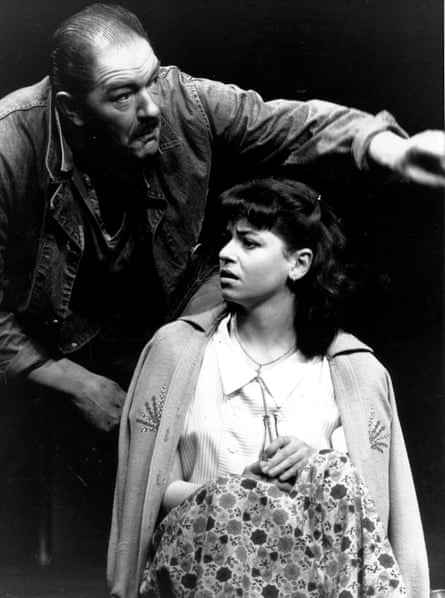
Though it doesn’t mean his other films are compromises or failures (certainly not!), only two or three of Godard’s 60s films escape this trap; among them perhaps the most significant and ripe for reevaluation is Les Carabiniers (1963). Universally trashed by critics and audiences alike upon its release, Les Carabiniers still hasn’t been successfully rescued or rediscovered in recent years. What caused it to be so rejected then and forgotten now? For starters, the film is true to itself. Its subject is the ugly, violent, and wastefully stupid collective “mobilization” known as war, and the film enacts—relentlessly, absurdly, bitterly—that ugliness, that violence, that wasteful stupidity. Unlike virtually every other war movie, even every anti-war movie, Les Carabiniers refuses to pull punches by offering courageous heroism, thrilling action, or manipulative emotionality to offset war’s suffering and horror. This is not because the film is particularly violent or graphic, but because everything about it is off-putting, from its characters, two troglodytic dolts named Michel-Ange and Ulysse (Patrice Moullet and Marino Masé), forced to go to battle by order of the King, and their shallow, materialistic wives Venus and Cleopatre (Genevieve Galea and Catherine Ribeiro); to the unceasing parade of cowardly, graceless skirmishes that often end in systematic slaughter or disgusting, juvenile violation (nearly all the women in the film have their skirts lifted up by soldiers with their guns); to the film’s overall look, over-processed black and white that comes out as a drab, desolate palette of grays, grays, and grays, rendering the barren, wintry landscapes of ruined rural cottages and personality-less apartment complexes all the more drearily depressing.

Les Carabiniers is a satiric fable in the aggressive tradition of Alfred Jarry (Ubu Roi is its obvious point of reference)—following through on its opening Borges quotation, everything in the film has been simplified (but not abstracted) for maximum bluntness. The miserable characters shout at each other in monosyllabic grunts (a typical exchange: “Shit!” “Why?” “Because”), and it’s not a coincidence that the only one who speaks out against the mindlessness of war is also the only one who speaks in Godard’s patented language of complex allusion. Michel-Ange and Ulysse look forward to and then enjoy their military service because of the boundless plunder promised them (“Hawaiian guitars, elephants”), and their unfeeling brutality comes through not only in the atrocities they commit, but in their banal descriptions of the atrocities in their postcards home, which Godard took from actual war-time correspondences: “A lot of blood and corpses . . . We kiss you tenderly.” Godard in turn depicts Michel-Ange and Ulysse’s tragic misadventures as banally as possible. Long takes are employed for demoralizing, drudging marches through forests that end in mass execution—the climax of these marches are as dryly portrayed as the long walks to them. Actual documentary war footage counterpoints Godard’s documentary-style fictional events, and here’s where Les Carabiniers becomes an extremely important moment in the demystification of the war movie, and the movies themselves. Godard accomplishes this by calling attention to the unreality of representations of war, be they documentary or fictional. On the micro level he painstakingly and accurately matches sound effects with their specific sources (“we never had a Heinkel roar for a Spitfire,” he explained in his first and only retort to critics after the film’s disastrous reception), but then cuts these noises in and out of the mix so abruptly and artificially that they can’t help but be noticed as separate images and sounds. Brecht is, as usual, the presiding spirit of Godard’s strategies. The characters are cinematic constructs and not “real” people or soldiers—all unknown actors, Moullet and Masé possess the odd physical exaggerations of a silent era comedy duo (the former a bizarre, freakish bumpkin boy, the latter a cigar-smoking, unshaven lug), while Galea and Ribeiro’s pancaked makeup and overdone lipstick make them ghostly, childlike apparitions straight out of a Griffith two-reeler.

As such, Les Carabiniers’ fable-like characters are images of images. But more than that, their understanding of the world is a misunderstanding of images. Michel-Ange attends his first movie and tears down the screen pawing at the naked woman in a bathtub projected there. Later he and Venus place two-page magazine ads for bras and men’s underwear over their own anatomies. And in what is the film’s most notorious sequence, Michel-Ange and Ulysse unpack a briefcase containing their spoils of war, categorized postcards of monuments, natural wonders, animals, paintings, and women they take to be deeds for the real things. The scene goes on for more than ten minutes, an appropriately exhausting metaphor for the bottomless commodization of life by societies and individuals ready to abstract the world into a collection of conquerable objects. The last commodity, of course, is war itself, which is why Godard refuses to make his film just one more palatable illustration of war. If we think of the world as images, then people are merely images, and therefore disposable; if we think of images as images, and not reality, we set our priorities straight; and, with respect to the influence of images and the reality they pretend, if we make our images bullshit-free maybe we can begin to look at the world they represent without the corrosive illusions that keep us in their potentially infantilizing, desensitizing power.

Source: Godard’s 60s: Les Carabiniers

Best films of 2023 in the UK: No 7 – “Saint Omer”

Alice Diop’s award-winning courtroom drama doubles as an unsentimental study in empathy with one of the year’s most mesmerising performances

By Guy Lodge

At this year’s Venice film festival, Alice Diop’s unblinking stunner Saint Omer was handed the prize for best debut film – a reward that would have seemed inadequate if it hadn’t shortly afterwards taken the grand prix in the main competition, and inaccurate under any circumstances. Diop’s film is only a debut if you’re happy to disregard documentary as a lesser branch of cinema that somehow doesn’t count; as her first dramatic feature, Saint Omer merely extends the clear-eyed gaze and burning social interest of her non-fiction work into new narrative terrain, with nary a tremor of uncertainty. Films like We showed Diop has form in braiding truth, storytelling and intense human scrutiny; Saint Omer isn’t so very different.

The surprise is that Diop’s entry into fiction takes the form of a courtroom drama, among the most rigidly procedural and rule-bound genres in the medium – only to strip it of its expected structures and rhythms, centring disordered interior feeling amid unyielding legal process. The case, drawn from a real-life 2016 headline-maker in France, is stark and horrifying: legally straightforward, perhaps, but psychologically tumultuous. Young Senegalese Frenchwoman Laurence Coly (Guslagie Malanda, often scarcely moving a muscle while giving one of the year’s most mesmerising performances) is accused of murdering her infant daughter. She doesn’t deny the act, but claims sorcery was to blame, sticking calmly to her story over days of frustrating testimony – shot by Claire Mathon with penetrating stillness, allowing the viewer to take in her micro-shifts in expression and intonation, her consistency of comportment, her occasionally lofty turns of phrase, as she repeats her awful confession over and over.

The audience, like the jury, can decide for themselves how much they believe her, but Diop isn’t interested in making a wholly objective screen Rorschach test. Instead, she assumes the conflicted viewpoint of a nominally detached observer, successful author and fellow Senegalese descendant Rama (Kayjie Kagame), who sees Medea-type dynamics in Coly’s story, and aims to write something about it. She’s not prepared, however, for the tacit connection she feels with this infamous stranger, as a woman, as an African and as an expectant mother. By inviting us into Rama’s perspective, Diop’s stoic, wholly unsentimental study in empathy invites audiences to consider their own affinities and prejudices regarding this case – how they can bring us closer to, or further from, an unhappy truth.

The humane austerity that Diop brings to what could have been luridly emotive true-crime material is quietly radical: the film’s steady, soulful watchfulness might point to her instincts as a documentarian, but also suggests the imposition of a non-western narrative sensibility on a story where Hollywood has shaped our instincts and expectations. In a script largely sewn from court records, Diop permits herself one climactic speech, delivered with measured calm and minimal table-banging, and one musical flourish: Nina Simone’s rendition of Little Girl Blue, played patiently in full, aching with recognition for legions of unheard Black women. But otherwise, this extraordinary film won’t be pushed toward convention, catharsis or conclusion: Diop, like her uncertain observer, is both ally and analyst to one woman’s riveting, unreliable history.

Source: Best films of 2023 in the UK: No 7 – Saint Omer | Movies | The Guardian

Sir Michael Gambon obituary

The word “great” is somewhat promiscuously applied to actors. But it was undoubtedly deserved by Sir Michael Gambon, who has died aged 82 after suffering from pneumonia.

He had weight, presence, authority, vocal power and a chameleon-like ability to reinvent himself from one part to another. He was a natural for heavyweight classic roles such as Lear and – in the days when white actors habitually played the role – Othello. But what was truly remarkable was Gambon’s interpretative skill in the work of the best contemporary dramatists, including Harold Pinter, Alan Ayckbourn, David Hare, Caryl Churchill and Simon Gray.

Although he was a fine TV and film actor – and forever identified in the popular imagination with Professor Albus Dumbledore in the Harry Potter franchise – the stage was his natural territory. It is also no accident that, in his private life, Gambon was an expert on, and assiduous collector of, machine tools and firearms for, as Peter Hall once said: “Fate gave him genius but he uses it as a craftsman.”

Off-stage, he was also a larger-than-life figure and  [ . . . ]

Continue at The Gurdian: Sir Michael Gambon obituary | Michael Gambon | The Guardian

Exclusive trailer for Tori and Lokita, the new film from the Dardenne Brothers

Picturehouse Entertainment has exclusively released the trailer for Jean-Pierre and Luc Dardenne’s gripping drama ‘Tori and Lokita.’

A young boy (Tori) and an adolescent girl (Lokita) who have travelled alone from Africa to Belgium, pit their invincible friendship against the difficult conditions of their exile.

The film is a story of a beautiful and unfailing friendship amidst the struggle for survival. The young friends help each other navigate the Belgian immigration system and a criminal underworld, paying smugglers, finding jobs on the black market and sending money to their families. The plot is set within the framework of a thriller, the suspense pulling ever tighter and more intense.

Winner of the special 75th-anniversary prize at this year’s Cannes Film Festival, the film stars first-time actors Pablo Schils and Joely Mbundu in profoundly moving performances as two young migrants from Africa.

The film is to be released exclusively in cinemas on 2 December 2022. Here’s the trailer.

Source: Exclusive trailer for Tori and Lokita, the new film from the Dardenne Brothers – HeyUGuys