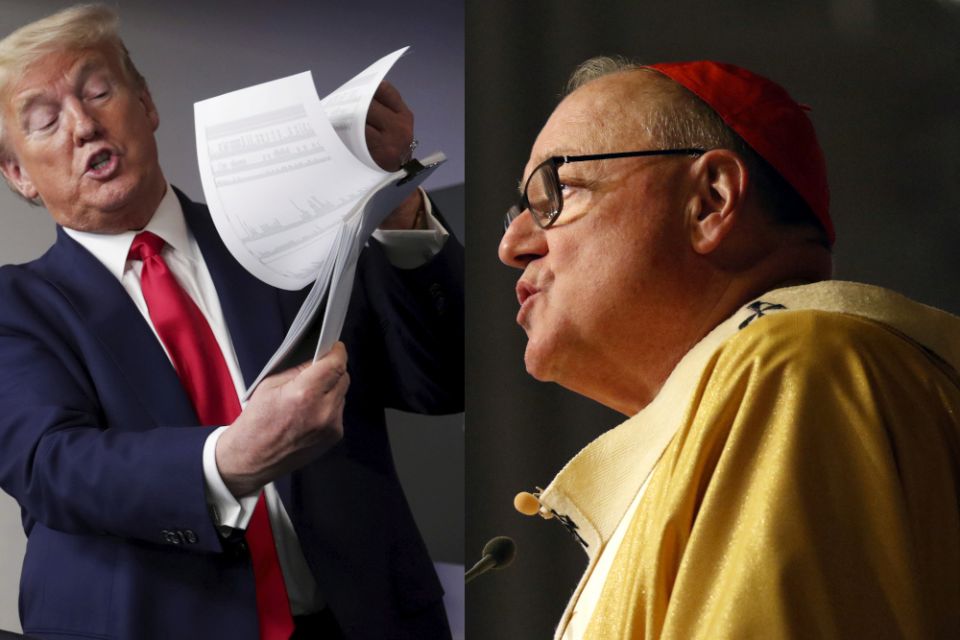
Cardinal Dolan’s public flattery of Trump forgets a few things

I wonder whether the U.S. Catholic bishops have crossed a sort of Rubicon recently.

When their Roman predecessor, the general Julius Caesar, brought his army illegally over the Rubicon River, he set in motion the events that ended the Republic and saw him presented with a crown. “The die is cast,” he is reputed to have said as he marched his army toward Rome: there was no going back. What he had done could not be undone and it would change the shape of history.

I do not think that New York Cardinal Timothy Dolan is in any danger of being crowned emperor (or, anything else). But I do believe that his public flattery of President Donald Trump from the pulpit of St. Patrick’s Cathedral and on Fox News may prove to be a moment from which American Catholicism cannot turn back.

Smart analysts have interpreted the cardinal’s blandishments as a savvy effort to smooth-talk the president into devoting stimulus funds to help Catholic schools that, no doubt, will struggle in the post-pandemic environment. Maybe that is what the cardinal thinks he is doing. Maybe it even looks smart from one point-of-view. But it seems to me that we have to overlook a lot to see how smart the cardinal is being.

Dolan praised Trump’s sensitivity to the “feelings of the religious community” on Fox News. Think about that.

Cardinal Dolan’s homily praising Donald Trump

Then, think about this. “I think Islam hates us,” or, “The children of Muslim American parents, they’re responsible for a growing number for whatever reason a growing number of terrorist attacks,” or think about what Trump said after the Supreme Court struck down his first travel ban that fulfilled his campaign promise of a “total and complete shutdown of Muslims entering the U.S.” — “Put a commission together. Show me the right way to do it legally.”

Continue reading “Cardinal Dolan’s public flattery of Trump forgets a few things”

Psychology Today: Trump Is a Four-Year-Old

Looking for the source of Trump’s appeal.

It’s quite impossible to watch president Trump for any length of time and remain unperturbed. He possesses what psychoanalysts call “high transference valence.” The ability to provoke strong reactions in others. In fact, this appears to be a big part of his appeal. Love him or hate him, you have to look.

You may argue that Trump elicits such strong reactions because he embodies a great threat in the mind of some and an attractive promise in the minds of others. We respond strongly to both threatening and attractive objects. Yet, given the basic ideological divide in contemporary American politics, this duality holds true for practically every president. Nothing there to explain the unique reaction Trump generates.


A better guess is that it’s the high degree of Donald Trump’s novelty that attracts attention across the board. Novelty is innately arousing to us regardless of its valence. People who slow down on the highway to rubberneck at the scene of an accident do not enjoy seeing mutilated bodies. They are compelled to look at something not ordinary.


But what is it that’s truly novel about Trump? Some argue that his uniqueness resides in his ‘outsider’ status as a novice politician, a businessman who has beaten the professional politicos at their own game. But this argument is weak. After all, we’ve seen political novices win elections before, and we’ve seen businesspeople succeed in politics, both in the US and abroad.

Moreover, the concepts of “business leader” and “political leader” are not that far apart in the cultural imagination. The fact that a rich, white Chief Executive Officer becomes Commander in Chief does not violate cultural expectations. There’s no genuine surprise in this narrative twist, other than, perhaps, that it took so long to materialize. Continue reading “Psychology Today: Trump Is a Four-Year-Old”

Watch the ad Trump doesn’t want you to see

Pandemic Shakes France’s Faith in a Cornerstone: Strong Central Government

SCEAUX, France — A couple of baguettes tucked under her arm, Maha Rambousek fiddled with a face mask that kept sliding off her nose. After a local decree made masks mandatory in public, she had quickly stitched it together, but was left confused when the policy was overturned two days later by the central government.

“We have some of the highest taxes and biggest public spending in the world, and the French people accept that because, implicitly, their protection was guaranteed by the state,’’ said Mr. Vermeren, who teaches at the University Paris 1 Panthéon-Sorbonne.

NY Times

“I don’t know who’s wrong or who’s right,’’ Ms. Rambousek said. “And I can’t turn to anybody for certainties.’’

The measure in Sceaux, a well-to-do suburb just south of Paris, was one of an increasing number of exceptional local challenges to the government’s handling of the coronavirus outbreak, which has shaken confidence in a cornerstone of French society: the primal authority of the centralized state.

The city of Perpignan lodged contagious patients in a hotel after the central government told people to self-isolate at home. Officials in the city of Marseille carried out widespread testing of both the sick and healthy even as the government ordered that only the seriously ill be tested. The city of Paris tightened a national lockdown by banning daytime jogging.

While France’s vaunted health care system has staved off disaster, France has suffered the world’s fourth-biggest death toll — now at 23,660 official deaths, behind the United States, Italy and Spain — a consequence, critics say, of the central government’s failure to anticipate the onslaught of the contagion.

That failure and a critical shortage of masks and testing kits — also resulting from gaps in state policies — led to the virus’s rapid early spread, prompting France to impose one of the word’s strictest nationwide lockdowns, now in its seventh week. [ . . . ]

Continue story at NY TIMES