US President Donald Trump suggested on Monday that he might use federal troops to end the protests that have erupted nationwide following the death of George Floyd, an unarmed black man who was killed in Minneapolis police custody. But to do so, Trump would need to formally invoke rarely used statutes known as the Insurrection Act.
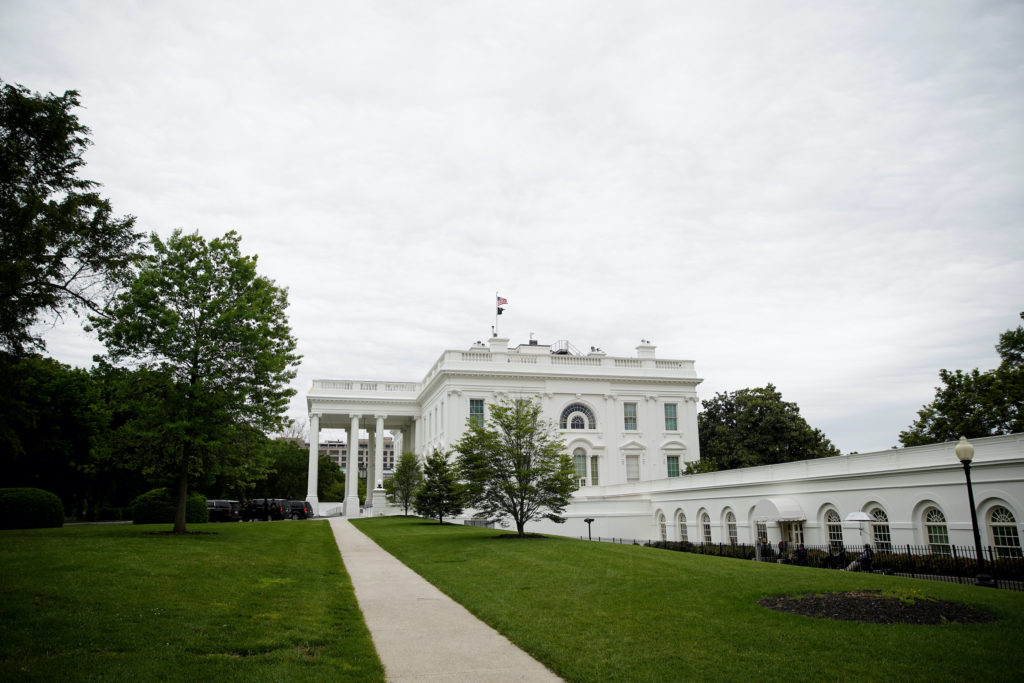
“Mayors and governors must establish an overwhelming law enforcement presence until the violence has been quelled,” Trump said during brief remarks at the White House on Monday.
Twitter said early Friday that a post by President Donald Trump about the protests overnight in Minneapolis glorified violence because of the historical context of his last line: “When the looting starts, the shooting starts.” The phrase was used by Miami’s police chief, Walter Headley, in 1967, when he addressed his department’s “crackdown on … slum hoodlums,” according to a UPI article from the time.
Peter Wehner Contributing writer at The Atlantic and senior fellow at EPPC
The president is defaming the memory of a woman who died nearly 20 years ago—and inflicting pain upon her family today.
“I’m asking you to intervene in this instance because the President of the United States has taken something that does not belong to him—the memory of my dead wife—and perverted it for perceived political gain.”
There may be a more damning thing that’s been said about an American president, but none immediately comes to mind.
There will be a summer tourism season in France, the government has insisted.
However, with social distancing and limited overseas travel, there will be a big drop in trade. Prime Minister Edouard Philippe has said they are facing “probably the worst test of modern times, while at the same time tourism is a jewel in the crown of the French economy”. Saving the industry is a national priority, he said.
Tourism professionals told Connexion that many are expecting at least a 50% reduction in annual turnover. Tourism Minister Jean-Baptiste Lemoyne has indicated that French residents will mostly holiday in France, though President Macron hinted at possible Europe-wide travel. At a press conference with Angela Merkel, the president said a co-ordinated plan should be ready by mid-June: “We will have a tourist season in Europe alongside the virus.” [ . . . ]
Throughout the coronavirus pandemic, questions have been raised about why the U.S. federal government was not better prepared for such a crisis. Scrutiny of President Trump has been intense, but questions extend beyond him to the efficacy of government and civil service more broadly. William Brangham talks to the American Enterprise Institute’s Yuval Levin and The Atlantic’s George Packer.
Full Transcript courtesy PBS
Judy Woodruff:
Throughout this entire crisis, questions continue to be raised about why the U.S. government was not better prepared for such a challenge.
As William Brangham tells us, those questions include how the Trump administration views the role of government and civil service broadly.
William Brangham:
That’s right, Judy.
Most people would agree that the scale and speed of this pandemic would have taxed the resources and abilities of any administration and of any president. But the Trump administration’s response has certainly come under some intense scrutiny.
Let’s turn now to two writers who have looked at this response closely.
Yuval Levin is the director of social, cultural and constitutional studies at the American Enterprise Institute. He’s the author of “A Time to Build: From Family and Community to Congress and the Campus, How Recommitting to Our Institutions Can Revive the American Dream.”
And George Packer’s recent articles in “The Atlantic” look at the Trump administration’s response to this crisis. He is also author of a recent book on the diplomat Richard Holbrooke and, before that, author of “The Unwinding: An Inner History of the New America,” among other books.
Gentlemen, thank you both very much for being here.
George Packer, to you first.
You have written that the seeds of the administration’s response were in some ways predictable, given the way the administration viewed the role of the government preceding this crisis.
Can you explain that a little bit more?
George Packer:
I think Trump spent the first three years of his administration almost in combat with his own government, his own bureaucracy, rooting out people he perceived as disloyal, placing cronies and sycophants in key political jobs, and creating an atmosphere of fear and of chill among the career civil service, so that, by the time the pandemic came, there was a kind of passivity and even absenteeism in big, important areas of the federal government that Trump had seen as serving no purpose, beyond his own personal political interests.
And so once he needed a bureaucracy to do things in order to keep the country safe, to protect us, it wasn’t there. Either people — jobs were unfilled or people were, in a sense, hiding under their desks because they knew that, if they said something Trump didn’t like, he would come after them. And that’s been happening throughout the pandemic.
William Brangham:
Yuval Levin, the same question to you.
You have written also that there has been certainly a denigration of expertise and a somewhat chaotic decision-making process within the White House.
Do you think that that has also affected the pandemic response?
Yuval Levin:
I do.
I agree with what George has said. And I think the way that he’s it in his recent pieces in “The Atlantic” has been quite right.
But I would focus particularly on the White House staff and the team around the president, which expresses the president’s own attitude about the relationship he should have to the rest of the government.
The White House staff is there to enable the president to receive information in the form of decisions to be made and to process it, to listen to expertise, to make decisions.
And the fact is, that process has never existed in this White House. There has never been a functional structure of decision-making. That’s a problem at any time, but it becomes an enormous problem at a moment of crisis, when you have to have a reliable chain of command, you have to have a reliable process for making decisions, you have to have distinctions between what’s said in public and what is said in private, and how the president thinks about his task of communicating to the public in a reassuring way.
None of that, none, is happening in an effective way in this administration. And what you’re finding is a president whose understanding of the job has not been formed by any experience at any level in government.
For the first time in our history, we have a president who has not served either as a senior military officer or as a senior public official before becoming president. Instead, he comes into the job as a performer, and he sees himself in the job as a public performer putting on a show.
And the fact is, in a crisis, the president has to be an inside player, where he has to be making decisions and operating the arms of the government from within. This president just has no conception of how that is supposed to work, no trust in the rest of the system. And in a time of pressure and crisis, it shows.
William Brangham:
George, you and Yuval are making this same point, but devil’s advocate here.
We have seen other crises affect other administrations where they have been caught flat-footed. We saw it in Katrina, after 9/11, even in the initial stages of the housing crisis.
Isn’t some flat-footedness, isn’t some initial chaos and confusion to be expected, especially when this virus really does, in some ways, trump the severity of those other crises?
George Packer:
Yes, that’s true.
And in other countries that we look to as examples of well-functioning democracies in Europe and in Asia, even the ones that seem to have done well, Germany, South Korea, they have made mistakes. Others, Spain and Italy, have seen results that have been as bad as or worse than ours.
I think the difference is what you Yuval was just describing, which is that these are the kind of unavoidable blunders of big, unwieldy governments faced with something that very few governments plan for, anticipate and are ready for. And very few politicians have the courage and foresight to get out ahead of facts and listen to their scientists and their experts, and do things the public may not like even before the public knows they’re doing them.
What we see in this case, in Trump’s case, is a White House that has continually undermined its own administration’s response at every step of the way. It’s as if at every moment when the question was, what is the best way to get out ahead of this and minimize suffering and death, Trump has done the opposite.
And that’s — I don’t know if that’s true in any other country in the world, and that’s a direct result of his idea of what it means to be president, which I think, in his case, is — that means to use power to serve his own interests, not to lead the country, not to solve the country’s problems, certainly not to bring the country together, instead, to divide us in his own interests.
William Brangham:
Yuval, picking up on George’s point here, it has been brought up several times that, if the president really does see this as primarily a political issue to solve, not a public health one, one could argue that the president should have used all the levers at his power in the federal government to ramp up testing, to deal with the shortages of protective supplies.
Why do you think that the president seemingly was reluctant to use the levers of government, if one could argue those might have saved lives and those might have then strengthened his electoral chances in November?
Yuval Levin:
Yes, I think reluctance ends up just not being quite the right term here.
I think the president has turned out to be incapable of using the levers of power in an effective way. There’s no question, as you suggest, and as George says, that this is a crisis that would have overwhelmed any government and that has overwhelmed many governments.
The question is, how do you learn from mistakes in your response? How do you mobilize over time? That our government wasn’t prepared for this in advance is not an indictment. But that we have not learned from mistakes over two and three months, that we are still basically in the same place we were in terms of our capacity to establish a process for decision-making that helps us improve over time is the fault of the senior executives in the Trump administration.
There’s no way around it. Our country has done some things very well. I think the health system handled this OK. The American public has been willing to make tremendous sacrifices. Many governors have stepped up. Some federal officials have stepped up.
But the president has a distinct role here, a coordinating and reassuring role, that he has simply failed to perform. And I don’t think that that’s a decision he’s made.
I think that’s just an incapacity that’s been revealed and which, of course, was evident in some respects before, but becomes especially problematic in a moment of crisis like this.
William Brangham:
All right, really interesting conversation.
Yuval Levin, George Packer, thank you both very much for being here.
“In my life, I have watched John Kennedy talk on television about missiles in Cuba. I saw Lyndon Johnson look Richard Russell squarely in the eye and and say, “And we shall overcome.” I saw Richard Nixon resign and Gerald Ford tell the Congress that our long national nightmare was over. I saw Jimmy Carter talk about malaise and Ronald Reagan talk about a shining city on a hill. I saw George H.W. Bush deliver the eulogy for the Soviet bloc, and Bill Clinton comfort the survivors of Timothy McVeigh’s madness in Oklahoma City. I saw George W. Bush struggle to make sense of it all on September 11, 2001, and I saw Barack Obama sing ‘Amazing Grace’ in the wounded sanctuary of Mother Emanuel Church in Charleston, South Carolina.
“These were the presidents of my lifetime. These were not perfect men. They were not perfect presidents, god knows. Not one of them was that. But they approached the job, and they took to the podium, with all the gravitas they could muster as appropriate to the job. They tried, at least, to reach for something in the presidency that was beyond their grasp as ordinary human beings. They were not all ennobled by the attempt, but they tried nonetheless.
“And comes now this hopeless, vicious buffoon, and the audience of equally hopeless and vicious buffoons who laughed and cheered when he made sport of a woman whose lasting memory of the trauma she suffered is the laughter of the perpetrators. Now he comes, a man swathed in scandal, with no interest beyond what he can put in his pocket and what he can put over on a universe of suckers, and he does something like this while occupying an office that we gave him, and while endowed with a public trust that he dishonors every day he wakes up in the White House.
“The scion of a multigenerational criminal enterprise, the parameters of which we are only now beginning to comprehend. A vessel for all the worst elements of the American condition. And a cheap, soulless bully besides. We never have had such a cheap counterfeit of a president* as currently occupies the office. We never have had a president* so completely deserving of scorn and yet so small in the office that it almost seems a waste of time and energy to summon up the requisite contempt.
“Watch how a republic dies in the empty eyes of an empty man who feels nothing but his own imaginary greatness, and who cannot find in himself the decency simply to shut up even when it is in his best interest to do so. Presidents don’t have to be heroes to be good presidents. They just have to realize that their humanity is our common humanity, and that their political commonwealth is our political commonwealth, too.
Watch him behind the seal of the President of the United States. Isn’t he a funny man? Isn’t what happened to that lady hilarious? Watch the assembled morons cheer. This is the only story now.”



 Pas De Merde