My Paris: Seduced by the Past 

“Paris is an ocean. Explore it, and you still won’t know its depths.” –  Honoré de Balzac

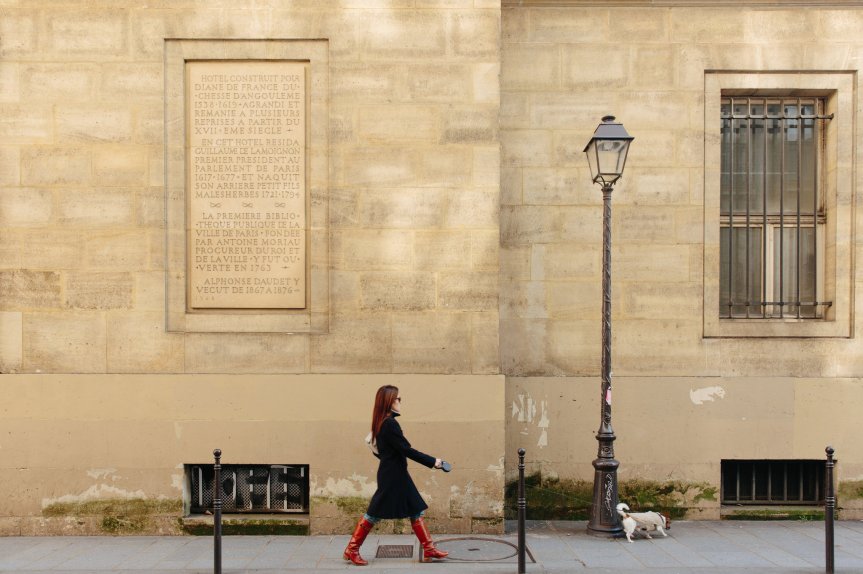
The streets of the Marais are narrow enough in some places that sunlight pierces the shadowy canyons between its soaring Renaissance-era buildings for just a few hours a day. At night the lanes take on a mysterious, medieval air when streetlamps sputter to life, casting a sheen on timeworn turrets, carved doors and stone mansions.

Slip into a cobbled alley off the Rue des Francs-Bourgeois, a main artery, and you’ll find yourself standing where the Duke of Orleans was assassinated in 1407 by a power-hungry rival’s henchmen. Around the corner, the magnificent 18th-century Hôtel de Soubise palace, home to France’s national archives, showcases the last, anguished letter written by Marie Antoinette, bidding “adieu” to her sister before heading to the guillotine.

Strolling amid the steep walls and angular slate roofs always transports me back to a bygone era — a storied past that vibrates beneath the ferment of the chic international crowds, designer boutiques, neo-bistrots, kosher delis and L.G.B.T. clubs.

Fifteen years ago, I was lucky enough to find a quaint apartment on a small rue in the central Marais. I’d just moved from Washington, D.C., to be the bureau chief for a financial news agency covering the birth of Europe’s new currency, the euro, which I would go on to write about for the former International Herald Tribune and The New York Times. In short order, that historic project burst into a Continentwide financial, social and political crisis, the aftershocks of which I continue to report about today. [ . . . ] Full Story

Family Pictures | Maison Européenne de la Photographie 

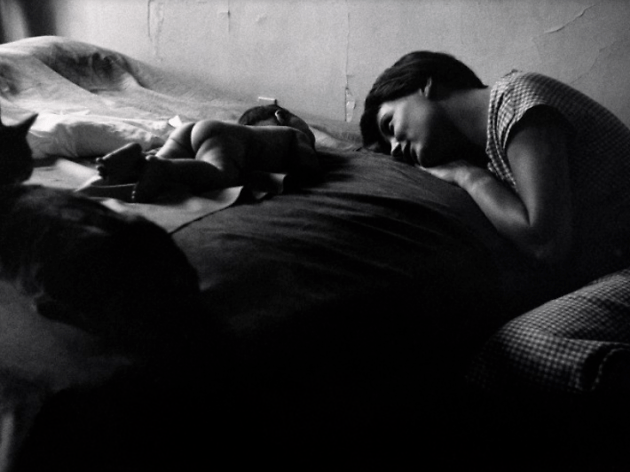
Family is sacred and is often the first thing we capture on camera. And the Maison Européene de la Photographie is exhibiting candid family shots taken by many eminent artists. For example, Harry Callahan’s devotion for his wife Eleanor; who he photographed naked from all angles in magnificent chiaroscuro. Richard Avedon’s admiration for his father when he was suffering from cancer, is expressed in a series of seven modest and respectful portraits which nevertheless caused a scandal when they were exhibited for the first time at MoMA in 1974. [ . . . ]

Full Story & Slideshow: Family Pictures | Maison Européenne de la Photographie (MEP) | Art in Paris

Charlie Hebdo: a sober homage to the victims Place de la République in Paris

Two years after the attacks on Charlie Hebdo and the Hyper Cacher, a few hundred people gathered on Saturday evening at the Place de la République in Paris , In a sober tribute to the 17 victims, whose names were read.

“It’s raining, it’s cold, I’m a little cold, but I still came, because I had to be there,” explained to the AFP, visibly moved, an elderly woman leaning on a cane, which experienced Cabu when drawing in a lecture hall in May 68. the attack against Charlie Hebdo satirical newspaper (12 died January 7, 2015), “it’s something, especially as it was the starting point for all What followed after, “she added, referring to the wave of attacks that France has faced in two years.

A “participatory canvas” was unrolled at the foot of the statue, made of colorful hands where dozens of people wrote a message in tribute to the victims. The gathering was announced Friday at the call of the French Association of Victims of Terrorism (AFVT), supported by several organizations including SOS Racisme, Licra and UEJF.”Every day victims need attention, recognition””We could not not be there,” Guillaume Denoix of Saint Marc, general manager of the AfVT, told the press a “I’m still Charlie” sign in hand [. . . ]

Read Full Story: Charlie Hebdo: a sober homage to the victims Place de la République in Paris

Are the French rude? Wherever you go, there you are

This ridiculous article from the New York Daily News really ticked me off,  for several reasons. Firstly, if there are any people who should be sensitive to an underserved reputation for rudeness, it should be New Yorkers. I’ve dined in Paris and New York, chatted with waiters, and asked for help from strangers in both cities. My own experience is that Parisians and New Yorkers are for the most part friendly and accommodating to visitors, mainly because they are so proud of their city, I think. Secondly, if this NY Daily News reporter had a bad experience in a Paris restaurant, how unfair is it to label “the French” as rude?  I once received a smart-ass remark from a waitress at the Carnegie Deli, but I didn’t blame every New Yorker from Times Square to the Catskills.  Worse, what if I blamed “the Americans” because Sophie the waitress was having a bad hair day? I’ve always liked the saying, “Wherever you go, there you are!” 
Read this story below from the New York Daily News, and please comment. I’d like to know what you think!
[ Mike Stevenson / Pas De Merde]

The French were so rude to me in Paris that I had to seek out American eateries | NY Daily News

I went to Paris, but ate like a New Yorker.

Blame the French. My first experience in the City of Light was met with a wave of rudeness — particularly in restaurants — despite how reluctant I was to believe the stereotype that the French are cold.

It’s tough being an American in Paris. Especially when the only French words you know are “Bonjour,” “Merci” and “Au Revoir.”

My sister and I made an effort to greet everyone we met with the proper pleasantry in French, but despite our attempts at speaking the language, we weren’t exactly treated hospitably. [ . . .  ]

Read more of this nonsense at:http://www.nydailynews.com/life-style/french-rude-paris-opted-american-food-article-1.2928043

Historians Imagine What Paris Sounded Like in the 18th Century

Imagine the sounds coming out of a busy blacksmith shop in an alleyway in Paris sometime back in the 18th century: the hammering of wrought iron, the rhythmic whoosh of air as the blacksmith uses a bellows to stoke a fire.

We have no recordings of the actual sounds of Paris in those early days, so to try and make those 18th-century streets and alleys of Paris come to life takes a bit of careful historical research and a little imagination. Continue reading “Historians Imagine What Paris Sounded Like in the 18th Century”