“Natacha (almost) flight attendant”: an original comedy with a five-star cast

A rare comic book heroine born in 1970, Natacha, by screenwriter Gos and illustrator François Walthéry published in the comic book magazine Spirou, is being adapted for the screen for the first time.


By Jackie Bornet

This adaptation of the comic strip Natacha, Flight Attendant , is a very pleasant surprise, and the “almost” in the title corrects the situation compared to the original. It is not, in fact, a cinematic version of the album, but a new adventure that explores the heroine’s origins and her first steps in the airborne universe. Directed by Noémie Saglio, her film is full of charm and energy, embodied by Camille Lou, alongside Vincent Dedienne, Didier Bourdon, Elsa Zylberstein, Isabelle Adjani, and Fabrice Luchini, no less.

Perfect for this joyful spring period, Natacha (almost) flight attendant is released in theaters on Wednesday, April 2.

Source: “Natacha (almost) flight attendant”: an original comedy with a five-star cast

Classic Film Review: Fernandel gives the 1952 Mademoiselles the “French Touch (Coiffeur pour Dames)”

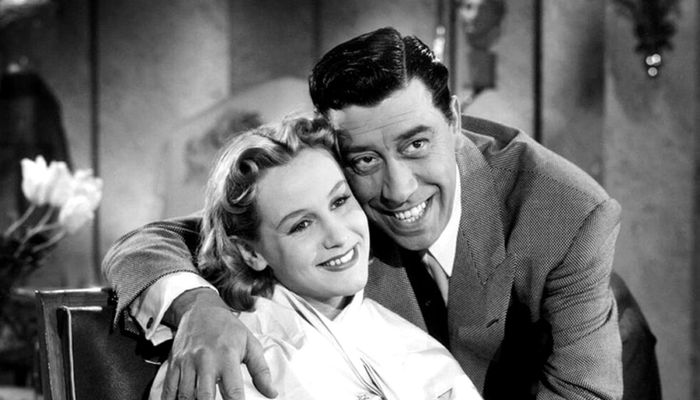
Fernandel

“French Touch,” aka “An Artist with the Ladies” and titled “Coiffeur pour Dames” in its native France, is a screen comedy adapted from a stage play that could have been tailor-made for its star.

The French vaudeville singer and comic Fernandel plays a lowly sheep-shearer who clips his way to hair styling stardom in post-war Paris by giving scalp “massages” that are catnip to the ladies. That points him and us towards a marriage-threatening, client-clinging, teen daughter seducing finale that screams out for something bawdier than the mild-mannered 1950s would allow.

But more importantly, as our anti-hero Mario juggles the wife (Blanchette Brunoy), the many upper class clients and the somewhat smitten 18 year-old daughter of a client (Françoise Soulié) he has massaged his way into, dodging husbands and fathers as he bounces from office to salon to apartment along the way, you miss the doors he should be slamming behind him or getting slammed in his face.

Marius the sheep shearer (Fernandel) has a gift, something the ladies of his village pick up on straight away.

“You’ll go far with those hands!”

Whatever leering accompanied that on the stage, it’s largely brushed past in this not-particularly-bawdy comedy. Because in a few too-quick scenes, we watch Marius work his way from sheep and dressing up horse tails for contests at county fairs, to dog grooming and hair-styling for plastic dolls in Marseilles, where he meets Aline (Brunoy) and talks her into marrying him and following him to Paris as he pursues his dream.

Even in a tiny salon working for somebody else, “Mario” as he now calls himself, becomes famous for “fingers that speak.” To clients, “each hair is a violin string” (in French with English subtitles) for this “virtuoso” of the scissors, shampoo and hair dryer.

He seems destined for glory, and not just for mastering the basics. The hairdresser is “everyone’s confidante and father confessor.” The ladies want his coiffeur adorning their heads and his fingers working their scalps into relaxing release.

“Your profession’s so gay,” one client swoons, in a pre-Stonewall use of the word. Mario is simply irresistible.

The first client to truly cross the line is kept woman Edmonde (Arlette Poirier). She demands that he come to her apartment to prep her for an evening at the theater with her married lover, and they get so carried away that the next thing you know, they’re in bed together.

How he knew to keep a pair of pajamas with him at all times is why he is French and you and I are not.

But it isn’t until Mario clips 20 years off the wife of the kept woman’s paramour that his world changes. He saves Mme Brochard’s (Renée Devillers) marriage, and she sets him up in his own salon. Soon, every posh Parisienne is at his fingertips. Literally.

Naturally, our Icarus flies too close to the sun…or daughter, in this case, Mme. Brochard’s hip teen daughter (Françoise Soulié).

Yes, modern viewers are allowed to say “Ewww” here. Even accounting for the difference in eras, that wasn’t Miss Austen’s Empire waistline England and 18 paired with a stout, grinning hair-dyed fop of his late 40s isn’t played for the big laughs it might have delivered. Not that young Denise seems over the moon about the hairdresser who pines for her.

That goes for much of this Jean Boyer film. Whatever his earlier reputation, this outing seems muted and muzzled, watered down even for its era. He is best-known for his pre-war films, although he worked steadily up until his death in 1965. “Un mauvais garçon,” “Virginie” and “We Go to Monte Carlo” might be his most famous credits, although as a writer and composer, he had a tune on the “Chocolat” soundtrack decades after his passing.

Still, Fernandel is in fine form and the framework of this follicle-friendly farce holds it all together. It’s not a great French sex comedy, even of its era, but it’s well worth checking out, if for nothing else than considering how it might be remade, even today.

A bawdier version where they don’t forget to slam a few doors could still play.


Source: Classic Film Review: Fernandel gives the 1952 Mademoiselles the “French Touch (Coiffeur pour Dames)” | Movie Nation

Flow review – beguiling, Oscar-winning animation is the cat’s whiskers

Latvian director Gints Zilbalodis’s enchanting eco-fable about a lone moggy in a flooded world is a triumph of imagination over budget

By Wendy Ide

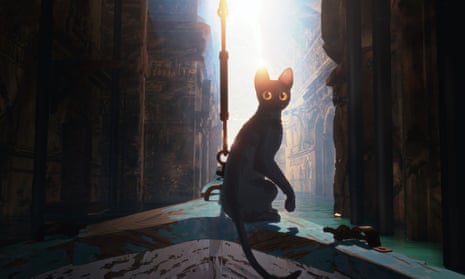
Animation as a medium and fairytales as a subject have always been natural bedfellows. You only need to look at Disney’s princess industrial complex to understand that sparkle-dusted happily-ever-after is big business; that the appetite for this particular breed of magical thinking (plus associated merchandising and sequined tat) is enduringly healthy. But the beguiling, Oscar-winning, dialogue-free Latvian animation Flow, which tells of a solitary cat who must learn to cooperate with a mismatched pack of other species to survive a catastrophic flood, is a little different.

The fairytale here is not the story the picture tells – it’s the story of the film itself. Created by a tiny team with a minuscule budget of about £3m, and rendered entirely on the free open-source 3D software Blender, Flow has been on a journey: its premiere in Cannes; the haul of prizes (54 to date), culminating in the Oscar for best animated feature – that is the stuff of film industry fantasy.


While the limited budget certainly shows on screen at times, it also gave director Gints Zilbalodis a considerable degree of creative freedom. With more money comes compromise and consensus film-making, plus a tendency to spoon-feed the audience rather than challenge them. Flow, however, embraces mystery: we see a disaster unfold in the same way the animals do – with no warning or context.

Zilbalodis has chosen not to explain the recent history of what seems to be a post-apocalyptic but stunningly verdant, geographically unspecified world. There are signs, in the lush forest, of human habitation and the remnants of civilisation. The cat lives in a house that appears to have once been home to a kitty-obsessed sculptor. Feline statues of varying sizes stand like sentinels in the grounds; a half-finished carving still rests on a workbench. But whether the former inhabitant has been relocated or is long since dead – perhaps along with the rest of humanity – is left open to the audience to interpret, and your reading of the background to the story very much depends on how bleakly apocalyptic your worldview is.

The cat’s happy solitude in the abandoned building is interrupted by a sudden environmental disaster: rapidly rising flood waters submerge the house and the forest surrounding it. A last-minute reprieve comes in the shape of a drifting sailboat, but the cat is outraged to discover that the vessel must be shared with another passenger – an unflappable and permanently chilled-out capybara. As the boat drifts, it takes on other creatures: an acquisitive ring-tailed lemur with a weakness for shiny trinkets; a wise but haughty secretarybird; and an excitable goofball of a dog.

One of the most distinctive elements of Zilbalodis’s vision is his decision to let his animals remain animals, instead of attempting to squeeze them into the mould of personhood. The character design and animation of the creatures are where the film’s meagre budget is most evident, and yet behavioural details are minutely observed. The cat – a neat, slinky, self-contained little black moggy – is pure feline, from the insouciantly twitching tip of its tail to its testy chirrup of annoyance (all the animal sounds are real, rather than voice actors cosplaying) at having to share a space with other critters. As an alternative to stamping human personalities on them, Zilbalodis instead encourages us to see elements of ourselves in the animals.

Being a self-taught animator accustomed to working on his own (his previous feature film, Away, was an entirely solo project created on his computer), the director has revealed in interviews that he identifies most with the self-sufficient cat, who must learn to cooperate with others. And anyone with a tendency to hoard accessories and to overpack when travelling will feel a kinship with the lemur.

An eco-parable, Flow is not exactly mining new thematic territory; from Wall-E to Cartoon Saloon’s My Father’s Dragon to The Wild Robot and numerous Studio Ghibli pictures, animated movies dealing with imminent climate collapse are relatively plentiful. However, the approach of Flow, with its animals’-eye, in-the-moment immediacy and its resistance to cutesiness and anthropomorphism, is bracingly fresh and unexpected. The animation, meanwhile, transcends its financial constraints to achieve moments of shimmering, heart-swelling loveliness.

Deliberately enigmatic in approach, with its focus on tiny, cat-level details and a provocative hint that the end of humanity may not be the end of the world, Flow doesn’t hammer home a single message. Other takeaways include the need to work together to survive, the value of adaptability – and that cats will always push stuff off tables given half the chance.

Source: Flow review – beguiling, Oscar-winning animation is the cat’s whiskers | Animation in film | The Guardian

‘Dog on Trial’ Review: Zany Courtroom Comedy With a Canine Star Turn

Laetitia Dosch
Laetitia Dosch makes her directorial debut

Laetitia Dosch’s ‘Dog on Trial’ delivers what its title promises, but surprises with its tonal swerves and the magnetic presence of its non-human MVP.

By Gut Lodge

Can animals act? Sensible people would say not: Our four-legged friends can’t read a script or construct a character, and if they come across charismatically on screen, that’s simply down to obeying commands, plus the deft touch of an editor. The more whimsically accommodating among us would say those last two points are true of some human actors too; Hitchcock, with his infamous “actors are cattle” quip, suggested as much. Either way, it’s hard to watch Kodi, the ragged, hungry-eyed canine star of “Dog on Trial,” without sensing, whether by sheer good fortune or some mysterious process of empathy, a genuine performance afoot.

Called upon to jump, slump, tremble and even (sort of) sing, with an expressive range spanning untethered aggression and resigned melancholy, the biscuit-colored crossbreed hits every mark required of him by Laetitia Dosch‘s endearingly eccentric directorial debut, and emerges as its most compelling element. On many films, that would seem a slight; in the case of this one, an earnest animal-rights parable in the guise of a broad knockabout farce, it’s surely the intention for this particular dog to have his day. (Rarely has a film seemed so precision-engineered to win the Palme Dog award for best canine performer at Cannes, and sure enough, following “Dog on Trial’s” Un Certain Regard premiere in May, Kodi duly and deservedly took the prize.)

Dosch, the French-Swiss actor who broke through with her delightful star turn in 2017’s “Jeune Femme,” ostensibly plays the lead as Avril, a frazzled, kind-hearted Swiss lawyer with a penchant for hopeless cases, in both the personal and legal sense. This time, unusually, it’s woebegone mongrel Cosmos (Kodi) and his equally hangdog human Dariuch (Belgian actor-comedian François Damiens), who’s facing legal action after Cosmos bit and injured three women. Separate from Dariuch’s debt to the victims, the law states that the dog should be put down. Avril successfully argues that, as an autonomous being, Cosmos should be tried independently, and so “Dog on Trial” proceeds.

This may sound like a premise from a more naïve era of family-friendly Hollywood creature comedies (“Beethoven’s Sixth Amendment,” perhaps), but Dosch’s script, co-written with “My Everything” director Anne-Sophie Bailly, leans hard into the absurdity of the idea while shooting for scathing adult satire. The case escalates fast — as does everything in a frenetic, incident-crammed film, clocking in at just 80 minutes — into a national cause célèbre, inspiring rowdy public demonstrations for and against Cosmos’s right to live, while a procession of professed experts weigh in on the morality and soul of the common mutt. Much of this is witty, as Dosch’s exuberant, up-for-anything direction dips into animation and faux-documentary stylings to convey the barrelling rush of a media circus, while there’s some considered philosophical reflection on animal behavior and ethics amid all the hijinks.

At times, however, “Dog on Trial’s” brash, busy approach leashes its impact. It’s top-heavy with story for such a slender-framed work, as sketchily developed strands involving Avril’s colleagues and her lonely young neighbor jostle for screen time with the more substantial and immediately relevant subplot of the lawyer’s growing attachment to Cosmos’s charming, court-appointed handler Marc (a winning Jean-Pascal Zadi), and the mistreated animal’s gradual softening under his care. Any dog lover will be thoroughly disarmed by this development, and by Kodi’s irresistible enactment of this arc. But they’ll be vulnerable to the next of the film’s emphatic tonal lurches, as its zanier storytelling impulses ran into some sense of duty to the realities of Switzerland’s legal system.

Consider it the shaggy misfit in the litter of recent French-language legal studies, from “Anatomy of a Fall” to “The Goldman Case” — for all its hectic tragicomic slaloming, “Dog on Trial” ultimately takes the shape of a procedural, interested in how justice is determined, and for whom. Dosch is, as ever, an appealingly off-kilter presence before the camera; behind it, she doesn’t have complete control over her film’s wriggling ideas and restless formal execution. Yet there’s something quite suitably untamed about it too. Knowing not all viewers will be on its side, “Dog on Trial” throws its lot in with the animals, barking and clawing and occasionally behaving badly to make its point — and generously throwing the spotlight on its hairier hero to bring that home.

Source: ‘Dog on Trial’ Review: Zany Courtroom Comedy With a Canine Star Turn

Director pays bittersweet homage to late actress

Luc Dardenne would have liked to work with Emilie Dequenne again

The tale of actress Emilie Dequenne is the stuff of legend. At age 17, she appeared in her first film and then found herself crowned at the Cannes Film Festival. The film was Rosetta – a harrowing tale of growing up in poverty in a post-industrial region of Belgium. The film was a turning point in the career of Duquenne, the Dardenne brothers Luc and Jean-Pierre that directed it and even on Belgium’s place in world cinema.

“It’s really unfair to die so young”

Dequenne sadly passed away recently at the age of 43. For director Luc Dardenne, the pain is double. “It’s really unfair to die so young,” he told the daily Libre Belgique. “We all know what Emilie did for cinema, but we’ll never know what she could still have done.”

Unlike other actors that the Dardenne brothers worked with, Dequenne never appeared in another of their films. Dardenne regrets this. “She told us, ‘You’ll never work with me again as I’m still Rosetta for you’. She was right.”

Although they had thought of her occasionally, they felt she needed a strong lead role. “But now that will never happen because of this damn disease.”

(Michael Leahy. Source: La Libre Belgique. Photo: Nicolas Landemard / Picture Alliance )

Source: Director pays bittersweet homage to late actress