
Jean-Luc Godard et Anna Karina

Jean-Luc Godard et Anna Karina
Directed by Arnaud Desplechin, Tromperie (also known as Deception, 2021) is a deeply introspective and thought-provoking adaptation of Philip Roth’s novel. Featuring Denis Podalydès and Léa Seydoux in the lead roles, the film explores the complex, often ambiguous relationship between a writer and his mistress, seamlessly blurring the boundaries between fiction and reality. With its richly layered dialogue and philosophical tone, Tromperie invites viewers into an exploration of love, memory, and the blurred lines of storytelling.

Set in the 1980s in London, the film follows Philip (Denis Podalydès), a successful American novelist, and his unnamed lover (Léa Seydoux), a married woman who visits him frequently in his writing studio. Their interactions unfold as a series of emotionally charged dialogues—sometimes tender, sometimes confrontational—exploring themes of desire, fidelity, and the power dynamics at play in creative relationships.
As Philip’s bond with his mistress deepens, he also reflects on his past relationships, including those with his wife, former lovers, and even characters from his own literary works. Tromperie delicately weaves the line between reality and fiction, challenging the viewer to question where the truth ends and the imagination begins.
The Nature of Fiction and Reality – The film encourages the audience to grapple with the distinctions between what is real and what Philip conjures in his mind as a writer.
Desire and Betrayal – The emotional undercurrents of love, passion, and infidelity form the crux of the story, reflecting the complexities and contradictions inherent in human relationships.
Exile and Identity – Set against the backdrop of Philip’s life as an American writer living in Europe, the film examines themes of cultural alienation, belonging, and the internal conflicts that shape both his personal and creative identity.
Premiering at the Cannes Film Festival in 2021, Tromperie earned critical acclaim for its sophisticated storytelling and the exceptional performances of its leads. Léa Seydoux delivers a mesmerizing portrayal of emotional depth, while Denis Podalydès embodies the intellectual yet morally complex character of Philip with subtle brilliance.
Unlike conventional narratives driven by action, Tromperie thrives on the power of words, remaining true to Roth’s literary style. Its cerebral approach and philosophical layers make it a captivating watch for those who appreciate dialogue-heavy, thought-provoking cinema. With its blend of romance, intellectual exploration, and literary elegance, Tromperie stands as a remarkable adaptation of one of Roth’s most compelling works, inviting reflection on the nature of love, identity, and the boundaries of storytelling.

Daniel Auteil directs and stars as a disillusioned criminal lawyer who has been appointed to defend a man accused of murdering his wife.
Daniel Auteil directs and stars as disillusioned criminal lawyer Jean Monier, who has been appointed to defend Nicolas Milik, a man accused of murdering his wife. While everything points to his guilt, Monier takes up the case, convinced of his innocence. As his investigations keep taking him back to the night of the murder and the family dynamics, he gets closer to his client, adding to the pressure to defend him. What began as an ordinary case will put him to the test.
Auteuil’s seasoned performance and Gadebois’ nuanced portrayal of Milik add depth to this courtroom thriller, which explores themes of moral ambiguity and redemption.
Director: Daniel Auteuil
Starring: Daniel Auteuil, Grégory Gadebois
A rare comic book heroine born in 1970, Natacha, by screenwriter Gos and illustrator François Walthéry published in the comic book magazine Spirou, is being adapted for the screen for the first time.
By Jackie Bornet
This adaptation of the comic strip Natacha, Flight Attendant , is a very pleasant surprise, and the “almost” in the title corrects the situation compared to the original. It is not, in fact, a cinematic version of the album, but a new adventure that explores the heroine’s origins and her first steps in the airborne universe. Directed by Noémie Saglio, her film is full of charm and energy, embodied by Camille Lou, alongside Vincent Dedienne, Didier Bourdon, Elsa Zylberstein, Isabelle Adjani, and Fabrice Luchini, no less.
Perfect for this joyful spring period, Natacha (almost) flight attendant is released in theaters on Wednesday, April 2.
Source: “Natacha (almost) flight attendant”: an original comedy with a five-star cast
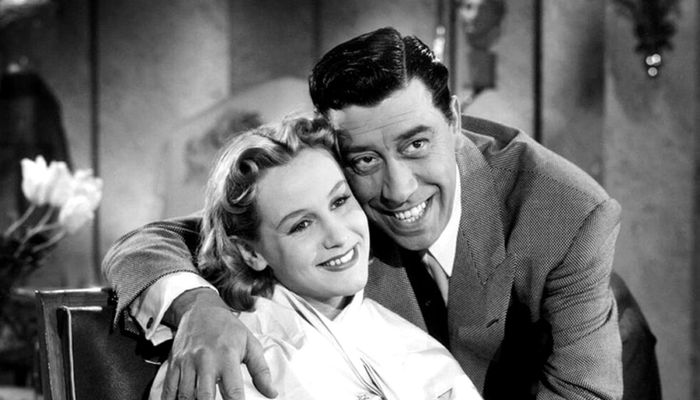
“French Touch,” aka “An Artist with the Ladies” and titled “Coiffeur pour Dames” in its native France, is a screen comedy adapted from a stage play that could have been tailor-made for its star.
The French vaudeville singer and comic Fernandel plays a lowly sheep-shearer who clips his way to hair styling stardom in post-war Paris by giving scalp “massages” that are catnip to the ladies. That points him and us towards a marriage-threatening, client-clinging, teen daughter seducing finale that screams out for something bawdier than the mild-mannered 1950s would allow.
But more importantly, as our anti-hero Mario juggles the wife (Blanchette Brunoy), the many upper class clients and the somewhat smitten 18 year-old daughter of a client (Françoise Soulié) he has massaged his way into, dodging husbands and fathers as he bounces from office to salon to apartment along the way, you miss the doors he should be slamming behind him or getting slammed in his face.
Marius the sheep shearer (Fernandel) has a gift, something the ladies of his village pick up on straight away.
“You’ll go far with those hands!”
Whatever leering accompanied that on the stage, it’s largely brushed past in this not-particularly-bawdy comedy. Because in a few too-quick scenes, we watch Marius work his way from sheep and dressing up horse tails for contests at county fairs, to dog grooming and hair-styling for plastic dolls in Marseilles, where he meets Aline (Brunoy) and talks her into marrying him and following him to Paris as he pursues his dream.
Even in a tiny salon working for somebody else, “Mario” as he now calls himself, becomes famous for “fingers that speak.” To clients, “each hair is a violin string” (in French with English subtitles) for this “virtuoso” of the scissors, shampoo and hair dryer.
He seems destined for glory, and not just for mastering the basics. The hairdresser is “everyone’s confidante and father confessor.” The ladies want his coiffeur adorning their heads and his fingers working their scalps into relaxing release.
“Your profession’s so gay,” one client swoons, in a pre-Stonewall use of the word. Mario is simply irresistible.
The first client to truly cross the line is kept woman Edmonde (Arlette Poirier). She demands that he come to her apartment to prep her for an evening at the theater with her married lover, and they get so carried away that the next thing you know, they’re in bed together.
How he knew to keep a pair of pajamas with him at all times is why he is French and you and I are not.
But it isn’t until Mario clips 20 years off the wife of the kept woman’s paramour that his world changes. He saves Mme Brochard’s (Renée Devillers) marriage, and she sets him up in his own salon. Soon, every posh Parisienne is at his fingertips. Literally.
Naturally, our Icarus flies too close to the sun…or daughter, in this case, Mme. Brochard’s hip teen daughter (Françoise Soulié).
Yes, modern viewers are allowed to say “Ewww” here. Even accounting for the difference in eras, that wasn’t Miss Austen’s Empire waistline England and 18 paired with a stout, grinning hair-dyed fop of his late 40s isn’t played for the big laughs it might have delivered. Not that young Denise seems over the moon about the hairdresser who pines for her.
That goes for much of this Jean Boyer film. Whatever his earlier reputation, this outing seems muted and muzzled, watered down even for its era. He is best-known for his pre-war films, although he worked steadily up until his death in 1965. “Un mauvais garçon,” “Virginie” and “We Go to Monte Carlo” might be his most famous credits, although as a writer and composer, he had a tune on the “Chocolat” soundtrack decades after his passing.
Still, Fernandel is in fine form and the framework of this follicle-friendly farce holds it all together. It’s not a great French sex comedy, even of its era, but it’s well worth checking out, if for nothing else than considering how it might be remade, even today.
A bawdier version where they don’t forget to slam a few doors could still play.
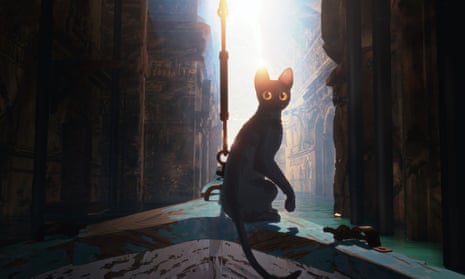
Latvian director Gints Zilbalodis’s enchanting eco-fable about a lone moggy in a flooded world is a triumph of imagination over budget
By Wendy Ide
Animation as a medium and fairytales as a subject have always been natural bedfellows. You only need to look at Disney’s princess industrial complex to understand that sparkle-dusted happily-ever-after is big business; that the appetite for this particular breed of magical thinking (plus associated merchandising and sequined tat) is enduringly healthy. But the beguiling, Oscar-winning, dialogue-free Latvian animation Flow, which tells of a solitary cat who must learn to cooperate with a mismatched pack of other species to survive a catastrophic flood, is a little different.
The fairytale here is not the story the picture tells – it’s the story of the film itself. Created by a tiny team with a minuscule budget of about £3m, and rendered entirely on the free open-source 3D software Blender, Flow has been on a journey: its premiere in Cannes; the haul of prizes (54 to date), culminating in the Oscar for best animated feature – that is the stuff of film industry fantasy.
While the limited budget certainly shows on screen at times, it also gave director Gints Zilbalodis a considerable degree of creative freedom. With more money comes compromise and consensus film-making, plus a tendency to spoon-feed the audience rather than challenge them. Flow, however, embraces mystery: we see a disaster unfold in the same way the animals do – with no warning or context.
Zilbalodis has chosen not to explain the recent history of what seems to be a post-apocalyptic but stunningly verdant, geographically unspecified world. There are signs, in the lush forest, of human habitation and the remnants of civilisation. The cat lives in a house that appears to have once been home to a kitty-obsessed sculptor. Feline statues of varying sizes stand like sentinels in the grounds; a half-finished carving still rests on a workbench. But whether the former inhabitant has been relocated or is long since dead – perhaps along with the rest of humanity – is left open to the audience to interpret, and your reading of the background to the story very much depends on how bleakly apocalyptic your worldview is.
The cat’s happy solitude in the abandoned building is interrupted by a sudden environmental disaster: rapidly rising flood waters submerge the house and the forest surrounding it. A last-minute reprieve comes in the shape of a drifting sailboat, but the cat is outraged to discover that the vessel must be shared with another passenger – an unflappable and permanently chilled-out capybara. As the boat drifts, it takes on other creatures: an acquisitive ring-tailed lemur with a weakness for shiny trinkets; a wise but haughty secretarybird; and an excitable goofball of a dog.
One of the most distinctive elements of Zilbalodis’s vision is his decision to let his animals remain animals, instead of attempting to squeeze them into the mould of personhood. The character design and animation of the creatures are where the film’s meagre budget is most evident, and yet behavioural details are minutely observed. The cat – a neat, slinky, self-contained little black moggy – is pure feline, from the insouciantly twitching tip of its tail to its testy chirrup of annoyance (all the animal sounds are real, rather than voice actors cosplaying) at having to share a space with other critters. As an alternative to stamping human personalities on them, Zilbalodis instead encourages us to see elements of ourselves in the animals.
Being a self-taught animator accustomed to working on his own (his previous feature film, Away, was an entirely solo project created on his computer), the director has revealed in interviews that he identifies most with the self-sufficient cat, who must learn to cooperate with others. And anyone with a tendency to hoard accessories and to overpack when travelling will feel a kinship with the lemur.
An eco-parable, Flow is not exactly mining new thematic territory; from Wall-E to Cartoon Saloon’s My Father’s Dragon to The Wild Robot and numerous Studio Ghibli pictures, animated movies dealing with imminent climate collapse are relatively plentiful. However, the approach of Flow, with its animals’-eye, in-the-moment immediacy and its resistance to cutesiness and anthropomorphism, is bracingly fresh and unexpected. The animation, meanwhile, transcends its financial constraints to achieve moments of shimmering, heart-swelling loveliness.
Deliberately enigmatic in approach, with its focus on tiny, cat-level details and a provocative hint that the end of humanity may not be the end of the world, Flow doesn’t hammer home a single message. Other takeaways include the need to work together to survive, the value of adaptability – and that cats will always push stuff off tables given half the chance.
 Pas De Merde