As rich and full-bodied as a fine French wine, Cédric Klapisch’s Burgundy-set family drama draws character from the soil on which it’s set.
[VARIETY] When I was 13 years old, my great-aunt arranged for me to visit a vineyard in France’s Loire valley, where I was allowed to spend an afternoon planting grape vines with the family who had worked those fields for centuries. Together, we visited the facilities where the harvest was crushed and fermented, and tasted the wine these artisans had produced from previous years. An experience like that forever changes one’s perspective on wine, from something that comes from a bottle to a living, breathing thing, originating from the earth, planted and harvested by hand, shaped by the attitudes and sensibility of those who cultivate it.
Cédric Klapisch’s “Back to Burgundy” is the closest any film has come to expressing that special symbiotic relationship between real people, the soil they tend, and the ineffably personal concoction that results from that connection.
Though not a documentary, this gorgeous French family saga benefits enormously from Klapisch’s natural curiosity, informed by research (he participated in a harvest in order to observe its nuances) and elevated by his insistence that they film over the course of a full year, so as to capture the impact of the seasons on both viticulture and its human stewards. Continue reading “Film Review: ‘Back to Burgundy’”→
When you think of France, sure you think of cheese and berets, baguettes and love–or at least adultery–and what else? Wine. You think of the Bordeaux you can’t afford, snapped up by those pesky Russian oligarchs and Chinese financiers. Or the Rhones that are earthy, or the Rosés that, while not fine wines are runaway must-have now on the American Left and Right Coasts to augment their Mediterranean diets. A special spot in the heart of France is reserved for Burgundy, Southeast of Paris, where the French relate with a fanaticism to the Grand Cru Montrachets, Mersaults, and Chambertins the way we do to fantasy baseball. Where we might head to Spring Training in Tucson, French director Cedric Klapisch’s father made a bi-annual visit to his Burgundy connection to smell the earth, pinch the grapes, shmoos—they do that in French Yiddish, too—with the domain owner and, of course line up the cases they’d lay in to make sure the good times rouler, that’s French for roll.
I almost said roulot. That’s because French actor Jean-Marc Roulot is also a vintner of Burgundy, and while Klapisch didn’t cast Roulot in his first film in the early 90s, he became a client for his burgundy. That’s until Klapisch decided that instead of making another film about the slightly cracked but earnest young urban sophisticates of When the Cat’s Away, Family Resemblances, Paris, My Piece of the Pie and The Spanish Apartment. He was ready to make a film in Burgundy about winemakers. And so, he arranged to film a story with an early writing partner Santiago Amigorena at actor-vintner Jean-Marc Rolout’s vineyard and cast him in the film. Big win for Roulot, who plays Marcel, the hired master winemaker on a family vineyard, and who infused the script with a level of detail about the life and production cycles of wine that’s perhaps seen nowhere else except in a documentary about winemaking, Natural Resistance, by Jonathan Nossiter and produced by the writer here, Amigorena.
Back to Burgundy is fiction and concerns three sibling Millennials, two brothers and a sister, and how they grapple with saving the family vineyard after the death of their father. It’s somewhere between a basic text for future sommeliers and wine connoisseurs and a porn flic about the process by which an actress’ pretty feet trod the terroir and then stamps the succulent grapes in the vats, as you hear each grape pop and sigh, Oh, mon Dieu, I die for you!
Okay, back to reality here, or at least the film. It helps that the three siblings are the prettiest 30-somethings in France right now—Pio Marmai as the older Jean, who returns to the farm after a 10 year self-exile that ended in Australia on a vineyard with a wife and son, Francois Civil as the baby brother, Jeremie, the dutiful but less talented son and young family man who has married into a more prominent wine family, and Ana Girardot as Juliette, the middle sister, whose taste buds and instincts–shown in the story all the way back to childhood–make her the natural master winemaker, heralding a timely nod to feminism come to France.
Now listen up: In this clip, first we’ll hear Pio Marmai as Jean explain–in French, of course– to a beautiful African grape harvester that he’s travelled the world but now he’s come home. That’s followed by Ana Girardot as Juliette addressing the entire crew that this is a special year, the first harvest without their father. And then it ends in La Paulée, the party that celebrates the end of the harvest, and is the only party outside of the one Stanley Kubrick filmed in Eyes Wide Shut that I’m truly sorry I missed.
In all this filmed beauty by the 56-year-old Klapisch—who worked as a waiter in a French restaurant while he studied film at NYU in the mid 80s—there’s a small gap. The story’s central problem—how to pay the inheritance tax—is sort of spat out like a rogue grape skin. I guess that’s forgivable, because Back to Burgundy is a fantasy set in the four seasons of beautiful wine country, with pretty people fighting to save the vision of Old France and the French standards that make France France. The original French title is “Ce qui nous lie.” What Binds Us. That’s not only a topic that has been on the minds of French filmmakers for the last two decades, in such masterpiece films as Olivier Assayas’ Summer Hours of 2009—but the French electorate itself. How you come out on such issues that are the sharp notes just below the surface of the enjoyable Back to Burgundy can drive you to drink.
Isabelle Huppert as a clumsy teacher, Romain Duris as headmaster
[Google Translation / CULTUREBOX]
This crazy movie far from realism, is the opportunity for a new meeting between Isabelle Huppert and Serge Bozon. The star, awarded in 2017 by a Golden Globe and a César for her role in “Elle” Paul Verhoeven, had already shot under the direction of the director five years ago in the highly unclassifiable “Tip Top”, in which she embodied an inspector of police with Sandrine Kiberlain.
This time, the French actress is Madame Géquil, bad teacher unsure of her in a suburban high school to the colorful headmaster (Romain Duris), married to a homemaker (José Garcia). One day, struck down during an experiment in her laboratory, she will feel a new energy in her, which will allow her to finally transmit her knowledge to her students, and especially to one of them.
“A film about education and the transmission of knowledge”, according to Bozon
The idea of the film, which transposes Stevenson’s book into the feminine and into the world of school, was first born in the spirit of the co-writer of the film Axelle Ropert. “What seemed interesting to me was the film about education whose heroine is a teacher in check, and failed since the beginning of his career,” said Serge Bozon.
“We needed the fantastic to get it to something other than its eternal failure”, adds the director, for whom “the film is perhaps at the crossroads of different genres, but at the same time it is finally very focused on a only one question, that of education “and the transmission of knowledge.
The actress as we see it rarely, as a fearful woman
The 45-year-old director also said he found “interesting to look at Isabelle Huppert a dimension she had never explored”. “She usually plays strong, assertive characters, which goes with the question of authority, of violence.There is the opposite: she plays a very weak character at first, completely cowardly, fearful, who lives in the shadow of his permanent failure, “he analyzes.
The fantasy of the film, far from all realism and with stylized characters and outraged, also allows him to be “more frontal”, he analyzes. “The refusal of realism for me, it is what allows to go to the essential”.
Monsieur Pas De Merde is very much anticipating the US release of Two Is Family, the new French film starring Clémence Poésy and Omar Sy. Also, the February release of Cest La Vie, directed by Eric Toledano, Olivier Nakache, is also on my short list to see this Spring! Read more in this piece fro UNIFRANCE
In February, a comedy dominated the European markets and an adventure film appealed to Italian spectators, while a second comedy got off to a strong start in Belgium.
During the first two months of 2017, French productions generated 14.7 million in admissions abroad, in the same period in 2018, they totaled only 6.75 million.
This can be explained by the huge success of Leap (7.96 million and 14 million in total) and of Two is a Family (1.94 million and 5.12 million in total), which by themselves alone sustained the greatest proportion of the 2017 results, a score that the performances of new titles cannot manage to equal, despite the fine careers of Call Me by Your Name (3.14 million) and C’est la vie! (1.55 million) [. . . ]
As they make their way, sometimes merry, sometimes melancholy, a double-portrait of the artists forms. It’s very moving.
ROGEREBERT.COM
Agnes Varda is almost 90 years old and she is still making films. That alone should be cause for dancing in the streets. But wait, there’s more: Agnes Varda is almost 90 years old and she is still making fantastic films. Searching, compassionate, provocative, funny, sad ones. This is one of them. You should see it, and then go dancing in the streets.
Varda has been making films since 1955, and throughout her career, which saw her as one of the key figures in the French New Wave, she’s been a generous and ingenious collaborator. For this movie, which is part character drama (with real-life characters), part road documentary, and part essay-film, Varda co-signs with the French artist who calls himself JR. A bit over one-third Varda’s age, he always sports a hat and dark glasses. His work is in photography and public art. He travels through Europe in a van that’s a photo booth, creating large-format portraits of people he meets. He goes even larger with some of his other works, creating giant pictures that he then affixes to the sides of buildings, or train cars, or ships. After which he documents that work, and lets nature take its course—the images are generally washed away by time. In this film, one is very dramatically swept off by the tide.
JR’s is a humanist artistic mission; he gets ordinary people to partake in his work, which inevitably delights them. This movie, which has the French title “Visages Villages,” opens with scenes set in various places where, Varda and JR explain in voiceover, they did not meet. (Included is a funny scene at a disco, where a spry Varda—her unusual bowl haircut totally white on top, with a thick ring of vermillion at bottom, a kind of tonsure—dances up a storm at the other end of the floor from JR.) Once each describes the others’ work, and their mutual admiration, they’re off in JR’s van.
Varda’s ideas for photo work bring her to places she visited long ago, and her own earlier films. They visit the village of Cherance, in Normandy, where Nathalie Sarraute, the great writer to whom Varda dedicated her amazing 1985 film, “Vagabond,” lived. They find the well-hidden graves of Henri Cartier-Bresson and his wife, and pay homage. But while they honor the dead, they concentrate on celebrating the living. At one village, they see a row of one-time miners’ houses, waiting to be torn down. The hold up is one woman, the surviving daughter of a miner, who’s staying put. Her portrait, along with vintage images of the miners from the town, is pasted to the houses. The port at Le Havre, a man’s world clotted with ship’s containers, sees its largely unheralded women celebrated with a triptych pasted to a block of stacked containers. An enlarged portrait of Guy Bourdain, a one time collaborator of Varda’s who went on to become a celebrated photographer, is put on a concrete bunker that Germans abandoned in World War II and ended up off a cliff and embedded in a beach. A visit to a goat farm inspires an artwork calling for goats to be permitted to own their own horns.
As they make their way, sometimes merry, sometimes melancholy, a double-portrait of the artists forms. It’s very moving. Varda’s sight, which served her so well so many years, is getting dimmer. At the same time she wonders why JR always wears dark glasses. This habit, she tells him, reminds her of an old friend, Jean-Luc Godard. The resemblance sets up the film’s finale, which is puzzling, heartbreaking, but ultimately celebratory. And wobbles the line between documentary and fiction so strongly that the vibrations will linger in your heart for days afterwards.

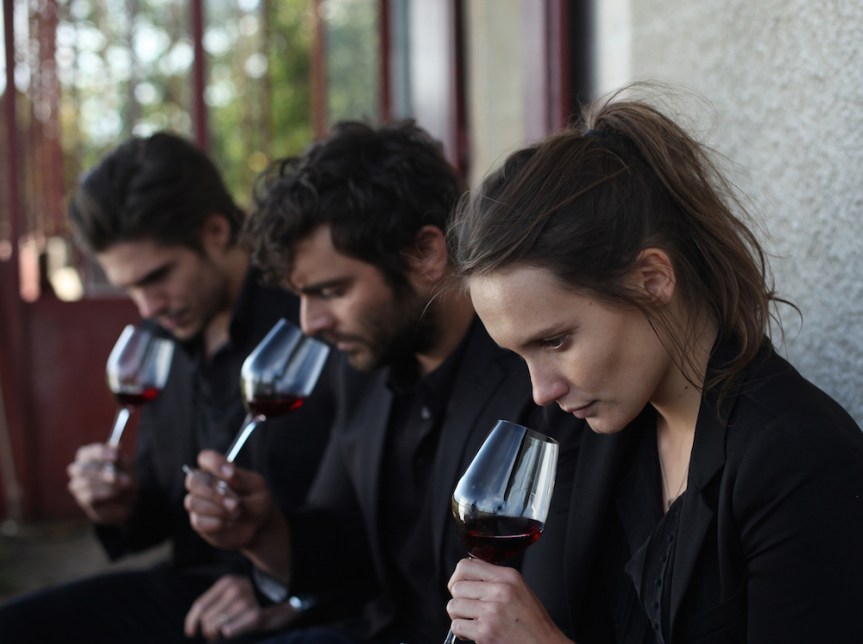 As rich and full-bodied as a fine French wine, Cédric Klapisch’s Burgundy-set family drama draws character from the soil on which it’s set.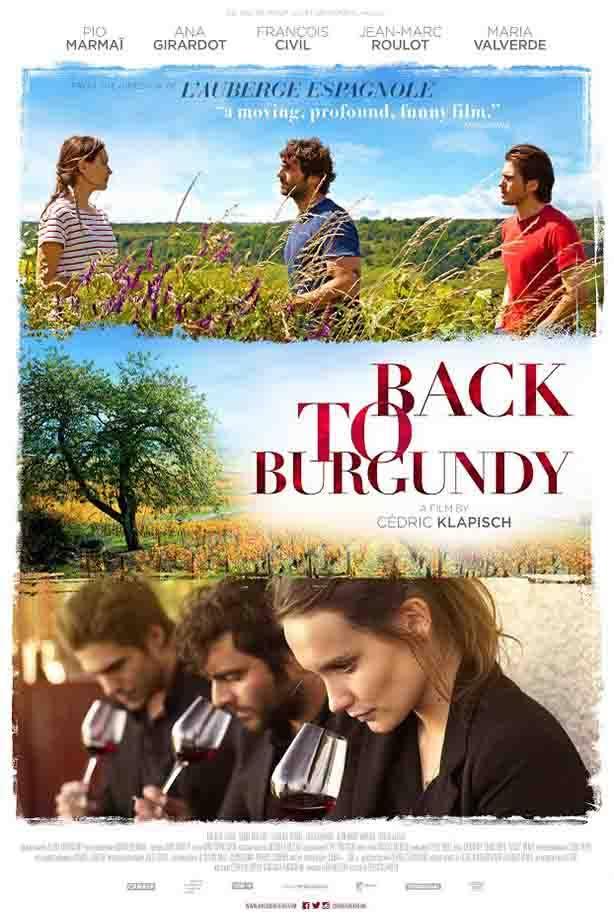


 Pas De Merde