“Jeannette, the childhood of Joan of Arc”, the musical of Bruno Dumont after Charles Péguy

“Jeannette, the childhood of Joan of Arc” is a musical. This writing, do not expect a dish in sauce of the style “The Ten Commandments”, version Élie Chouraqui and Pascal Obispo, or an adaptation in the mode “Joan of Arc Superstar”. There are, at the beginning, the texts that Charles Péguy dedicated to the Maid of Orleans: “Joan of Arc”, dating from 1897 while he was still an atheist, and “The mystery of the charity of Jeanne d ‘Arc’, of 1910, when he regained the Catholic faith. That already marks its difference. Then there is the look of Bruno Dumont. The director of ” Ma Loute ” presented in Cannes last year, and ” P’tit Quinquin ” in 2014, [ . . . ]

https://www.youtube.com/watch?v=GuqENb11uac

It would be a pity to limit the gaze on this film to those gags who often hold anachronism. It goes much further than that.

Source: “Jeannette, childhood of Joan of Arc”, the musical of Bruno Dumont after Charles Péguy

French pranksters replace holy water with alcohol

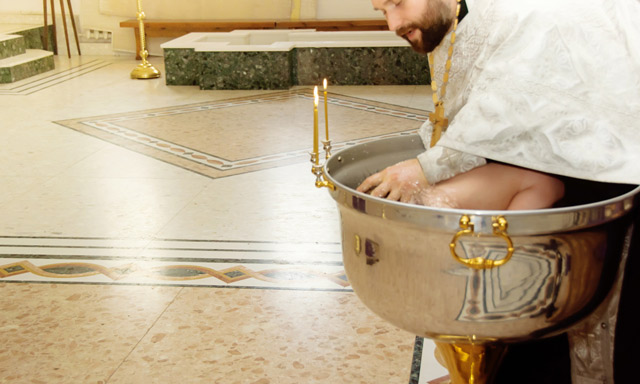
Tourists visiting a church in the picturesque French town of Chateau-Chalon were surprised to discover that local pranksters had replaced the fonts’ holy water with alcohol, the local tourism office said on Friday.

A dozen tourists sniffed out the telltale signs of eau-de-vie, a clear fruit brandy, when they visited the church in Jura, eastern France, at the end of August. “I made the sign of the cross and it smelt like eau-de-vie. Is this a local tradition?” the tourists asked officials at the nearby visitor centre. The enquiries prompted the authorities to carry out an impromptu investigation.  “A litre of brandy had been poured into both of the fonts, you really smelt the alcohol when you walked into the church,” local tourism official Pauline Fisseau said. The church is not regularly used for mass and the fonts are usually empty. The two fonts were immediately drained and cleaned before being filled with more traditional holy water ahead of a festival the following day. The identity of the pranksters and their intentions remains unknown. Village mayor Christian Vuillaume said it was “clearly a joke”.

Source: French pranksters replace holy water with alcohol – The Local

A Controversial Restoration That Wipes Away the Past

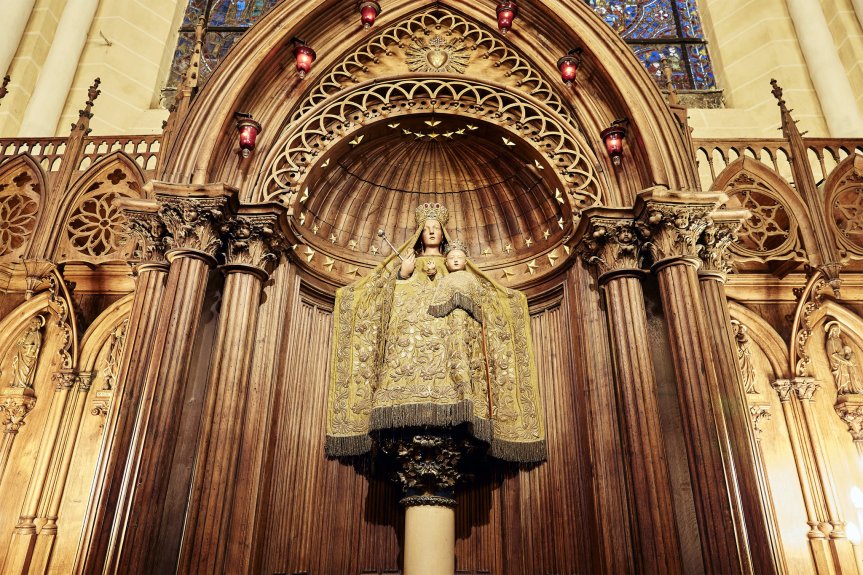
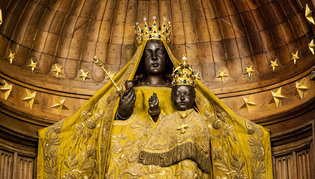
CHARTRES, France — The pilgrim did not find what he was searching for. As a child, Patrice Bertrand heard his mother recount details of her visit to the shrine of the famous Black Madonna of Chartres Cathedral, 60 miles southwest of Paris. Now Mr. Bertrand, 41, of Nantes, was following in her footsteps. But he was perplexed by what he discovered: “The statue I came to see is not here anymore,” he said. The Black Madonna had become white.

The decision to remove what a plaque in the cathedral calls the “unsightly coating” from the 16th-century wooden icon has come to symbolize the contested transformation of Chartres, which has been undergoing a decade-long restoration. For almost 500 years, pilgrims worshiped the Virgin’s dark visage, and it accrued the kind of mythic currency integral to Catholic worship. To some critics, the repainting has erased a cultural memory from a building its restorers say they are saving. [ . . . ] Read Full Story NY Times

A good exhibition is a lesson for the look – Saint-Merry

The Center Georges Pompidou offers a great retrospective of a major photographer Walker Evans (1903-1975) who spent most of his life as a photographer interested in the vernacular, in everyday life, in urban banality. He examined the American soul through its roads, advertisements, ordinary buildings, cars, pedestrians, and so on. It has marked generations of photographers.And at the end of the exhibition, a splendid text that questions less our look than the pleasure to look and evokes the spring of the artist.In this malicious parallel between church and museum, a question and then an affirmation come to mind: “What did you go to see in the desert? ”

Matthew 11: 7-9. As they were going away, Jesus began to say to the crowd about John, “What have you gone to see in the wilderness?” A reed stirred by the wind? But what did you go to see? A man dressed in precious clothes? Behold, those who wear precious garments are in the houses of kings. What have you gone to see? A prophet? Yes, I tell you, and more than a prophet”

Can we establish a parallel between the prophet and the artist?

Troubled question around the see.

John Deuzemes.


[ . . . ] Original French Translation: A good exhibition is a lesson for the look – Saint-Merry