Belleville, the Secret Birthplace of Communism 

Learn why you’ve probably never learned about the Belleville Commune in French history class.

Belleville, which encompasses most of the 20th arrondissement of Paris, is a neighborhood that feels a bit like its own country. And that’s not just because the “Beautiful City” is currently Paris’s Chinatown, or, more accurately, its Little Saigon.

This sprawling quartier built on a hill was actually once a suburb of Paris, which was accumulated by the French capital in the early 1800s. But in 1871, the citizens of Belleville worked together with members of the Parisian working class to overthrow the French government in the quartier and form the Commune of Belleville, which lasted for 72 days and resulted in one of the biggest massacres in French history. In one week, known as “the Bloody Week,” more than 15,000 people were killed in Belleville’s fight for working class independence. This event even went on to inspire political leaders like Karl Marx when he wrote his infamous Communist Manifesto.

If you’ve enjoyed this little history lesson, don’t miss more videos from anti-tourist Messy Nessy Chic, including this adventure into the Paris catacombs to watch The Rocky Horror Picture Show.

Source: Belleville, the Secret Birthplace of Communism – Frenchly

Watch Rocky Horror in the Paris Catacombs 


Halloween is here, gals and ghouls, and even though it might not be the biggest deal in France, there are still some in the country who know how to kick off the party right.

And Messy Nessy Chic, Frenchly’s favorite anti-tourist, has the scoop on where to go to find a very unusual Halloween celebration. Nessy’s motto is, “Don’t be a tourist in Paris,” and her videos capture the weird, the wild, and the mysterious lurking beneath the City of Lights. In this episode, she takes us to a screening of the cult classic The Rocky Horror Picture Show, hosted by the master of subterranean Paris known as La Cigale. “The Cicada” carved out his own amphitheater in the catacombs to screen old movies, and the creepy caverns are the perfect place for a spooky Halloween screening of this famous monster musical.

Nessy also heads to Studio Galande, which was featured in our article on what to do in Paris when it rains. For forty years this Latin Quarter cinema has done biweekly Rocky Horror showings with a full shadow cast, and the subcultural dedication rivals even that of the last few Rocky Horror theaters in New York. You won’t find it in a guidebook, but it’s not an event to be missed. Get your own tickets here, for an especially spooky — or at least sparkly — Halloween adventure.

Source: Watch Rocky Horror in the Paris Catacombs – Frenchly

Jean Cocteau

Cocteau

Jean Maurice Eugène Clément Cocteau (5 July 1889 – 11 October 1963) was a French poet, writer, designer, playwright, artist and filmmaker. Cocteau is best known for his novel Les Enfants Terribles (1929), and the films The Blood of a Poet (1930), Les Parents Terribles (1948), Beauty and the Beast (1946) and Orpheus (1949).

His circle of associates, friends included Kenneth Anger, Pablo Picasso, Joan Miró, Salvador Dalí, Gertrude Stein, Jean Hugo, Jean Marais, Henri Bernstein, Yul Brynner, Marlene Dietrich, Coco Chanel, Erik Satie, Ernst Jünger, Albert Gleizes, Igor Stravinsky, Marie Laurencin, María Félix, Édith Piaf, Panama Al Brown, Colette, Jean Genet, and Raymond Radiguet. (Wikipedia)

Modigliani
Modigliani’s portrait of Cocteau 1916

Tired of the Côte d’Azur? France has 35 other named coastlines 

Name one French coastline. Great. Now name another. Can’t? Here are all 36.

Despite a number of recent high-profile terrorist attacks, France remains the world’s most visited country. The numbers are going up, in fact: last year, the French welcomed 89 million foreign tourists, 8% more than in 2016.

But how familiar are those visitors with the many splendors of France? Here’s a test: quickly, name your favorite French museum, city, wine region (1) and beach. Most likely answers: the Louvre, Paris, Bordeaux (or Burgundy) and the Côte d’Azur.

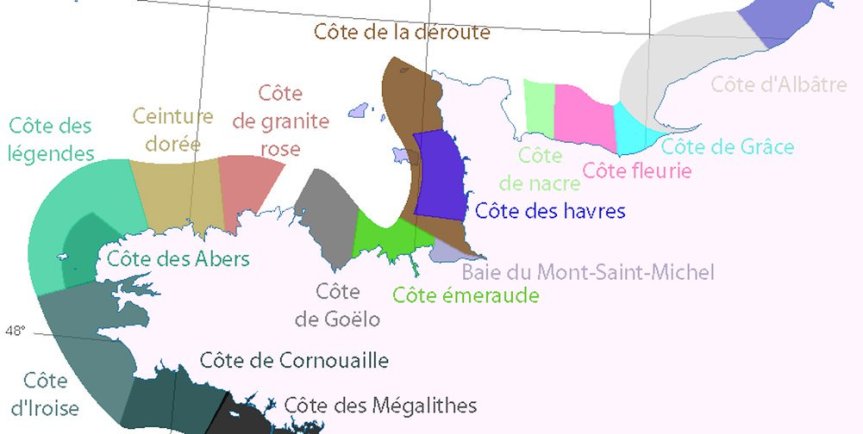
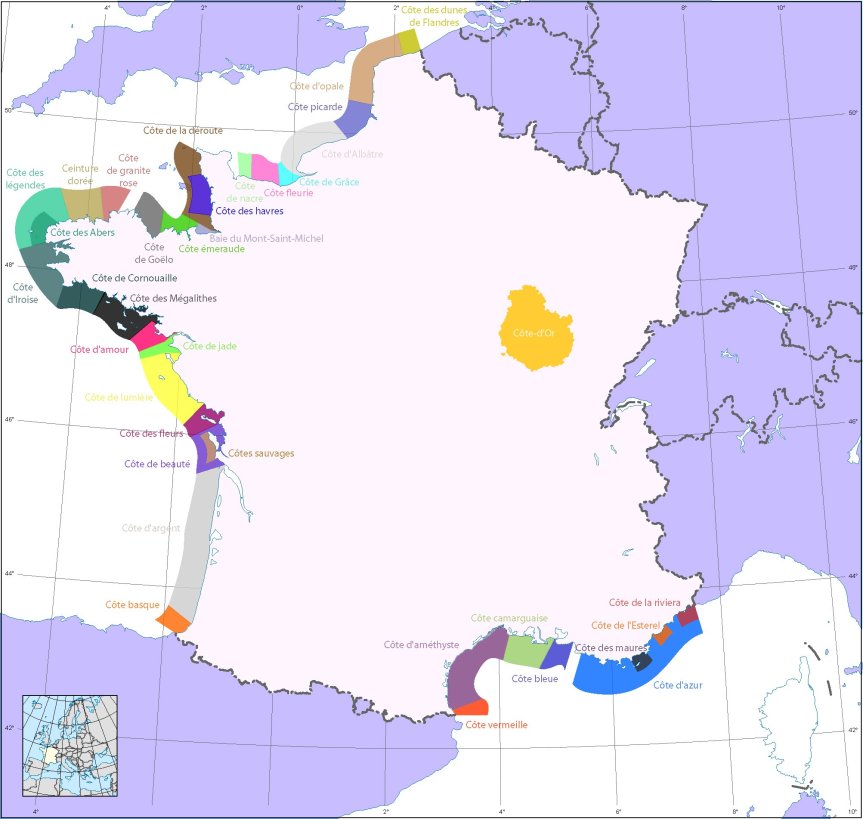
Hot and glamorous, the Côte d’Azur is the jewel in the crown of French seaside tourism. It’s also crowded and pricey. However, as this map shows, it’s just one of 36 named coastlines stretching along the country’s Atlantic and Mediterranean shores.

Commonly referred to in English as the French Riviera, the Côte d’Azur covers the eastern part of France’s Mediterranean coast. The term was coined by Stéphen Liégeard, who used it as the title for his 1887 book about his travels along the coast of the Provence in France and beyond, to Genoa in Italy. ‘Azure’ is the heraldic term for ‘blue’; he was perhaps inspired by his home département of Côte d’or (2). ‘Côte d’Azur’ quickly caught on, but only for the French part of the coast.

Hoping to emulate the success of their azure counterpart, many other French coasts were named soon thereafter, often after minerals, metals or colors (3). Each has its own particular history, climate, geography and charm. Below is a sample of some of the more remarkable stretches.

The Côte d’Opale (Opal Coast) was named in 1911 by local Édouard Lévêque, in homage to the region’s changeable light. Go here for two illustrious capes: Blanc-Nez (‘White Nose’) and Gris-Nez (‘Grey Nose’), the closest point between Europe and England, only 34 km (21 mi) from the white cliffs of Dover.

The Côte Fleurie (Flowered Coast) refers to the flowering apple trees in the interior. Dotting the coast are Deauville, Honfleur and other renowned seaside resorts – not forgetting Balbec, the fictional one from Proust’s A la recherche du temps perdu.

The beaches of the Cote de Nacre (Mother-of-pearl Coast) are better known by their D-Day code names: Gold, Juno and Sword.

The Baie du mont Saint-Michel (Bay of Mont Saint-Michel): A Unesco World Heritage site, this part of the Golf of Saint-Malo dividing Brittany from Normandy is dominated by the Mont Saint-Michel, a tidal island topped by a medieval abbey and pilgrimage site.[ . . . ]
Read full article at BIG THINK: Tired of the Côte d’Azur? France has 35 other named coastlines | Big Think

Commemorating the Global May ’68 Events 

Fifty years after the transformative May ’68 student-led protests in France, universities and cultural institutions across the country are presenting diverse programs and events that revisit the spirit of the ’60s in all of its facets, from revolution to social activism and more. Check back here periodically for an updated listing of events.

Read More: Commemorating the Global May ’68 Events | French Culture

The literature debate tearing apart Paris: should Céline’s racist pamphlets be published?


Louis-Ferdinand Céline was one of France’s greatest novelists – but plans to republish his anti-Semitic writing has dramatically divided Paris.

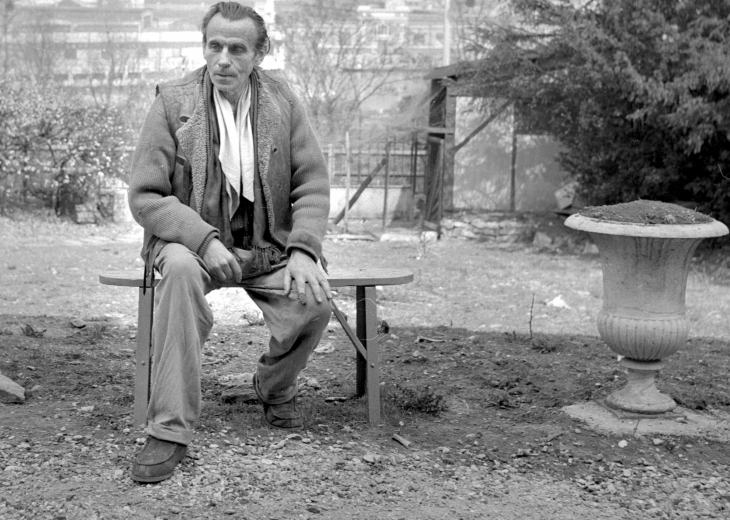
n a cold but sunny afternoon in late January I paid a visit to the Passage de Choiseul in the commercial heart of Paris. The passage is a covered arcade, one of many such places that were built across the Right Bank of Paris in the early part of the 19th century, and which were effectively the world’s first shopping malls. The Passage de Choiseul is also one of the most important and totemic sites in French literary history. It was the childhood home of the novelist Louis-Ferdinand Céline, arguably the greatest French writer of the 20th century, who still regularly outranks Marcel Proust in readers’ surveys and sales. Most significantly for his admirers, the passage was immortalised by Céline in his two magnificent novels, Journey to the End of the Night andDeath on the Instalment Plan, published in the 1930s. In Céline’s day the place was poor and decrepit and “stank of dogs’ piss”. Nowadays it is expensive and chic. But there is no trace of its most famous literary inhabitant – an extremely unusual fact in France, a country that prides itself on its literature, and where even the meanest provincial town has at least one Avenue Victor Hugo or Lycée Baudelaire.

I bought some pens and a notebook in the upmarket stationery shop just opposite the entrance to number 67, where I knew Céline had lived, and asked the lady behind the counter why there was no trace of the great man. She said that she was often asked this question by Céline’s admirers, who came from all over the world to this place, and that she did not know why there was no commemorative plaque or any other sign that Céline had lived here. She then hesitated, looked around to check that we were alone, and said quietly: “There are many Jews here who control business. They don’t want anyone to remember him.” [ . . . ] More at: The literature debate tearing apart Paris: should Céline’s racist pamphlets be published?