The Ukrainian capital regularly appears in French rap clips. Orelsan, Stromae, Damso … All have ventured on the banks of the Dnieper for one or more videos. Gringe has also chosen Kiev as part of the first clip of his next album.
We took advantage of the shoot to try to understand this craze.
” One more shoot! ” Exclaims a Ukrainian descending from the Marchroutka – these minibuses appeared in eastern countries at the fall of the Eastern bloc – which brings him back to Troieshchyna. In this popular and residential district of Kiev, located on the left bank of the Dnieper, the inhabitants are not surprised even more to see land cameras and technicians down the “panielki”. [ . . . ]
Winner of the European Films Awards and the Spanish Goya for his great critical and public success “Ida” (2015), Pawel Pawlikowski won the Cannes Direction Award with “Cold War”, an impossible love story during the Cold War. At the same time, he was handing Poland back to the Cannes loop with a magnificent film, something that had not happened for ages
Cold wars
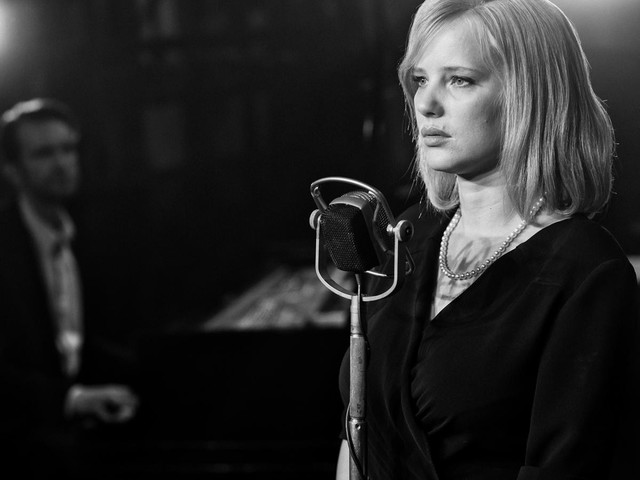
After “Ida”, everyone was waiting at the turn Pawel Pawlikowski. The selection of “Cold War” in Cannes was already reassuring, and the vision of the film, expectations are filled. Musician, Wictor (Tomasz Kot) discovers a talented young singer and dancer, Zula (Joanna Kulig). They fall in love and plan to join Paris. But Zula does not follow him. They will meet again in the City of Light, live together, then meet again in Poland, in a constant back and forth conditioned by both their feelings and a political context deleterious.
Pawel Pawlikowski finds the aesthetic rigor of “Ida”. Its ascetic black and white, its square format, its millimetric framing, its lights alternately wadded and contrasted. The image, which some will call glossy paper, is eminently poetic. Coldness? It probably comes from the geopolitical context of the time. This cold war (“Cold War”) is part of the romance, as if it contaminated it.
Attraction-repulsion
Wictor is enamored of freedom, but Zula, yet inhabited by her love, is still very attached to her homeland. After having joined Wictor in Paris, she will leave and marry an Italian, to find him again, and finally make a child with a Polish political framework … His position is like the “metaphor” (notion which is the subject of a very beautiful dialogue) of Poland under Soviet influence vis-a-vis the West. An attraction-repulsion that guides his conduct, and lead them to a fatal resolution, like the contemporary Poland that pays in nationalism.
Soprano Sabine Devieilhe’s signature operatic role, Lakmé, forms the starting point for her enticing album Mirages. A collection of opera and song in French, its theme is the exotic allure of faraway – and imagined – places and people. In addition to three numbers from Delibes’ opera, it features music by Berlioz, Debussy and Stravinsky and some rarer names: Thomas, Messager, Koechlin and Delage. Devieilhe is joined by mezzo-soprano Marianne Crebassa, pianist Alexandre Tharaud and the period-instrument orchestra Les Siècles under its founder, François-Xavier Roth.
Stocks of French Comté and Cantal cheese may drop significantly this year due to the effects of the summer heatwave and drought, producers have said, with some saying this is “the worst year ever” [ . . . ]