All the Poets (Musicians on Writing): Patti Smith

AFTER DECADES as a major force in punk rock — dating back to her shows at CBGB’s and her 1975 LP Horses — Patti Smith has earned a considerable reputation as a literary figure as well. She has introduced books of poems by Blake and Rimbaud, published several volumes of her own verse and song lyrics, and won the National Book Award for Just Kids, her 2010 memoir about her crucial early years with photographer Robert Mapplethorpe.

Smith’s new book is Devotion, a slim volume that is — at once — an ode to her favorite French writers, a short story or fable about a mysterious young ice skater, and a meditation on the creative process. (It is based on a speech Smith gave at Yale and is part of Yale University Press’s Why I Write series.)

Read full interview: All the Poets (Musicians on Writing): Patti Smith – Los Angeles Review of Books
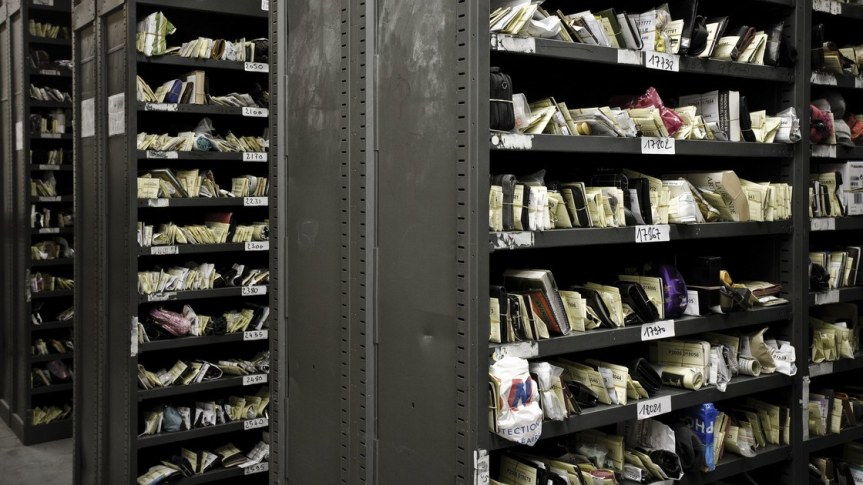
The Peculiar Poetry of Paris’s Lost and Found

On the southern edge of Paris, a five-thousand-square-foot basement houses the city’s lost possessions. The Bureau of Found Objects, as it is officially called, is more than two hundred years old, and one of the largest centralized lost and founds in Europe. Any item left behind on the Métro, in a museum, in an airport, or found on the street and dropped, unaddressed, into a mailbox makes its way here, around six or seven hundred items each day. Umbrellas, wallets, purses, and mittens line the shelves, along with less quotidian possessions: a wedding dress with matching shoes, a prosthetic leg, an urn filled with human remains. The bureau is an administrative department, run by the Police Prefecture and staffed by very French functionaries—and yet it’s also an improbable, poetic space where the entrenched French bureaucracy and the societal ideals of the country collide [ . . . ]

Read Full Story: The Peculiar Poetry of Paris’s Lost and Found | The New Yorker

Proust Letter About Neighbor’s Sex Lives Up For Auction

Marcel Proust is famous for transforming an evocative sensory experience into literary brilliance: I am writing, of course, of the nibble of a madeleine that catalyzed his immortal stroll down memory lane in “Swann’s Way.”

The author also, apparently, could turn an unwanted sensory intrusion into fairly amusing epistolary material. Among an astonishing collection of French literary miscellanea that will shortly go up for auction in Paris — the archive, which currently belongs to prolific collector Jean Bonna, includes first editions of works by Samuel Beckett and Honoré de Balzac, as well as correspondence from Victor Hugo and Gustave Flaubert — is a letter from Proust to his landlord’s son in which he objects to a certain unwanted auditory phenomenon in his apartment [ . . . ]

More at Source: Proust Letter About Neighbor’s Sex Lives Up For Auction – The Forward

Départ: Rimbaud

gun-that-shot-rimbaud

The most famous gun in French literary history, the revolver with which Paul Verlaine tried to kill his lover and fellow poet Arthur Rimbaud, sold for 434,500 euros ($460,000) at auction in Paris on Wednesday.

Départ


Enough seen. The vision has been encountered in all skies.

Enough had. Sounds of cities, in the evening, and in sunlight, and always.

Enough known. The stations of life. — O Sounds and Visions!

Departure amid new noise and affection!

Assez vu. La vision s’est rencontrée à tous les airs.

Assez eu. Rumeurs des villes, le soir, et au soleil, et toujours.

Assez connu. Les arrêts de la vie. – O Rumeurs et Visions !

Départ dans l’affection et le bruit neufs !

(Arthur Rimbaud ,1886)

The fascination with Fidel Castro of Saint-Germain-des-Prés 60s

In the 1960s, French intellectuals and artists, Gérard Philipe Jean-Paul Sartre, flocked to Havana, fascinated by the Cuban revolution. For them, Fidel Castro, died on the night of Friday to Saturday, will incarnate “hope”, at least for a time.Fidel Castro arrived when Stalinism was beginning to decline in ideals. He embodied hope, as something salutary, “said Jean Daniel, co-founder of L’Observateur, which then journalist with L’Express, met with Cuban in 1963. When on 1 January 1959, on the balcony of Santiago city Hall Cuba, Castro proclaimed the “beginning of the Revolution,” it is not yet a Marxist. But it is undeniably left and represents a great hope to some intellectuals after the Stalinist debacle.

Read Full Story: The fascination with Fidel Castro of Saint-Germain-des-Prés 60s