Michael Stevenson, aka Dai Bando, Johnny Foreigner, Monsieur Pas De Merde, is a blogger of French and British culture. His blogs "Pas De Merde" and "The Hobbledehoy" have been called "marvelous" by some, and "meh" by others.
Constantin “Tino” Rossi (29 April 1907 – 26 September 1983) was a French singer and film actor. Born in Ajaccio, Corsica, was gifted with a voice well suited for opera. He became a tenor in the French cabaret style. Later, he appeared in various movies.
During his career it is reported he recorded over 2000 songs and he appeared in more than 25 films.
Tino Rossi
Among his most famous hits, Petit Papa Noel sold over 30 million copies worldwide. Over the course of his 50-year singing career, Tino Rossi recorded over 2000 songs and sold over 200 million albums making him one of the best selling (and mostly forgotten) artists of all time.
I’ve always loved the hilariously desperate song “It Must Be Him” performed by Vikki Carr. The song sold over 1 million copies in 1967 and millions more since.
Vikki Carr remains a very under-appreciated vocalist, one who gets unfairly lumped-in with her white bread contemporaries dominating that woeful/golden era of 1960s MOR (Middle of the Road) radio.
On trips in the Stevenson family station wagon, my dad would play this musical spam on the car radio, punching in the dreaded WLKW button, while we kids in the back seat begged for DJ Joe Thomas playing Beatles, Beach Boys and Motown on WICE. But alas – this was elevator music without doors that open and let you out.
It was in the back seat of the Pontiac Tempest, that I learned Vicki Carr sang ‘grown-up” music that I actually liked. Eventually I saw her perform on TV with Merv, Johnny and Mike, where she was always beautiful, charming, and singing brilliantly. Still later, I became the odd used record customer who purchased both Vikki’s Greatest Hits album AND Moby Grape’s groovy debut (sans “flipping the bird”) while shopping at In Your Ear. Has anyone else ever purchased these two records together? No? Hooray for me.
Born Florencia Bisenta de Casillas-Martinez Cardona before opting for the anglicized stage name, Vikki Carr eventually enjoyed great success in the Latin music world, winning Grammy Awards for Best Mexican-American Performance in 1986.
This version of her hit song “It Must Be Him” is performed in Spanish, but the original song was sung in neither English nor Spanish, but in French – a reworking of Gilbert Becaud’s “Seul Sur Son Etoile.”
In 1971, she established the Vikki Carr Scholarship Foundation, dedicated to offering college scholarships to Hispanic students in California and Texas. To date, the Foundation has awarded more than 280 scholarships totaling over a quarter of a million dollars.
Such a lovely woman.
Though the lyrics to this song are quite dated (“Hello? Hello?…my dear God!”) when this tune is performed, let it not be sung by Jerry Vale, Jack Jones or Edie Gorme. Let it please be Vikki Carr!
Latvian director Gints Zilbalodis’s enchanting eco-fable about a lone moggy in a flooded world is a triumph of imagination over budget
By Wendy Ide
Animation as a medium and fairytales as a subject have always been natural bedfellows. You only need to look at Disney’s princess industrial complex to understand that sparkle-dusted happily-ever-after is big business; that the appetite for this particular breed of magical thinking (plus associated merchandising and sequined tat) is enduringly healthy. But the beguiling, Oscar-winning, dialogue-free Latvian animation Flow, which tells of a solitary cat who must learn to cooperate with a mismatched pack of other species to survive a catastrophic flood, is a little different.
The fairytale here is not the story the picture tells – it’s the story of the film itself. Created by a tiny team with a minuscule budget of about £3m, and rendered entirely on the free open-source 3D software Blender, Flow has been on a journey: its premiere in Cannes; the haul of prizes (54 to date), culminating in the Oscar for best animated feature – that is the stuff of film industry fantasy.
While the limited budget certainly shows on screen at times, it also gave director Gints Zilbalodis a considerable degree of creative freedom. With more money comes compromise and consensus film-making, plus a tendency to spoon-feed the audience rather than challenge them. Flow, however, embraces mystery: we see a disaster unfold in the same way the animals do – with no warning or context.
Zilbalodis has chosen not to explain the recent history of what seems to be a post-apocalyptic but stunningly verdant, geographically unspecified world. There are signs, in the lush forest, of human habitation and the remnants of civilisation. The cat lives in a house that appears to have once been home to a kitty-obsessed sculptor. Feline statues of varying sizes stand like sentinels in the grounds; a half-finished carving still rests on a workbench. But whether the former inhabitant has been relocated or is long since dead – perhaps along with the rest of humanity – is left open to the audience to interpret, and your reading of the background to the story very much depends on how bleakly apocalyptic your worldview is.
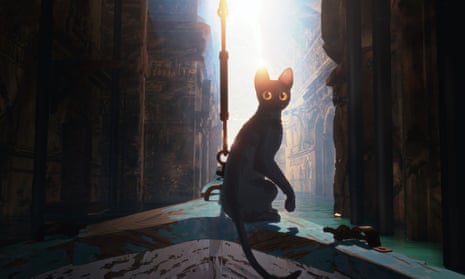
The cat’s happy solitude in the abandoned building is interrupted by a sudden environmental disaster: rapidly rising flood waters submerge the house and the forest surrounding it. A last-minute reprieve comes in the shape of a drifting sailboat, but the cat is outraged to discover that the vessel must be shared with another passenger – an unflappable and permanently chilled-out capybara. As the boat drifts, it takes on other creatures: an acquisitive ring-tailed lemur with a weakness for shiny trinkets; a wise but haughty secretarybird; and an excitable goofball of a dog.
One of the most distinctive elements of Zilbalodis’s vision is his decision to let his animals remain animals, instead of attempting to squeeze them into the mould of personhood. The character design and animation of the creatures are where the film’s meagre budget is most evident, and yet behavioural details are minutely observed. The cat – a neat, slinky, self-contained little black moggy – is pure feline, from the insouciantly twitching tip of its tail to its testy chirrup of annoyance (all the animal sounds are real, rather than voice actors cosplaying) at having to share a space with other critters. As an alternative to stamping human personalities on them, Zilbalodis instead encourages us to see elements of ourselves in the animals.
Being a self-taught animator accustomed to working on his own (his previous feature film, Away, was an entirely solo project created on his computer), the director has revealed in interviews that he identifies most with the self-sufficient cat, who must learn to cooperate with others. And anyone with a tendency to hoard accessories and to overpack when travelling will feel a kinship with the lemur.
An eco-parable, Flow is not exactly mining new thematic territory; from Wall-E to Cartoon Saloon’s My Father’s Dragon to The Wild Robot and numerous Studio Ghibli pictures, animated movies dealing with imminent climate collapse are relatively plentiful. However, the approach of Flow, with its animals’-eye, in-the-moment immediacy and its resistance to cutesiness and anthropomorphism, is bracingly fresh and unexpected. The animation, meanwhile, transcends its financial constraints to achieve moments of shimmering, heart-swelling loveliness.
Deliberately enigmatic in approach, with its focus on tiny, cat-level details and a provocative hint that the end of humanity may not be the end of the world, Flow doesn’t hammer home a single message. Other takeaways include the need to work together to survive, the value of adaptability – and that cats will always push stuff off tables given half the chance.


 Pas De Merde