
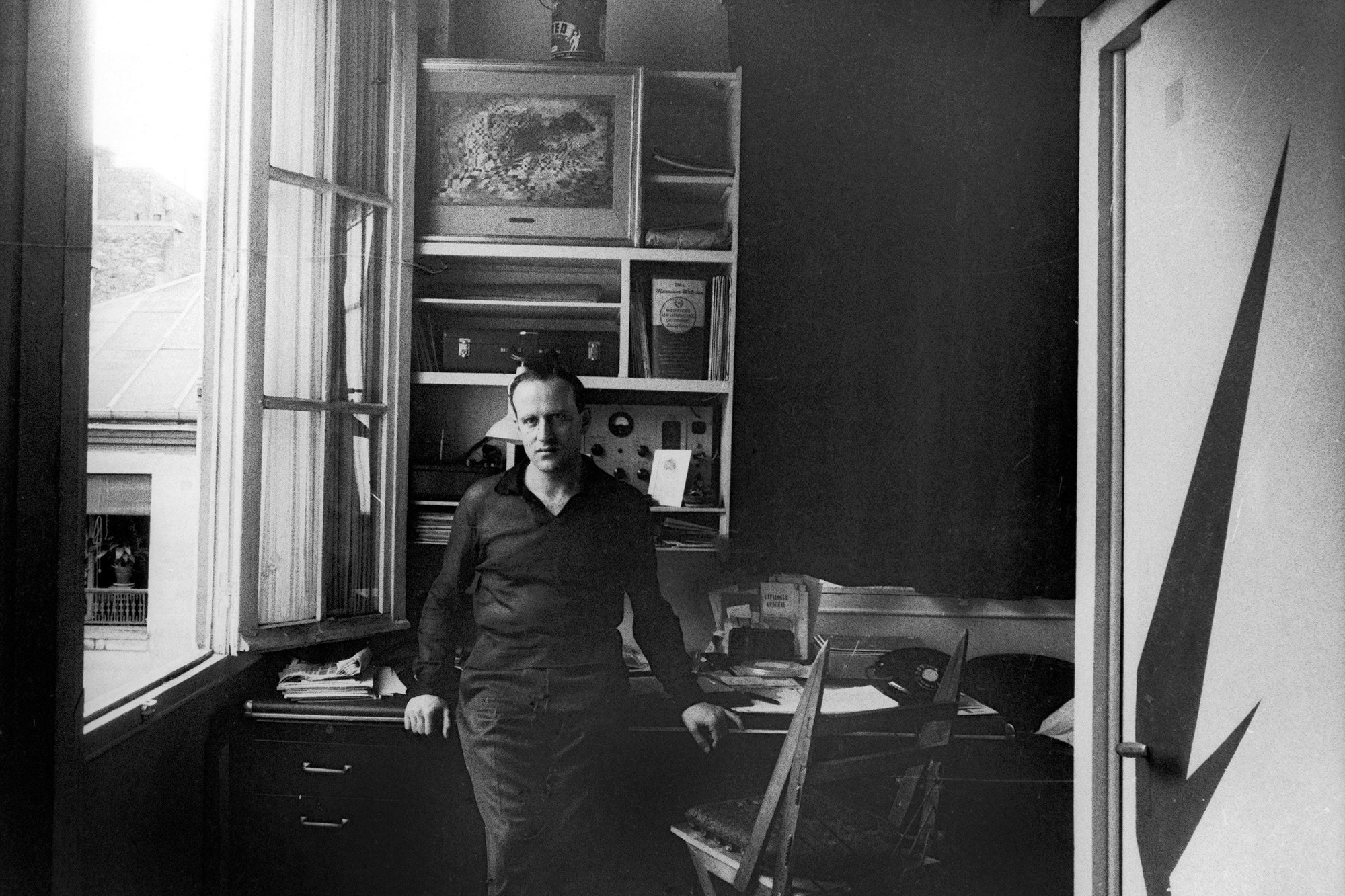
How Boris Vian brought cool to Paris.
By Dan Halpern
In 1946, Boris Vian—novelist, poet, playwright, songwriter, jazz trumpeter, screenwriter, actor, and general scourge of anyone failing to have enough fun in Paris in the postwar era—came to New York. He made the trip from France by submarine, caused a small international incident upon arrival, and had lunch. Then he ventured forth to discover America.
Vian was impressed by the state of American progress, which, he concluded, was far ahead of that of his native country, and not so impressed by American girls, whom he deemed silly things with large behinds. He ran into Hemingway but didn’t recognize him, and failed to say hello. He went to see the Empire State Building, only to discover that it had recently been demolished. He came across the Surrealist André Breton living in Harlem camouflaged as a black man and calling himself Andy. He spent a morning sitting in front of his hotel, hoping to see a lynching, but was disappointed.
Or so he said in “Impressions of America,” one of a series of columns written for Jean-Paul Sartre’s literary review, Les Temps Modernes, under the general title “Chronicles of a Liar.” In fact, Vian never visited the United States, except in his own imagination. But America was one of Vian’s most enduring fascinations, born of a love of jazz and matured by the postwar Continental vogue for all things transatlantic. The sentiment, however, has never remotely been returned; his obscurity in this country is all but perfect. Now it seems that this may be changing. TamTam Books, an enterprising publisher in Los Angeles, has embarked on translating a wide range of Vian’s work, including the scandalous pseudonymous novel that launched his career. Dalkey Archive Press has published the first American edition of his last novel, “Heartsnatcher” ($13.95), and Rizzoli has recently published Vian’s “The Manual of Saint-Germain-des-Prés” ($40), a facetious guidebook to bohemian Paris, left unpublished at his death, in 1959
Vian’s great novel, “L’Écume des Jours,” written in 1946, has become one of the most popular books in all of twentieth-century French literature, making Vian, in France, the sort of hero whom succeeding generations transform into an institution. (The title translates, literally, as “Foam of the Days,” or “Scum of the Days,” though it has been rendered, in various translations, as “Froth on the Daydream,” “Mood Indigo,” and, most recently, “Foam of the Daze.”) But while he was alive Vian was known less for his work than for being the epitome of Left Bank bohemia, standing at the center of its postwar rehabilitation after the trauma of the German Occupation. He was the presiding spirit of intellectual café society, and a close conspirator with Sartre and Simone de Beauvoir. He had no allegiance to existentialism, however. Instead, he offered a single absurd voice, dedicated to pleasure and provocation, to dreams and pure subjectivity. While Albert Camus and Maurice Merleau-Ponty spent their time worrying about choosing the right sort of authentic freedom or struggling against world-historical forces, Vian was more interested in amusing himself. “I am not an existentialist,” he wrote. “For an existentialist, existence precedes essence. For me, there isn’t any such thing as essence.”
“I was born, by chance, on March 10, 1920, at the door of a maternity ward, which was closed due to a strike,” Vian wrote by way of autobiography. “My mother, pregnant by the works of Paul Claudel (whom, to this day, I cannot stand), was in her thirteenth month and could not wait for a legal settlement to the issue.” In fact, he was born, on that day, into a well-to-do bourgeois family living in Ville-d’Avray, a suburb of Paris. The Vians lost most of their money in the crash of 1929, but by the time he was a teen-ager Boris was already committed to not letting anything get in the way of fun: he organized legendary parties in his family garden, with guests dancing into the night.
As a child, Vian was given a diagnosis of a heart problem, and he battled various ailments throughout childhood and adolescence. He often predicted that he would die before he was forty. An early death, and a long-foretold one, became an essential element of his personal mythology: he had no time to waste. He liked to say that one should be a specialist in everything, and he did his best to live up to this dictum.
In his late teens, Vian began listening to Duke Ellington and took up the trumpet. In 1941, his heart condition having kept him out of the war, he began performing with the clarinettist Claude Abadie’s jazz band, which soon was renamed the Abadie-Vian Orchestra. Meanwhile, he did his best to avoid any sort of regular work, though he did spend four years as a civil engineer, employed in the glassworks division of the French standards bureau. (His first assignment there was to find the perfect bottle, appropriately enough: one of his more famous songs is called “I Drink,” and runs, “I drink / the worst cheap wines./It’s disgusting / but it passes the time.”) After the war, he formed his own group, which he called the Little Choir of Saint-Germain of the Feet, and helped transform the underground club Le Tabou into one of the hottest spots in the city. As he wrote in “The Manual of Saint-Germain-des-Prés,” “Rather quickly Le Tabou evolved into a center of organized madness.”
When Vian was twenty-one, he married Michelle Léglise, the daughter of an inventor, and his first attempts at writing were done to amuse her. He began with poetry—a book of sonnets—and finished two novels before writing “Foam of the Days.” He dedicated it to her—“Pour mon bibi”—and the book has the quality of an absurd love letter, a fairy tale for grownups. Colin, a young man possessed of a fortune large enough to avoid any sort of work, and Chick, a young man without fortune who avoids work nonetheless, meet two girls, Chloe and Alise. Colin has a factotum, Nicolas, a sort of Surrealist Jeeves, who serves pâté made out of eels that he finds in the plumbing, carries on conversations with mice, sleeps with teen-age girls, and is Alise’s uncle. When Chick remarks on the resemblance between uncle and niece, noting a particular difference in the general area of the chest, Nicolas answers that, indeed, “she is more developed perpendicularly, if I may be permitted this precision.” Colin and Chloe fall in love, and marry.
But this simple tale is only the canvas onto which Vian’s hyperactive imagination splashes a rich variety of bizarre effects and contemporary allusions. He misses no opportunity to invent new words, or to play with the ambiguities of already existing ones. The book is peppered with pianos that mix cocktails according to which notes are played, rifles that require being fed by human warmth to grow regularly, a philosopher named Jean-Sol Partre, who arrives at his lectures on the back of an elephant, and a visit from a noncommittal Jesus, who refuses to take responsibility for any of it. The book is half a satirical picture of sleek postwar culture—gadgets, car trips, parties—and half a blooming forest of surreal effusions. Here is Colin, off to meet his friends, seeing the world as only he sees it and drawing his own conclusions:
That a pigeon-headed man is better suited to water than to ice is hardly something that most readers will feel requires no explanation, but Vian isn’t interested in explaining what he sees. He deploys his effects with deadpan bravado, as if they were nothing out of the ordinary. He works in a universe of pure lightness, rising up against what Italo Calvino once called “the weight, the inertia, the opacity of the world,” lifting himself above all laws of gravity out of a certainty that they do not apply to him.
Until, suddenly, they do. For most of the book, Colin and Chick live in a childish world, of girls and jazz and fun, but around them Vian’s surreal sketchbook starts to display an almost giddy cruelty. Vian evokes a mechanized world in which human lives, apart from those of the main characters, seem utterly expendable. At Partre’s lecture, his fans are so crazy to see him that some try to parachute in (a team of firefighters drown them with hoses) and others try to enter the hall through the sewers (security stomps them, and rats eat the survivors).
“Foam of the Days” is a deeply silly piece of work, but, as these macabre flourishes accumulate, it becomes, ultimately, a tragedy, following a descent into despair that is characteristic of Vian’s novels. Soon after her wedding, Chloe falls sick. A water lily is found growing in her lung, and her illness destroys Colin’s world, forcing him into the domain of money and misery and heaviness. Vian’s delight in youth and his sense of its fragility are always intertwined: it is the responsible lives of adults that are nonsensical, and a refusal to grow up that is the only reasonable way to live, but this natural course of things is not allowed. Like Vian, Colin wants nothing more than to play lovely games his whole life, but life will not let him.
“Foam of the Days” was the third novel that Vian wrote, but commercial success eluded him. In the summer of 1946, however, he made a wager with the head of a struggling publishing house that, given a few weeks, he could produce a best-seller. He sequestered himself for the next fifteen days, emerging to announce that he had discovered and translated a novel by an African-American writer named Vernon Sullivan, who had found no American publisher willing to touch it. The book, titled “I Spit on Your Graves,” is a pulpy, grotesque cartoon with a deliberately incendiary plot: a black man, passing for white, murders a pair of wealthy white girls he has seduced after his brother is lynched. Published in French toward the end of 1946, the book initially attracted only minimal notice, until a man named Daniel Parker, the leader of a right-wing morality watchdog group, Cartel d’Action Sociale et Morale, set out to have the book banned and its author, translator, and publisher prosecuted. The book’s notoriety increased further when a deranged man strangled his lover in a hotel room, and the police found a copy of the book by the bed. Passages in which the protagonist strangles a woman had been circled.
Riding on this tide of scandal, “I Spit on Your Graves” became the best-selling book in France in 1947. Amid the uproar, Vian maintained that he was merely the translator—he even published a text of the putative English original—but by the end of 1948 he had to admit that there was no Sullivan, and that he was the book’s sole author; he was eventually fined a hundred thousand francs for his offense to public morals. By then, a new Sullivan novel had appeared, “The Dead All Have the Same Skin,” the story of a white man so repulsed by the fear that he is black that he turns to murder and rape. Vian named him Dan Parker.
The Sullivan novels catapulted Vian to a sudden professional success, but, as he himself acknowledged, they are not very good. They are avowedly trashy, presumably influenced by Vian’s reading of American noir—an influence perhaps comparable to the effect of Hollywood B movies on French postwar cinema. Nonetheless, James Baldwin, in his long essay “The Devil Finds Work,” thought “I Spit on Your Graves” worth taking seriously: “What informs Vian’s book . . . is not sexual fantasy, but rage and pain: that rage and pain which Vian (almost alone) was able to hear in the black American musicians, in the bars, dives, and cellars, of the Paris of those years. . . . Vian would have known something of this from Faulkner, and from Richard Wright, and from Chester Himes, but he heard it in the music, and, indeed, he saw it in the streets.” Baldwin also observed that the book’s “vogue was due partly to the fact that it was presented as Vian’s translation of an American novel. But this vogue was due also to Vian himself, who was one of the most striking figures of a long-ago Saint-Germain des Prés.”
Indeed, from the end of the war, Vian was everywhere you looked—“the Prince of a subterranean kingdom,” his biographer Noël Arnaud called him, “a prince in shirtsleeves with a trumpet for his scepter.” “The Manual of Saint-Germain-des-Prés” portrays a scene filled with poets and painters, movie stars, singers, and philosophers—Jean Cocteau, Jean Genet, Alberto Giacometti, Tristan Tzara, Juliette Gréco, Simone Signoret. De Beauvoir, describing a party at the Vians’, recalled:
American culture, discouraged in France by the Vichy regime, held enormous attraction for the postwar generation, and arguably helped France reshape its sense of self after the shame of the Occupation. Vian was at the center of this movement. He wrote a vast amount of jazz criticism, most of it for a journal called Jazz Hot, a publication that was, to the music of the time, something like what Cahiers du Cinéma was, later, to film. He became a leading promoter of American jazz in France, helping organize Paris gigs for Duke Ellington, Charlie Parker, and Miles Davis, and taking visiting musicians to parties, restaurants, and clubs.
He also wrote three more novels as Sullivan and three under his own name, but nothing sold as well as “I Spit on Your Graves,” and, with each failure, Vian’s finances became shakier. His marriage ended, and so did the novels; his entire corpus of fiction was produced in an extraordinary burst of activity between 1946 and 1953. He kept himself busy, however, turning his attention to music, journalism, the theatre, and translations. His collected works, published recently in France, run to fifteen large volumes—six novels under his own name and four under the Sullivan pseudonym, as well as a torrent of plays, poems, short stories, film scripts, opera librettos, cabaret shows, essays, criticism, treatises, pornography, and hundreds of songs. He published writings under twenty-seven different pseudonyms, and translated a great deal of American fiction, including works by Richard Wright, Raymond Chandler, and Ray Bradbury.
Even as his health declined, through the nineteen-fifties, he showed a willingness, indeed a compulsion, to turn his talents to anything. He recorded many of his own songs, and, in 1954, his music restored him to notoriety, when “The Deserter”—an antiwar song written just before France’s defeat in Indochina and on the brink of the French-Algerian war—was banned. He also acted in six movies, most notably in Roger Vadim’s film version of “Les Liaisons Dangereuses.” He rounded out his career as a jazz A. & R. man, first for Philips and then for his friend the record producer Eddie Barclay.
Vian remains difficult to categorize, in part because he both was and wasn’t a creature of his time. For all his cultural centrality in postwar Paris, his books have much less in common with anything his contemporaries were up to than with the linguistic playfulness of writers who preceded him, from Mallarmé to the Surrealists, or, for that matter, with literature that came just after—the practitioners of the nouveau roman who emerged in the late fifties, or the game-playing Oulipo crowd of the sixties. “He lived ahead,” Arnaud wrote. “He was, and remains, on the arc of the future.” “Foam of the Days” was largely ignored on its publication, but it became a totemic book to the revolutionary generation of 1968: by 1962, it had sold only three thousand copies; by 1975, the figure had reached a million.
But by then Vian was long dead. In 1959, as he sat in a movie theatre, watching an adaptation of “I Spit on Your Graves”—a French production that he had wanted nothing to do with and had tried to prevent from being made—his weak heart finally gave out. He was thirty-nine. According to Vian legend, he was able to bear only ten minutes of the movie before collapsing, and his last words were “These guys are supposed to be American? My ass!” Evidently, the Americans in the film were not the Americans Vian had seen in his head, and, for Vian, what he saw in his head was all that counted. In the preface to “Foam of the Days” he wrote, “There are only two things: love in all its forms with pretty girls and the music of New Orleans or Duke Ellington, it’s the same. The rest should disappear, for the rest is ugly, and the brief demonstration that follows gathers all its energy from the fact that the story is entirely true, because I imagined it from one end to the other.” ♦
Source: Prince of Saint-Germain | The New Yorker
[ Published in the print edition of the December 25, 2006, issue. ]


 Pas De Merde