Movie review: ‘Young Mothers’ by Dardenne Brothers

In Young Mothers, we have four teenagers navigating their motherhood while dealing with addiction, love, unstable parents and absent partners

By Anuradha Vellat

No process tests the spirit like motherhood does. A body in continuous transition for nine months for humans. Even the non-mothers know that growing a fetus inside takes a toll and might even change the body’s anatomy for good. Add to this the cocktail of adolescence and you have an impending train wreck.

In Young Mothers, a French feature directed by Jean-Pierre Dardenne and Luc Dardenne – referred to as the Dardenne Brothers – and screened at the Dharamshala International Film Festival (DIFF) 2025, we have four teenagers navigating their motherhood while dealing with addiction, love, unstable parents and absent partners.

Perla, Julie and Araine are new mothers, their babies only a few weeks old. Perla pesters the father of the child, a teen himself, to be with them. He is dismissive of her. For Julie, the struggle is her own addiction. She distrusts herself with the responsibilities. Araine, meanwhile, understands the precarity of the life that lies ahead. Growing up with an abusive parent, she knows the repercussions her own baby might incur and wishes to give her away.

The girls – Jessica, Perla, Julie and Araine, played by Babette Verbeek, Lucie Laruelle, Elsa Houben and Janaina Halloy Fokan, respectively – live in the maternal home in Liege, Belgium, and are at the crossroads of adulthood. There is no pregnancy glow, no time for cravings, no partner to take turns to hold the baby. Just a few good women, symbolic of their own absent mothers, at a shelter, who have their backs to help them from falling into an emotional cesspool. Jessica is due any time soon, which is when she longs for her own mother who abandoned her as a child.

The girls want to assert themselves because they have just undergone a very adult process. However, they are scared of the consequences of their assertions which further confuse them. The girls see their relationships with their children as extensions of their longings in life, with fears of guilt and abandonment creeping in every now and then.

The phenomenal thing about Young Mothers is that the Dardenne Brothers do not delve into a singular state of being. They use the complexities of the community of teenage mothers to drive the plot. The directors are aware of the impossibility of describing the process of carrying a child so they stick to teen impulses and the actors deliver extraordinarily. Shot with a handheld camera, the scenes are intimate and often anxiety-inducing, especially because it involves weeks-old children in the arms of their “child mothers”.

The Dardenne Brothers trust their viewers with the intelligence of interpretations, which was evident from the ample conversations after the screening: Was the film about the universal question of motherhood? Was it particularly intense because of undetected post-partum showing up in individual ways? Was it about assertion of identities, which subverts the trope of a sacrificial mother?

It is difficult to arrive at conclusions after watching Young Mothers but the longing for closure is a closure in itself.

Source: DIFF review: ‘Young Mothers’ by Dardenne Brothers | Hollywood

The Dardenne Brothers’ ‘Young Mothers’ Gets 10 Minute Ovation In Cannes

Cannes habitués Jean-Pierre Dardenne and Luc Dardenne debuted their latest film, Young Mothers, in Competition this afternoon, greeted by a 10.5-minute ovation.

The story follows five girls who are housed in a shelter for young mothers. The teenagers are hoping for a better life for themselves and their babies.

Marking their ninth time in Competition, the Dardenne brothers are two-time Palme d’Or winners, for 1999’s Rosetta (which also took a Best Actress prize for Emilie Dequenne who passed away earlier this year), and for 2005’s L’Enfant.

Other laurels the Belgian brothers have received on the Croisette include Best Screenplay for 2008’s Lorna’s Silence, a shared Grand Prize for 2011’s The Kid with a Bike, Best Director for Young Ahmed in 2019 and a special 75th Award for 2022’s Tori and Lokita.

Luc Dardenne told the Cannes Film Festival of Young Mothers, “We wanted to tell five stories about five young girls who, each in their own way, escape a destiny — a prison.” However, there’s slightly more lightness to the film than their previous collaborations.  Luc Dardenne credited the music in the movie, “which wasn’t in the last two films.”

Added Jean-Pierre Dardenne speaking to Cannes, “A baby that’s crying, that you need to put down… these are things that we have incorporated… It adds tempo — a completely different rhythm.”

The cast includes Babette Verbeek, Janaina Halloy Fokan, Samia Hilmi, Elsa Houben and Lucie Laruelle.

Goodfellas has international sales on Young Mothers and Diaphana is distributing in France.

Source: The Dardenne Brothers’ ‘Young Mothers’ Gets 10.5-Minute Ovation In Cannes – IMDb

‘Tori and Lokita’ Trailer: Dardennes Return with Fiery Immigration Drama

Exclusive: The film, which won the 75th Anniversary Prize at Cannes last year, opens in select theaters on March 24.

Jean-Pierre and Luc Dardenne have spent their 50-year filmmaking career crafting politically charged works of realism that never shy away from the systemic injustices in the world. Their unflinching brand of filmmaking has earned them two Palme d’Or awards amid countless other honors, but their latest film might be their angriest work yet.

“Tori and Lokita” saw the Dardennes take on the immigration systems of first-world countries and the needless bureaucracy that often leaves people’s lives hanging in the balance. Telling the story of two children who are determined not to be separated as they try to immigrate from two separate countries, it was an instant hit when it premiered at the 2022 Cannes Film Festival.

Per the official synopsis, from two-time Palme d’Or winners Jean-Pierre and Luc Dardenne comes the story of 17-year-old Lokita and 12-year-old Tori (in remarkable debut performances from Pablo Schils and Joely Mbundu), two immigrants — from Benin and Cameroon, respectively — struggling for survival on the margins of society. The inseparable pair work as performers in a cheap trattoria, dealing drugs on the side for the restaurant’s abusive cook, while balancing the demands of an indifferent bureaucracy and a band of violent smugglers. When Lokita is held captive while working in a marijuana grow house, Tori scrambles to save his companion from their abusers, as events spiral out of control.

“Tori and Lokita” was overwhelmingly praised when it premiered at Cannes, where it ultimately won the festival’s 75th Anniversary Prize. In his Cannes review, IndieWire’s David Ehrlich wrote that, “Like most of the duo’s work, ‘Tori and Lokita’ leverages the irreducible nature of human dignity against the ever-worsening apathy of human civilization. Like much of their work — including the Palme d’Or winner ‘Rosetta’ and the 2002 masterpiece, ‘The Son’ — the film’s threadbare story hinges on effectively parentless children whose need for support leads them towards danger. And like the best of their work, which this sobering return to form represents from its curious first shot to its furious last beat, its premise pulls tighter until even the simplest actions are endowed with breathless intensity.”

Sideshow and Janus Films will release “Tori and Lokita” in New York and Los Angeles on Friday, March 24, with a nationwide expansion coming in the following weeks. Watch the trailer, an IndieWire exclusive, below.


Source: ‘Tori and Lokita’ Trailer: Dardennes Return with Fiery Immigration Drama

Exclusive trailer for Tori and Lokita, the new film from the Dardenne Brothers

Picturehouse Entertainment has exclusively released the trailer for Jean-Pierre and Luc Dardenne’s gripping drama ‘Tori and Lokita.’

A young boy (Tori) and an adolescent girl (Lokita) who have travelled alone from Africa to Belgium, pit their invincible friendship against the difficult conditions of their exile.

The film is a story of a beautiful and unfailing friendship amidst the struggle for survival. The young friends help each other navigate the Belgian immigration system and a criminal underworld, paying smugglers, finding jobs on the black market and sending money to their families. The plot is set within the framework of a thriller, the suspense pulling ever tighter and more intense.

Winner of the special 75th-anniversary prize at this year’s Cannes Film Festival, the film stars first-time actors Pablo Schils and Joely Mbundu in profoundly moving performances as two young migrants from Africa.

The film is to be released exclusively in cinemas on 2 December 2022. Here’s the trailer.

Source: Exclusive trailer for Tori and Lokita, the new film from the Dardenne Brothers – HeyUGuys

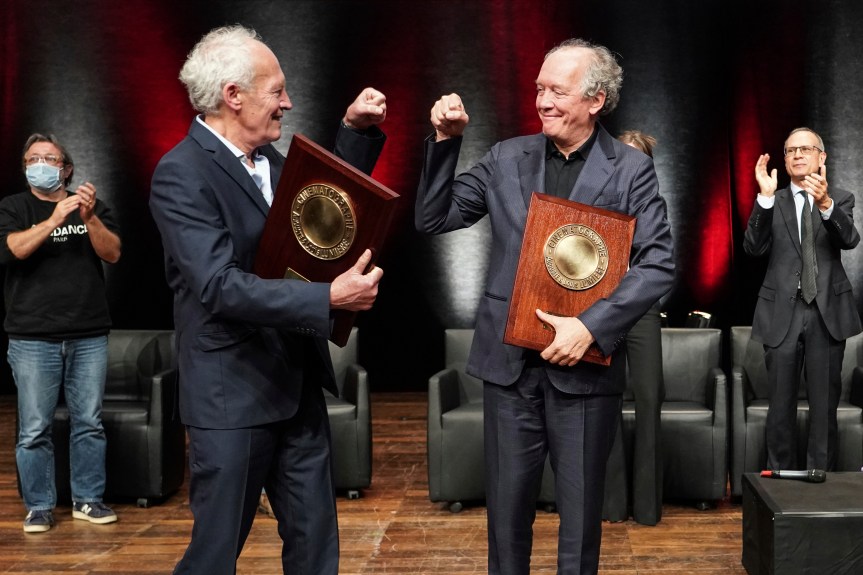
Dardenne Brothers Give Emotional Speech at Lumière Festival in France

Luc and Jean-Pierre Dardenne spoke while accepting a lifetime achievement award in Lyon, just as France rolls out a nightly curfew.

Jean-Pierre and Luc Dardenne gave a rousing speech at the Lumière Festival in Lyon on Friday before accepting the event’s lifetime achievement award. They were welcomed to the stage by Cannes Film Festival director Thierry Frémaux (who also runs the Lyon event) and actress Emilie Dequenne, the star of the pair’s 1999 film “Rosetta.” The filmmaking brothers, whose last film was the 2019 Cannes selection “Young Ahmed,” spoke candidly about coronavirus and inequality at a masterclass earlier as part of the festival.

“Few things have changed in the 20 years since we made ‘Rosetta’ [the brothers’ first of two Cannes Palme d’Ors]. The coronavirus is not responsible for everything, and there are still so many inequalities in the world. They are right to fight,” Luc Dardenne said. Along with “Rosetta,” about a young woman struggling to hold down a job in a broken world, the brothers also earned Cannes’ top prize in 2005 with “L’enfant.”

“Being excluded from the world of work, of production, of consumption, of the human community, creates a feeling of humiliation, of worthlessness, of not existing. That’s what ‘Rosetta’ was about and it’s still true today — that solitude, it’s a question of human dignity,” Luc Dardenne said.

In stressing that the concerns of “Rosetta” remain relevant today, Luc also said, “There’s a responsibility that comes with being a filmmaker. Of course we like it when people like our film, but it’s even better they can become Rosetta, share her distress, become her. If a film can make someone who is locked up inside their own pre-conceived notions become someone else, and if this feeling stays with them, that’s what we want to achieve.”

Luc Dardenne also went on to explain how they formally achieved the societal intentions of the film which, like the majority of their body of work, employs a neorealist style to paint a picture of the working class in France. “In many of our films, there’s this notion of belonging. Rosetta has no place in society, she doesn’t know where she belongs. So when directing, we try and find a place for her. We put the camera in ‘the wrong place’” he said. “So that the character isn’t obvious to the viewer. If you feel you’re losing the character, you’re more interested.”


Source: Dardenne Brothers Give Emotional Speech at Lumière Festival in France | IndieWire

Jean-Luc and Pierre Dardenne: A Portrait of 2020’s Lumiere Awardees

When Jean-Luc and Pierre Dardenne gained the Palme d’Or for “Rosetta” in 1999 — upending such hotly fancied contenders as Pedro Almodovar’s “All About My Mom” — it wasn’t precisely an out-of-nowhere arrival. The Belgian brothers have been already of their mid-forties, having begun their profession in documentary filmmaking 20 years earlier than, and had already loved a fiction breakthrough with 1996’s award-winning “La Promesse.”

However it felt like an invigorating new wave all the identical. Towards the tip of a decade marked by auteurist flash and swagger, the empathetic, unvarnished realism of their working-class survival story gave world cinema a clean-scrubbed human face: intent on making audiences focus extra on the lives being introduced than the administrators’ fashion of presentation.

In a career-making efficiency, the 18-year-old Emelie Dequenne performed a teen struggling to help herself and her alcoholic mom with fleeting, fragile jobs: Although by the way a damning examine of Belgian labour legislation and social welfare, the movie was no political screed. With the sort of grainy on a regular basis element that solely comes by way of acute human curiosity and statement — all the way down to its wince-inducing depiction of interval ache amid poverty — the brothers plainly distinguished themselves from the filmmakers to whom they drew instant crucial comparisons, together with Ken Loach and Robert Bresson. Continue reading “Jean-Luc and Pierre Dardenne: A Portrait of 2020’s Lumiere Awardees”