How to Keep Criticism from Sinking Your Soul: Walt Whitman and the Discipline of Creative Confidence

“I do not trouble my spirit to vindicate itself or be understood.”

Re-examine all you have been told at school or church or in any book, dismiss whatever insults your own soul,” Walt Whitman (May 31, 1819–March 26, 1892) wrote in offering his timeless advice on living a vibrant and rewarding life in the preface to Leaves of Grass. When Whitman first published his masterpiece in 1855, it was met with indifference punctuated by bursts of harsh criticism. It is difficult to imagine just how insulting to the young poet’s soul such reception must have been, or what it took for him to dismiss it and carry on writing. What buoyed his spirit through the tidal wave of negativity was an extraordinary letter of appreciation from Ralph Waldo Emerson — the era’s most respected literary tastemaker and Whitman’s greatest hero, whose 1844 essay The Poet had inspired Leaves of Grass. The young poet wore Emerson’s praise of “incomparable things said incomparably well” like an armor, almost literally — he carried the letter folded in his shirt-pocket over his heart, regularly reading it to friends and lovers.

It is certainly easier, though never easy, to dismiss what insults one’s soul when it comes from critics who haven’t earned one’s confidence — “Take no notice of anyone you don’t respect,” Jeanette Winterson offered in her ten wise rules of writing. But to dismiss criticism that insults the soul from someone we respect — or, harder still, love — requires superhuman strength of spirit. How do we hold on to the integrity and solidity of our conviction and vision, be it creative or existential, when it is being challenged and censured by a person we regard with high intellectual esteem and tenderness of heart?

Whitman modeled this exquisitely in an encounter with Emerson himself.

On a crisp February afternoon in 1860, five years after the publication of Leaves of Grass, the two men took a two-hour walk along Boston Common. They had by then befriended one another and formed a courteous, frank relationship embodying Emerson’s ideal of friendship“A friend is a person with whom I may be sincere.” That winter day, Whitman found Emerson to be “in his prime, keen, physically and morally magnetic, arm’d at every point, and when he chose, wielding the emotional just as well as the intellectual.” When the criticism came, Whitman knew it sprang from that selfsame source — a quality of character he deeply respected, even revered. And yet, rather than coming undone by self-doubt, he was able to stay rooted in his own values and vision.

Writing in Specimen Days (public library) — the endlessly rewarding collection of prose fragments and diary entries, which gave us Whitman on the wisdom of treesthe power of musicthe essence of happinessthe “meaning” of art, and optimism as a force of resistance — he recounts:

During those two hours he was the talker and I the listener. It was an argumentstatement, reconnoitring, review, attack, and pressing home, (like an army corps in order, artillery, cavalry, infantry,) of all that could be said against that part (and a main part) in the construction of my poems, “Children of Adam.” More precious than gold to me that dissertation — it afforded me, ever after, this strange and paradoxical lesson; each point of E.’s statement was unanswerable, no judge’s charge ever more complete or convincing, I could never hear the points better put — and then I felt down in my soul the clear and unmistakable conviction to disobey all, and pursue my own way. “What have you to say then to such things?” said E., pausing in conclusion. “Only that while I can’t answer them at all, I feel more settled than ever to adhere to my own theory, and exemplify it,” was my candid response. Whereupon we went and had a good dinner at the American House. And thenceforward I never waver’d or was touch’d with qualms, (as I confess I had been two or three times before).

Emerson — the patron saint of self-reliance, who exhorted: “Trust thyself: every heart vibrates to that iron string.” — no doubt appreciated this orientation of spirit. Whitman’s first and foremost biographer, the great naturalist John Burroughs, goes even further in his sublimely poetic 1896 biography Whitman: A Study:

In many ways was Whitman, quite unconsciously to himself, the man Emerson invoked and prayed for — the absolutely self-reliant man; the man who should find his own day and land sufficient; who had no desire to be Greek, or Italian, or French, or English, but only himself; who should not whine, or apologize, or go abroad; who should not duck, or deprecate, or borrow; and who could see through the many disguises and debasements of our times the lineaments of the same gods that so ravished the bards of old.

To be sure, Whitman did not dismiss criticism wholesale — rather, he separated the wheat from the chaff through the sieve of confidence and surefooted creative vision. But criticism, he believed, could be far more valuable than praise. In Leaves of Grass, he wrote under the heading “STRONGER LESSONS”:

Have you learn’d lessons only of those who admired you and were tender with you? and stood aside for you?
Have you not learn’d great lessons from those who reject you, and brace themselves against you? or who treat you with contempt, or dispute the passage with you?

The kind of criticism he readily dismissed was that of the professional critics and opinionators — those aimed at tearing down rather than improving a writer’s art, for their judgments are based on the standards of their time and therefore tend to censure any vigorous break with convention. Such critics are apt to pronounce any work of true originality bad, and then to embody W.H. Auden’s incisive observation that “one cannot review a bad book without showing off.”

Burroughs noted this in his praiseful biography of Whitman, composed at a time when the poet was still more rejected than celebrated by his era:

There are no more precious and tonic pages in history than the records of men who have faced unpopularity, odium, hatred, ridicule, detraction, in obedience to an inward voice, and never lost courage or good-nature.

[…]

Every man is a partaker in the triumph of him who is always true to himself and makes no compromises with customs, schools, or opinions.

Whitman himself had proclaimed in Leaves of Grass:

I do not trouble my spirit to vindicate itself or be understood.

Later in life, he would reflect:

Has it never occurr’d to any one how the last deciding tests applicable to a book are entirely outside of technical and grammatical ones, and that any truly first-class production has little or nothing to do with the rules and calibres of ordinary critics?… I have fancied the ocean and the daylight, the mountain and the forest, putting their spirit in a judgment on our books. I have fancied some disembodied human soul giving its verdict.

[…]

The quality of BEING, in the object’s self, according to its own central idea and purpose, and of growing therefrom and thereto — not criticism by other standards, and adjustments thereto — is the lesson of Nature.

Illustration by Margaret C. Cook for a rare 1913 edition of Leaves of Grass. (Available as a print.)

Whitman’s poetry, founded upon the unshakable foundation of his creative and spiritual vision, eventually catapulted him to the top of the English-language literary pantheon. Leaves of Grass endures as one of the most beloved poetic works of all time, having influenced generations of writers and buoyed ordinary livers of life through the worst existential upheavals — such is the power of poetic truth channeled with unwavering stability of confidence and vision.

Complement with Descartes on the crucial difference between confidence and pride, Bruce Lee on willpower and self-esteem, and some excellent advice from great writers on how to survive criticism, then revisit Whitman on creativitydemocracy, his advice to the young, and his most direct definition of happiness.

Source: How to Keep Criticism from Sinking Your Soul: Walt Whitman and the Discipline of Creative Confidence – The Marginalian

“Little Prince” Author Antoine de Saint-Exupéry on How a Simple Human Smile Saved His Life 

“Care granted to the sick, welcome offered to the banished, forgiveness itself are worth nothing without a smile enlightening the deed.”

By Maria Popova

Though researchers since Darwin may have spent considerable effort on the science of smiles, at the heart of that simple human expression remains a metaphysical art — one captured nowhere more beautifully and grippingly than in a short account by Antoine de Saint-Exupéry (June 29, 1900–July 31, 1944), found in Letter to a Hostage (public library) — the same exquisite short memoir he began writing in December of 1940, a little more than two years before he created The Little Prince on American soil, which also gave us his poignant reflection on what the Sahara desert teaches us about the meaning of life.Source: “Little Prince” Author Antoine de Saint-Exupéry on How a Simple Human Smile Saved His Life – The Marginalian

In a creative sandbox for what would become Saint-Exupéry’s most famous line in The Little Prince — “What is essential is invisible to the eye.” — he writes:

How does life construct those lines of force which make us alive?

[…]

Real miracles make little noise! Essential events are so simple!

One such essential event in Saint-Exupéry’s life had to do with the mundane miracle of a simple smile, a gift he so poetically describes as “a certain miracle of the sun, which had taken so much trouble, for so many million years, to achieve, through ourselves, that quality of a smile which was pure success.” He once again channels the spirit of his famous Little Prince line and writes:

The essential, most often, has no weight. The essential there, was apparently nothing but a smile. A smile is often the essential. One is paid with a smile. One is rewarded by a smile. And the quality of a smile might make one die.

Indeed, in a subsequent chapter, Saint-Exupéry recounts an incident that rendered a smile very much the difference between life and death — his life and death. One night during his time in Spain as a journalist reporting on the Civil War, he found himself with several revolver barrels pressed tightly into his stomach — the militia of the rebel forces had snuck up on him under the veil of the dark and captured him in “solemn silence,” staring at his tie — “such a luxury was not fashionable in an anarchist area” — rather than his face. He recounts:

My skin tightened. I waited for the shot, for this was the time of quick trials. But there was no shot. After a complete blank of a few seconds, during which the shifts at work appeared to dance in another universe — a kind of dream ballet — my anarchists, slightly nodding their heads, bid me precede them, and we set off, without hurry, across the lines of junction. The capture had been done in perfect silence, with an extraordinary economy of movement. It was like a game of creatures of the ocean bed.

I soon descended to a basement transformed into a guard post. Badly lit by a poor oil lamp, some other militia were dozing, their guns between their legs. They exchanged a few words, in a neutral voice, with the men of my patrol. One of them searched me.

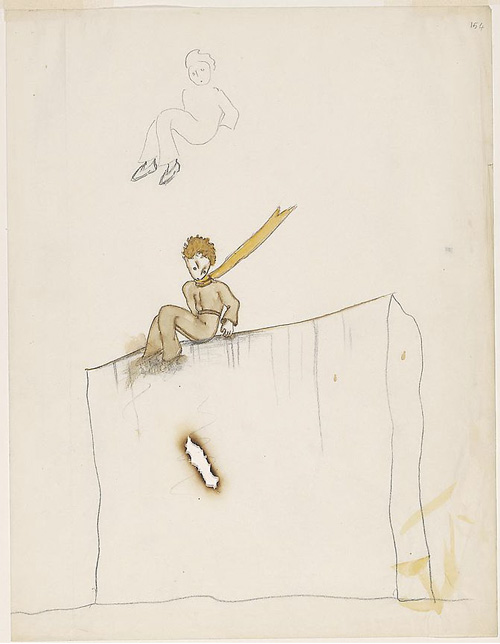
One of Saint-Exupéry’s original watercolors for The Little Prince.

Saint-Exupéry didn’t speak Spanish, but he understood enough Catalan to gather that his identity documents were being requested. He tried to communicate to his captors that he had left them at the hotel, that he was journalist, but they merely passed around his camera, yawning and expressionless. The atmosphere, to his surprise, wasn’t what one would expect of an anarchist militia camp:

The dominant impression was that of boredom. Boredom and sleep. The power of concentration of these men seemed exhausted. I almost wished for a sign of hostility, as a human contact. But … they gazed at me without any reaction, as if they were looking at a Chinese fish in an aquarium.

(One has to wonder whether that desire for contact, whatever its nature or cost, might be a universality of the human condition — the same impulse that drives trolls to spew the venom of hostility as a desperate antidote to their own apathy and existential boredom. Aggression is, perhaps, the only form of contact of which they are capable, and yet it is contact they crave so compulsively.)

After a tortuous period of observing his captors wait for nothing in particular, Saint-Exupéry grew increasingly exasperated with a longing for contact, for the mere acknowledgement of his existence. He paints the backdrop of the miracle that would take place:

In order to load myself with the weight of real presence, I felt a strange need to cry out something about myself, which would impose upon them the truth of my existence — my age for instance! That is impressive, the age of a man! That summarizes all his life. This maturity of his has taken a long time to achieve. It was grown through so many obstacles conquered, so many serious illnesses cured, so many griefs appeased, so many despairs overcome, so many dangers unconsciously passed. It has grown through so many desires, so many hopes, so many regrets, so many lapses, so much love. The age of a man, that represents a good load of experience and memories. In spite of decoys, jolts, and ruts, you have continued to plod like a horse drawing a cart.

Saint-Exupéry was thirty-seven at the time.

But what happened next had nothing to do with the achievement of age, or the gravitas of maturity, or any other willful self-assertion. Instead, it was driven by the simplest, most profound form of shared humanity:

Then the miracle happened. Oh! a very discreet miracle. I had no cigarette. As one of my guards was smoking, I asked him, by gesture, showing the vestige of a smile, if he would give me one. The man first stretched himself, slowly passed his hand across his brow, raised his eyes, no longer to my tie but to my face, and, to my great astonishment, he also attempted a smile. It was like the dawning of the day.

This miracle did not conclude the tragedy, it removed it altogether, as light does shadow. There had been no tragedy. This miracle altered nothing visible. The feeble oil lamp, the table scattered with papers, the men propped against the wall, the colors, the smell, everything remained unchanged. Yet everything was transformed in its very substance. That smile saved me. It was a sign just as final, as obvious in its future consequences, as unchangeable as the rising of the sun. It marked the beginning of a new era. Nothing had changed, everything was changed. The table scattered with papers became alive. The oil lamp became alive. The walls were alive. The boredom dripping from every lifeless thing in that cellar grew lighter as if by magic. It seemed that an invisible stream of blood had started flowing again, connecting all things in the same body, and restoring to them their significance.

The men had not moved either, but, though a minute earlier they had seemed to be farther away from me than an antediluvian species, now they grew into contemporary life. I had an extraordinary feeling of presence. That is it: of presence. And I was aware of a connection.

The boy who had smiled at me, and who, until a few minutes before, had been nothing but a function, a tool, a kind of monstrous insect, appeared now rather awkward, almost shy, of a wonderful shyness — that terrorist! He was no less a brute than any other. But the revelation of the man in him shed such a light upon his vulnerable side! We men assume haughty airs, but within the depth of our hearts, we know hesitation, doubt, grief.

Nothing had yet been said. Yet everything was resolved.

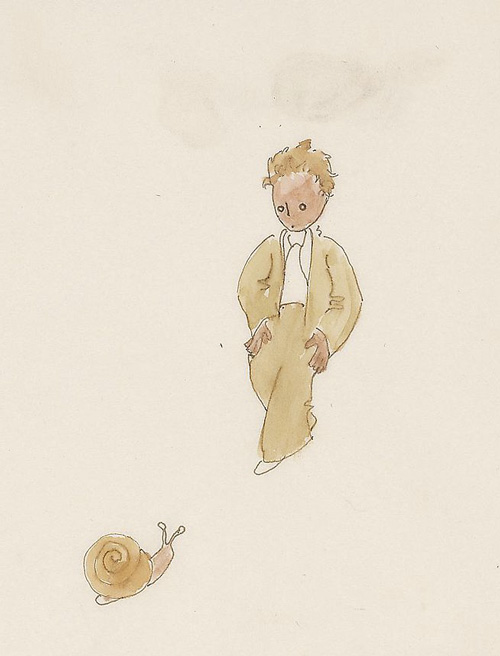
One of Saint-Exupéry’s original watercolors for The Little Prince.

Saint-Exupéry ends with a reflection on the sacred universality and life-giving force of that one simple gesture, the human smile:

Care granted to the sick, welcome offered to the banished, forgiveness itself are worth nothing without a smile enlightening the deed. We communicate in a smile beyond languages, classes, and parties. We are faithful members of the same church, you with your customs, I with mine.

Four years after he wrote Letter to a Hostage, which is a sublime read in its totality, Saint-Exupéry disappeared over the Bay of Biscay never to return. Popular legend has it that Horst Rippert, the German fighter pilot who shot down the author’s plane, broke down and wept upon hearing the news — Saint-Exupéry had been his favorite author. What a tragic form of contact, war.