Blaise Cendrars et les petits gitans d’Aix 1945


Blaise Cendrars et les petits gitans d’Aix 1945

“What is it like, such intensity of pain?”

There are times in life when the firmament of our being seems to collapse, taking all the light with it, swallowing all color and sound into a silent scream of darkness. It rarely looks that way from the inside, but these are always times of profound transformation and recalibration — the darkness is not terminal but primordial; in it, a new self is being born, not with a Big Bang but with a whisper. Our task, then, is only to listen. What we hear becomes new light.
A century ago, Rainer Maria Rilke (December 4, 1875–December 29, 1926) extended a timeless invitation to listening for the light in his poem “Let This Darkness Be a Bell Tower,” translated by Joanna Macy and Anita Barrows in their altogether indispensable book In Praise of Mortality: Selections from Rainer Maria Rilke’s Duino Elegies and Sonnets to Orpheus (public library).
I read it here accompanied by another patron saint of turning darkness into light — Bach, and his Cello Suite No. 5 in C Minor, performed by Colin Carr:
LET THIS DARKNESS BE A BELL TOWER
by Rainer Maria RilkeQuiet friend who has come so far,
feel how your breathing makes more space around you.
Let this darkness be a bell tower
and you the bell. As you ring,what batters you becomes your strength.
Move back and forth into the change.
What is it like, such intensity of pain?
If the drink is bitter, turn yourself to wine.In this uncontainable night,
be the mystery at the crossroads of your senses,
the meaning discovered there.And if the world has ceased to hear you,
say to the silent earth: I flow.
To the rushing water, speak: I am.
Complement with the great Buddhist teacher Pema Chödrön on transformation through dark times, Emily Dickinson’s darkness-inspired ode to resilience, and Rebecca Solnit on hope in the dark, then revisit Rilke on the relationship between solitude, love, and creativity, the lonely patience of creative work, and the difficult art of giving space in love.
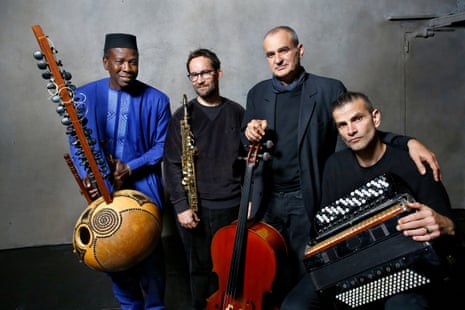
This stellar quartet channel a multitude of influences to irresistible effect
By John Fordham
The French cellist Vincent Segal is one of those peripatetic players who shows up across the musical frontier: on albums by Sting or “barefoot diva” Cesária Évora, on an arthouse film score or a dancefloor remix of Bumcello, the duo he formed with drummer Cyril Atef almost a quarter of a century ago. Segal’s most feted collaboration remains with Malian kora master Ballaké Sissoko on Chamber Music (2009) and Musique de Nuit (2015), where they pulled the traditions of Africa and Europe into a seductive neoclassical fusion.
Here, the pair are joined by accordionist Vincent Peirani and soprano sax player Émile Parisien on a venture that proves just as irresistible, even if its title translates as The Lost. It’s a sprightly, restless set, with Segal’s plucked cello providing a thrumming heartbeat to what is a communal, improvisational approach. There are reflective pieces – Sissoko’s Ta Nyé and Banja bookend the record in flurries of kora – but more typical is the group’s reworking of the late Joe Zawinul’s Orient Express, while on Esperanza the quartet seem to be channelling a drunken Colombian cumbia. Although inflected by various accents – there’s a Balkan feel to Izao, a touch of John Coltrane to Parisien’s sax – this is truly fusion music.
Source: Sissoko Segal Parisien Peirani: Les Égarés review – an awesome foursome | Music | The Guardian
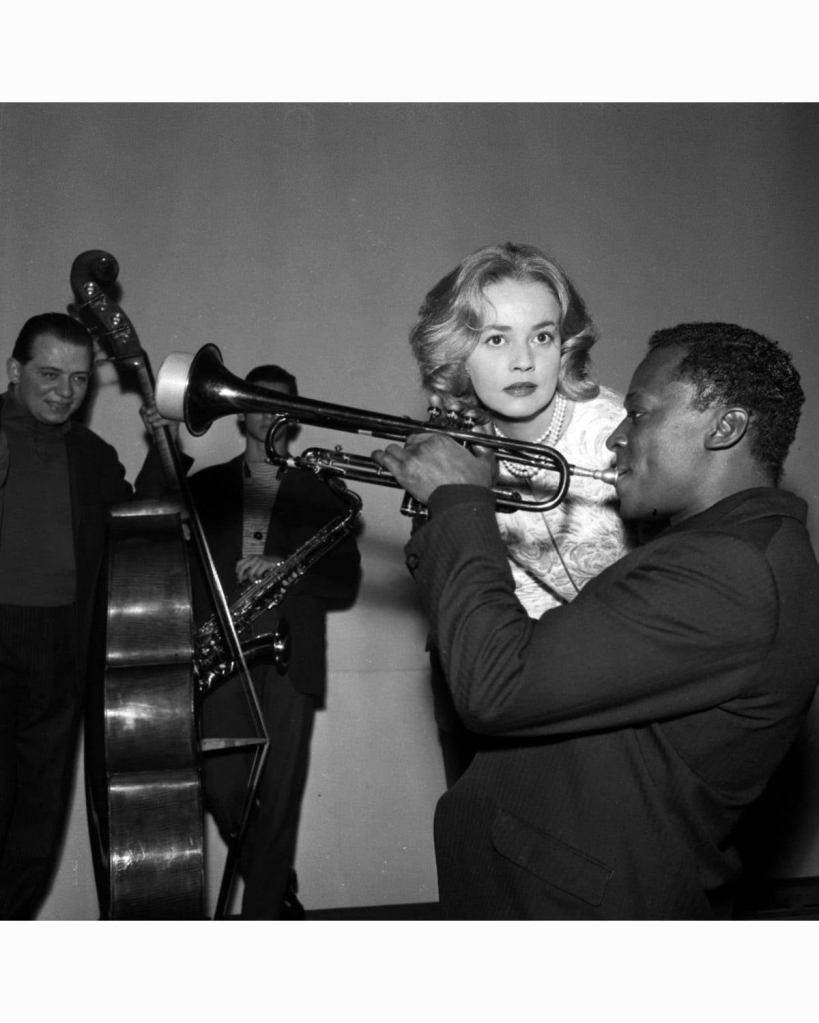
Jeanne Moreau et Miles Davis sur le tournage du film “Ascenseur pour l’échafaud” de Louis Malle, 1958

Isabelle Huppert photographiée par Édouard Boubat, 1985

